
Official statement
What you need to understand
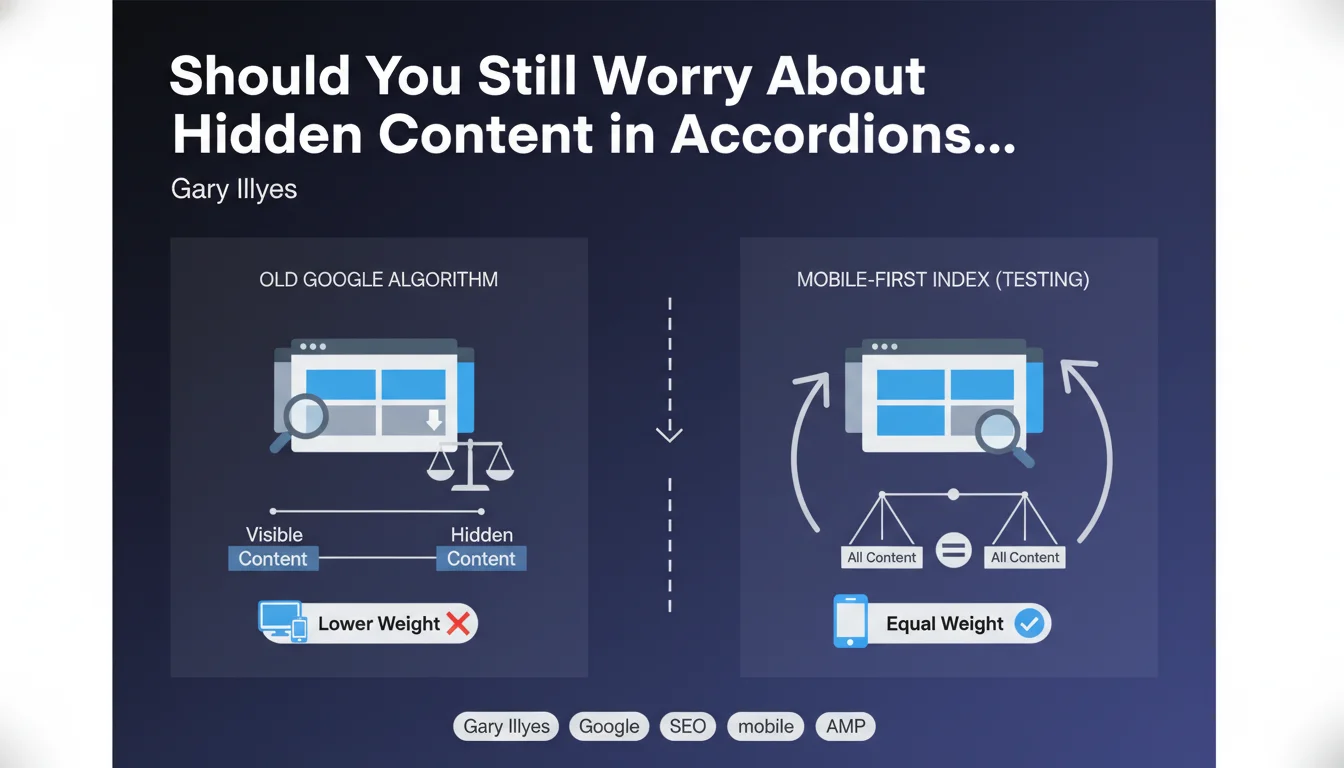
Google indexes content placed in accordions and tabs normally, contrary to certain widespread beliefs in the SEO community. This official clarification puts an end to doubts about the valorization of this type of interactive content.
Some studies had suggested that content hidden in these elements might be devalued by the algorithm. Google formally denies this hypothesis and confirms that the weight given to this content remains equivalent to that of directly visible text.
If a site nevertheless finds that its accordion content is not being properly taken into account, the problem comes from the technical implementation, not from a Google algorithmic penalty.
- Content in accordions and tabs receives normal weight in SEO
- No devaluation is applied by default by Google
- Indexing problems stem from technical implementation errors
- This official position confirms current UX best practices
SEO Expert opinion
This statement is consistent with what we've been observing in the field for several years. Sites that correctly use accordions to structure their content generally don't experience any loss of visibility—quite the opposite, in fact.
Nevertheless, an important nuance must be made: not all accordions are technically equal. Some JavaScript implementations load content asynchronously or generate it dynamically in a way that can complicate crawling by Googlebot. Accordions based on pure CSS or with content present from the initial DOM are generally better handled.
Another point of attention concerns mobile-first indexing. Google now primarily indexes the mobile version of sites. Yet accordions are precisely very widely used on mobile to save screen space. This practice therefore remains perfectly aligned with Google's current indexing strategy.
Practical impact and recommendations
- Continue using accordions to improve user experience without fear for your SEO
- Verify the technical implementation: content must be present in the source HTML, not only loaded via JavaScript
- Test Google-side rendering via Search Console to ensure the content is visible to the search engine
- Favor simple technical solutions: pure CSS or JavaScript with content already in the DOM
- Avoid deferred AJAX loading that injects content only after user interaction
- Structure your accordions semantically with appropriate HTML tags (details/summary or ARIA)
- Keep important content accessible: don't hide your main strategic content in accordions if possible
- Audit your existing pages with accordions to identify potential indexing issues
Accordions and tabs represent an excellent solution for optimizing user experience while preserving your SEO. The key lies in flawless technical implementation.
These technical optimizations can nevertheless prove complex, particularly to precisely diagnose why certain content is not being properly indexed. A thorough technical audit and expertise in JavaScript SEO are often necessary to ensure your accordions work perfectly from the search engine perspective. If you're experiencing persistent difficulties or want to secure your approach from the design phase, guidance from SEO specialists can save you valuable time and avoid costly visibility mistakes.
💬 Comments (0)
Be the first to comment.