
Official statement
What you need to understand
What exactly does Google say about grammar's impact on SEO?
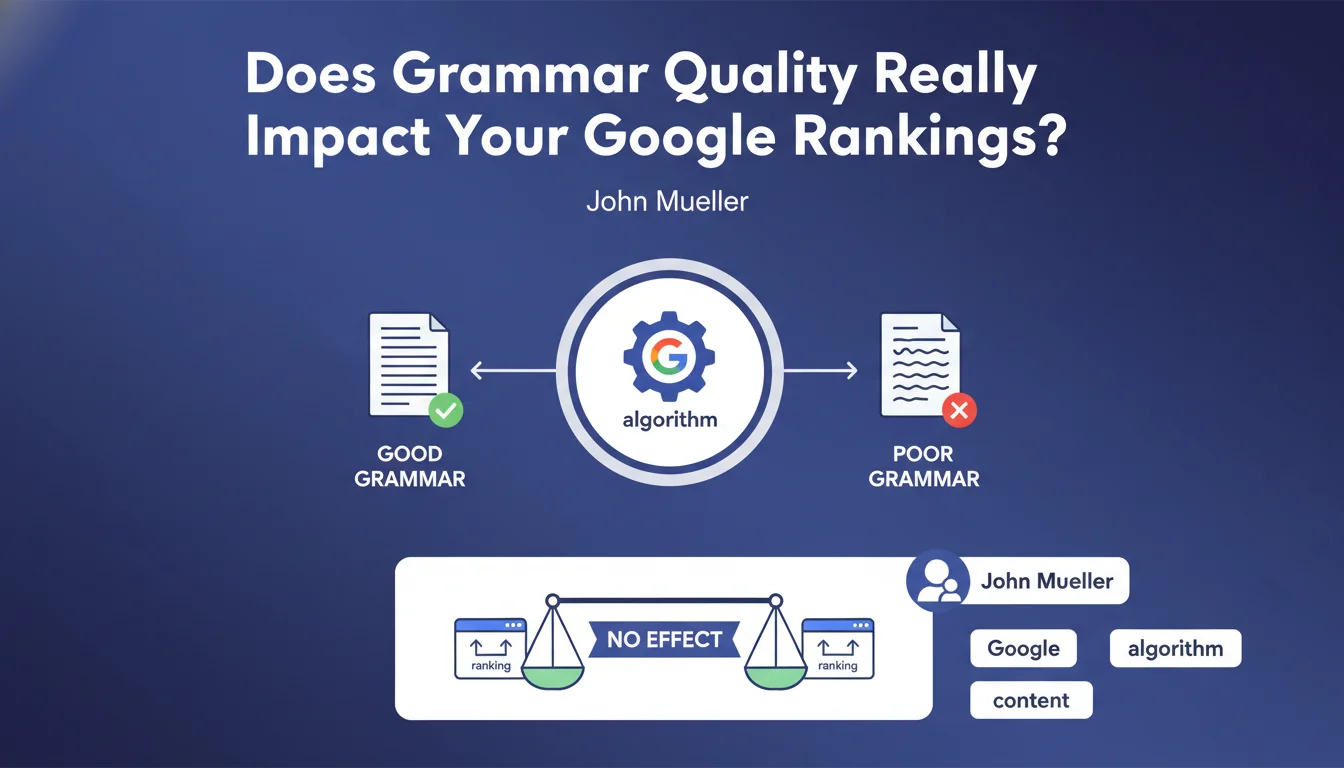
Google has officially stated that the grammatical quality of content is not a direct ranking factor in its algorithm. Spelling mistakes, syntax errors, or conjugation issues do not directly penalize a web page in search results.
This position may seem surprising at first glance, but it's explained by the complexity of processing grammar at a global scale. Google indexes billions of pages in hundreds of different languages, each with its own grammatical rules and regional variations.
Why doesn't Google take this criterion into account?
Grammatical analysis would require considerable computational resources and specific linguistic models for each language. Moreover, many relevant and useful contents may contain grammatical imperfections while perfectly answering the search intent.
Google therefore prioritizes other signals such as content relevance, site authority, user experience, and behavioral signals to evaluate a page's quality.
What are the real quality criteria considered by Google?
Although grammar isn't a direct factor, Google assesses overall content quality through several measurable dimensions.
- Semantic relevance: match between content and search intent
- Expertise and authority: credibility of the author and site (E-E-A-T)
- Readability and structure: content organization with headings, paragraphs, lists
- Behavioral signals: bounce rate, time on page, interactions
- Freshness and comprehensiveness: updates and complete coverage of the topic
SEO Expert opinion
Is this statement consistent with what we observe in practice?
In practice, we do indeed observe that sites with minor grammatical imperfections can rank very well if they excel in other criteria. However, the reality is more nuanced than the official statement suggests.
Content riddled with errors can indirectly impact SEO through behavioral signals. If visitors quickly leave the page because it's difficult to read, Google will interpret this as a sign of low quality.
What important nuances should be added to this statement?
While grammar is not a direct ranking factor, it strongly influences users' perception of quality. Poorly written text harms credibility, reduces engagement, and increases bounce rate.
Moreover, with the evolution of Google's artificial intelligence and particularly language models like BERT, MUM, or SGE, linguistic analysis capabilities are improving considerably. It's not unrealistic that Google will progressively integrate more sophisticated editorial quality criteria.
In which cases does grammatical quality become critical?
For e-commerce sites, errors on product pages can significantly reduce conversion rates. Google considers these conversion signals in its overall assessment of a site's quality.
In the context of AI-generated content, grammar that's too perfect and uniform can paradoxically signal automated content with low added value. Authenticity and unique editorial voice become quality markers.
Practical impact and recommendations
What should you do concretely to optimize your content?
Even though Google doesn't directly evaluate grammar, overall editorial quality remains a strategic investment. It improves user experience, strengthens credibility, and encourages natural sharing.
Focus on message clarity rather than absolute grammatical perfection. Slightly imperfect but authentic and useful content will always outperform technically perfect but hollow text.
What mistakes should you absolutely avoid?
Don't completely neglect editorial quality on the grounds that Google doesn't measure it directly. Massive and repeated errors harm readability and user trust.
Also avoid over-optimizing your content at the expense of natural flow. Text stuffed with keywords but poorly structured will perform worse than natural, well-organized text.
How can you audit and improve your site's editorial quality?
Implement a systematic proofreading process for your priority content, particularly on strategic pages (conversion pages, pillar articles). Use correction tools like Antidote or Grammarly, but always supplement with human validation.
Analyze your engagement metrics in Google Analytics: time spent, bounce rate, scroll depth. These indicators reveal whether your content is truly readable and engaging, regardless of its grammatical perfection.
- Prioritize clarity and structure of content before grammatical perfection
- Systematically proofread strategic pages (conversion, pillar pages)
- Monitor engagement metrics to detect problematic content
- Use correction tools but maintain an authentic editorial voice
- Train your writers in web writing best practices (structure, headings, lists)
- In YMYL domains, invest more in editorial quality to strengthen E-E-A-T
- For AI content, systematically add a layer of human expertise
- Test different editorial styles and measure their impact on conversions
Although Google doesn't directly penalize grammatical imperfections, overall editorial quality remains an essential pillar of an effective SEO strategy. It indirectly influences rankings via user experience, behavioral signals, and perception of expertise.
Optimizing editorial quality across an entire site can represent a significant investment in time and resources. For businesses looking to maximize the impact of their content strategy while maintaining a balance between editorial quality, SEO optimization, and regular production, support from a specialized SEO agency enables the establishment of efficient processes and helps achieve measurable results more quickly.
💬 Comments (0)
Be the first to comment.