
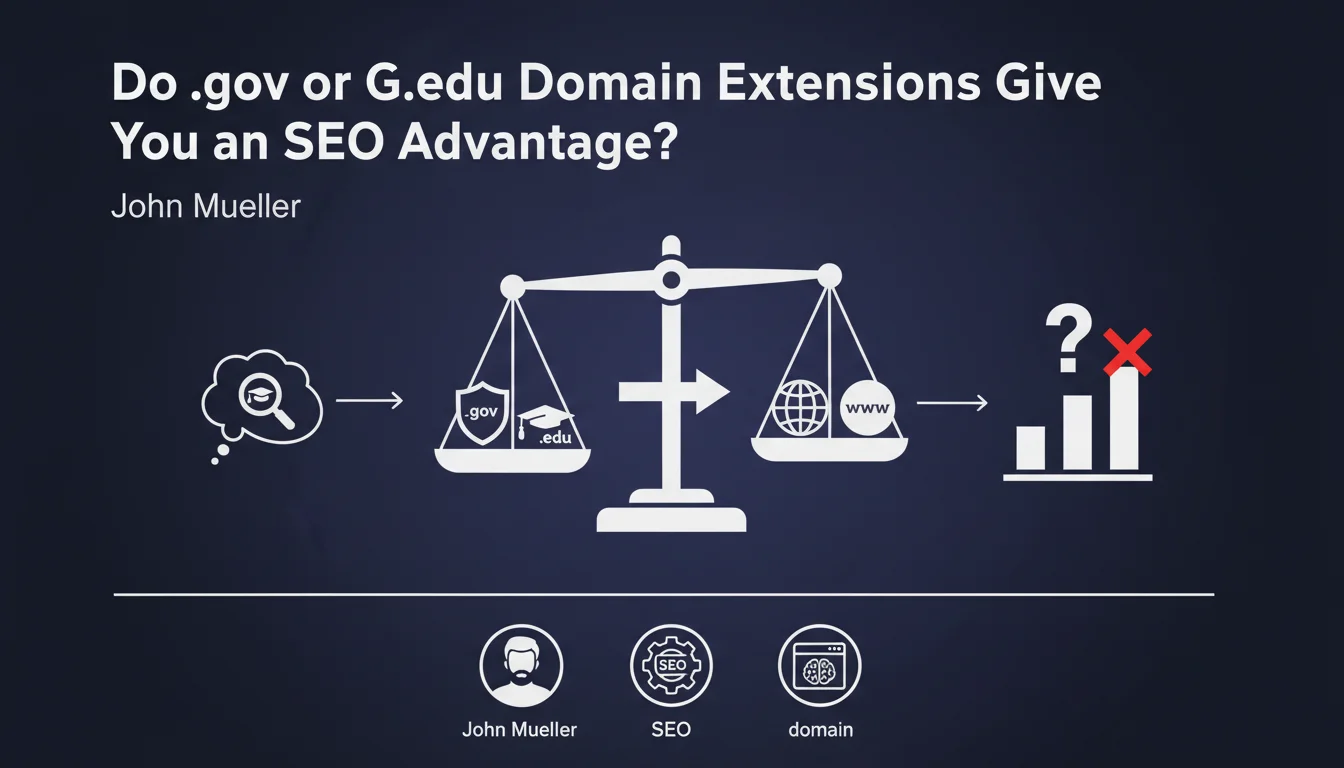
Official statement
What you need to understand
Google has confirmed that the domain extension itself is not a ranking factor. A site with .gov, .edu, .org or .com is treated identically by the search algorithm.
This clarification puts an end to a persistent myth in the SEO community: the one claiming that certain domain extensions would benefit from preferential treatment in search results.
However, there's an important nuance to understand. If government or educational sites often appear well-positioned, it's not because of their extension, but rather due to:
- The quality and authority of their content, often written by recognized experts
- Their exceptional backlink profile, with links coming from highly reliable sources
- Their age and reputation established over the years
- The trust granted by users and other institutional websites
In summary, the extension doesn't create authority, it simply reflects the type of organization that owns the site. It's the traditional quality signals that make the difference.
SEO Expert opinion
This statement is perfectly consistent with what we observe in the field. SEO audits regularly confirm that the extension doesn't directly influence site rankings.
However, there's an indirect effect that shouldn't be overlooked. Since .gov and .edu domains are strictly reserved for certain organizations, they naturally benefit from increased credibility among internet users and webmasters. This trust translates into more shares, mentions and natural links.
Within the framework of the E-E-A-T (Experience, Expertise, Authoritativeness, Trustworthiness) concept, these domains often present stronger signals. But beware: it's not automatic. A poorly designed .gov site with poor content will have no advantage over a quality .com site.
Practical impact and recommendations
- Don't waste time trying to obtain a .gov or .edu extension if you're not eligible
- Choose an extension that's consistent with your business and geographic area (.fr for France, .com for international)
- Invest instead in content quality and demonstrated expertise on your site
- Develop your backlink profile by obtaining links from authoritative sources, regardless of their extension
- Strengthen your E-E-A-T signals: demonstrate your expertise, display your authors, cite your sources
- For link building strategies, target domains with real strong authority (DA, Trust Flow) rather than focusing on the extension
- Monitor your competitors: analyze what really makes them strong (content, backlinks, technical) rather than just their domain name
Implementing a comprehensive SEO strategy integrating these different aspects (technical optimization, expert content creation, development of a quality link profile) requires sharp expertise and rigorous coordination. These cross-optimizations demand time and varied skills. If you want to accelerate your results while avoiding costly mistakes, support from a specialized SEO agency can allow you to benefit from a personalized strategy and monitoring adapted to your specific objectives.
💬 Comments (0)
Be the first to comment.