
Official statement
What you need to understand
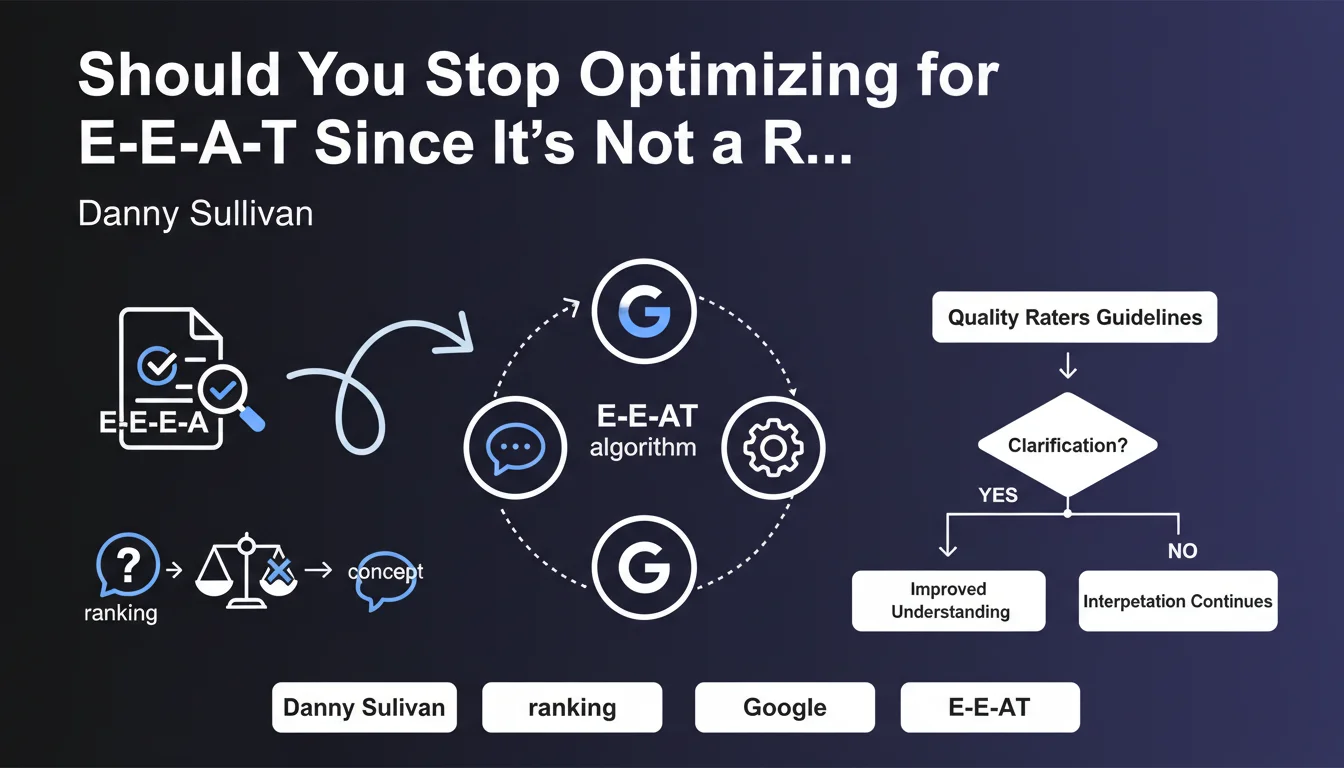
Google is preparing to clarify the wording of E-E-A-T in its guidelines for quality raters. This clarification follows persistent confusion within the SEO community.
The official message remains consistent: E-E-A-T is neither a direct ranking factor nor a specific algorithm. Rather, it's a conceptual framework used by human evaluators to assess content quality.
The confusion stems from ambiguous wording in the official documentation, which can suggest that E-E-A-T directly influences search results. This semantic ambiguity has fueled numerous debates and divergent interpretations.
- E-E-A-T remains a fundamental concept for guiding the creation of quality content
- The guidelines will be reworded to avoid any confusion about its exact nature
- The principles of experience, expertise, authoritativeness, and trustworthiness remain essential
- This clarification doesn't change the SEO best practices to adopt
SEO Expert opinion
This clarification was necessary and reflects a recurring communication issue at Google. In practice, we observe daily that sites demonstrating strong E-E-A-T signals perform better in search results.
The nuance is important: while E-E-A-T isn't a direct factor, the hundreds of signals that compose it are indeed taken into account by the algorithms. Citations from recognized authors, backlinks from authoritative sites, brand mentions, detailed bios, proof of expertise... all these elements influence rankings.
Practical impact and recommendations
This statement doesn't fundamentally change your SEO strategy, but confirms the approach to adopt regarding E-E-A-T optimization.
- Continue strengthening expertise signals: detailed author bios, professional references, certifications and training
- Develop your domain's authoritativeness: qualitative link building strategy, press mentions, industry partnerships
- Document real-world experience: case studies, verifiable testimonials, concrete proof of practical application
- Reinforce trustworthiness: cited sources, verifiable data, transparency about authors and the organization
- Adapt intensity according to your sector: YMYL sites require much greater E-E-A-T investment
- Don't try to "optimize E-E-A-T" like a technical checklist, but build genuine legitimacy in your field
- Avoid false signals: fictitious authors, fake biographies, fake reviews or testimonials
💬 Comments (0)
Be the first to comment.