
Official statement
Other statements from this video 4 ▾
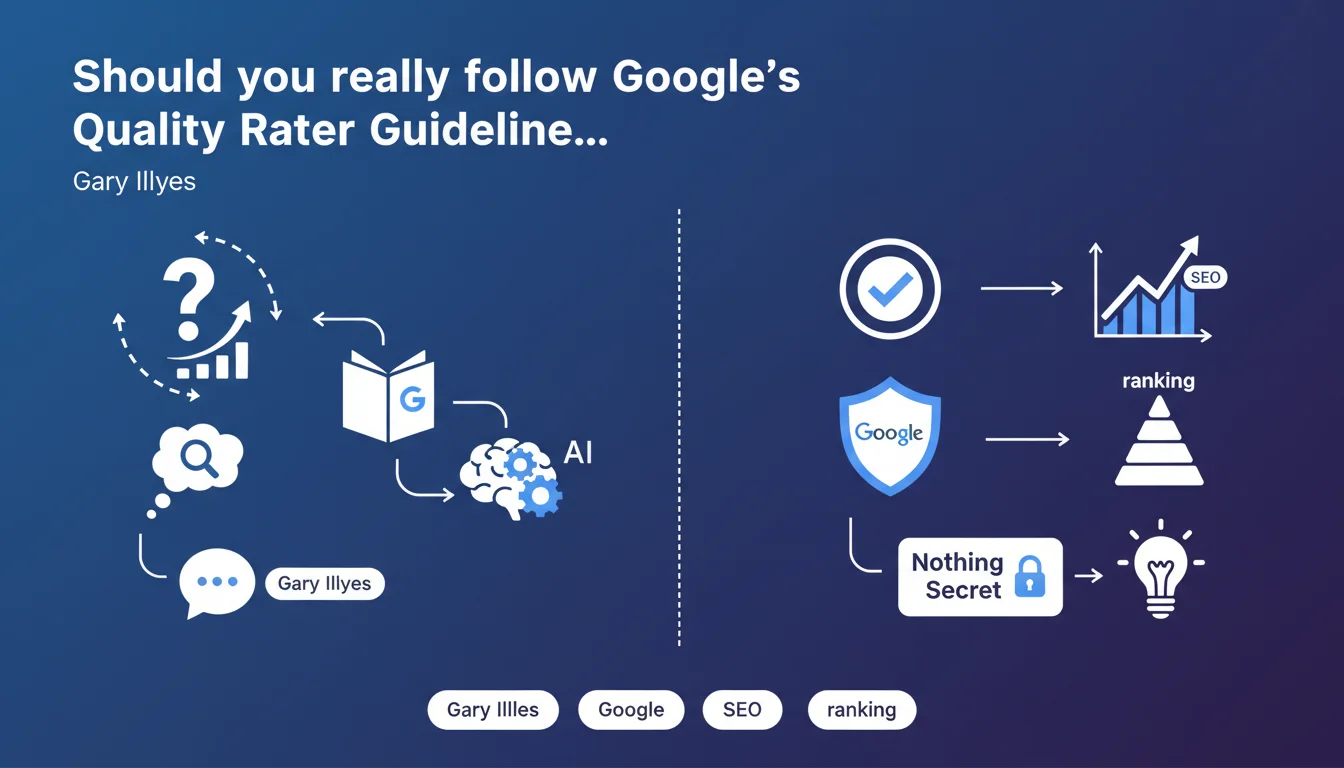
Google has made its Quality Rater Guidelines publicly available, stating they contain nothing confidential. These directives officially serve as a reference for understanding what the algorithm considers a high-quality site. For an SEO practitioner, it's a document worth knowing but not blindly following.
What you need to understand
Why does Google publish these guidelines without fearing they'll be exploited?
The Quality Rater Guidelines (QRG) are the instruction manual given to human evaluators who rate search results. Google uses them to train and refine its algorithms, not to directly rank pages.
If Google makes them public, it's because they reveal no mechanically exploitable ranking factors. They describe qualitative concepts — E-E-A-T, main content quality, reputation — that the algorithm attempts to approximate through hundreds of technical signals.
Do these guidelines directly influence the ranking algorithm?
No, not directly. Human raters never modify live rankings. Their evaluations serve to validate algorithm modifications during internal A/B testing.
Google launches an update, compares results before/after through rater scores, then decides whether to deploy or not. The QRG thus indirectly define what the algorithm learns to value, but don't constitute a ranking factors checklist.
What do these directives actually contain?
- Detailed definitions of what constitutes high/low quality content depending on query type
- The E-E-A-T concept (Experience, Expertise, Authoritativeness, Trustworthiness) explained with concrete examples
- Instructions on evaluating Main Content versus secondary and advertising content
- Specific criteria for YMYL pages (Your Money Your Life) where quality requirements are maximum
- Annotated examples showing why certain pages deserve high or low scores
SEO Expert opinion
Does this transparency mean you can 'hack' the algorithm by following them?
No, and that's a common trap. The QRG describe qualitative objectives, not technical levers. Saying "this content must demonstrate expertise" doesn't explain how the algorithm detects that expertise.
Google probably uses hundreds of indirect signals — domain age, external citations, user behavior, semantic analysis — to approximate these concepts. Blindly applying the QRG as an SEO checklist misses the point entirely: understanding which technical signals Google actually uses to evaluate these criteria.
Do real-world observations confirm what these guidelines claim?
Partially. E-E-A-T clearly works on YMYL queries — health, finance, legal. We observe that sites with identified authors, media mentions, institutional backlinks perform better.
But on standard commercial or informational queries, the correlation is far less obvious. [To verify] : Google claims the QRG faithfully reflect what the algorithm values, but many well-ranked sites routinely violate several guideline principles.
Should you read them in full or can you skip them?
Yes, you should read them at least once. Not to make them your SEO bible, but to understand Google's conceptual framework. It helps decode vague official communications like "create quality content".
Practically? Read them, internalize the E-E-A-T and YMYL concepts, then return to measurable technical signals. The QRG give you the philosophy; SEO work consists of finding the levers that translate it into rankings.
Practical impact and recommendations
What should you concretely change on your site after reading the QRG?
Focus on tangible signals that communicate expertise and trust, not general philosophy. The QRG value author transparency? Add detailed author pages with biographies, links to social/professional profiles, publication portfolios.
They stress reputation? Work on your external mentions — citations in sector media, guest posts on recognized sites, presence in relevant professional directories. The algorithm captures these signals through backlink analysis and named entity recognition.
What mistakes should you avoid when interpreting these guidelines?
Don't fall into "QRG-washing": mechanically adding "about" sections, author photos and update dates isn't enough if your main content remains mediocre. Google evaluates main content depth, originality and usefulness first.
Also avoid over-optimizing for E-E-A-T at the expense of search intent. An article packed with author credentials but that doesn't directly answer the query will perform poorly, QRG or not.
How do you audit your site by Quality Rater standards?
- Identify your YMYL pages (health, finance, legal) and evaluate them with the strict QRG criteria
- Verify that each important page clearly shows who created the content and why this person/organization is qualified
- Audit your external reputation: are your brand/authors positively cited elsewhere on the web?
- Analyze the ratio of main content versus ads/distractions — the QRG heavily penalize pages where ads overwhelm the MC
- Test your pages on mobile: the QRG stress content accessibility without excessive zoom or horizontal scrolling
- Compare your pages to annotated examples from the QRG in your niche to calibrate your quality level
❓ Frequently Asked Questions
Les Quality Rater Guidelines sont-elles un facteur de classement direct ?
Dois-je suivre les QRG à la lettre pour bien ranker ?
L'E-E-A-T fonctionne-t-il vraiment sur toutes les requêtes ?
Où puis-je consulter ces Quality Rater Guidelines ?
Les QRG changent-elles souvent ?
🎥 From the same video 4
Other SEO insights extracted from this same Google Search Central video · published on 30/11/2022
🎥 Watch the full video on YouTube →
💬 Comments (0)
Be the first to comment.