
Official statement
Other statements from this video 4 ▾
- □ Do Quality Rater Guidelines Reveal Google's Secret Algorithm Roadmap?
- □ Is E-A-T Really a Direct Ranking Factor in Google's Algorithm?
- □ Should you really stop writing for Google and focus entirely on your audience instead?
- □ Should you really follow Google's Quality Rater Guidelines to boost your SEO rankings?
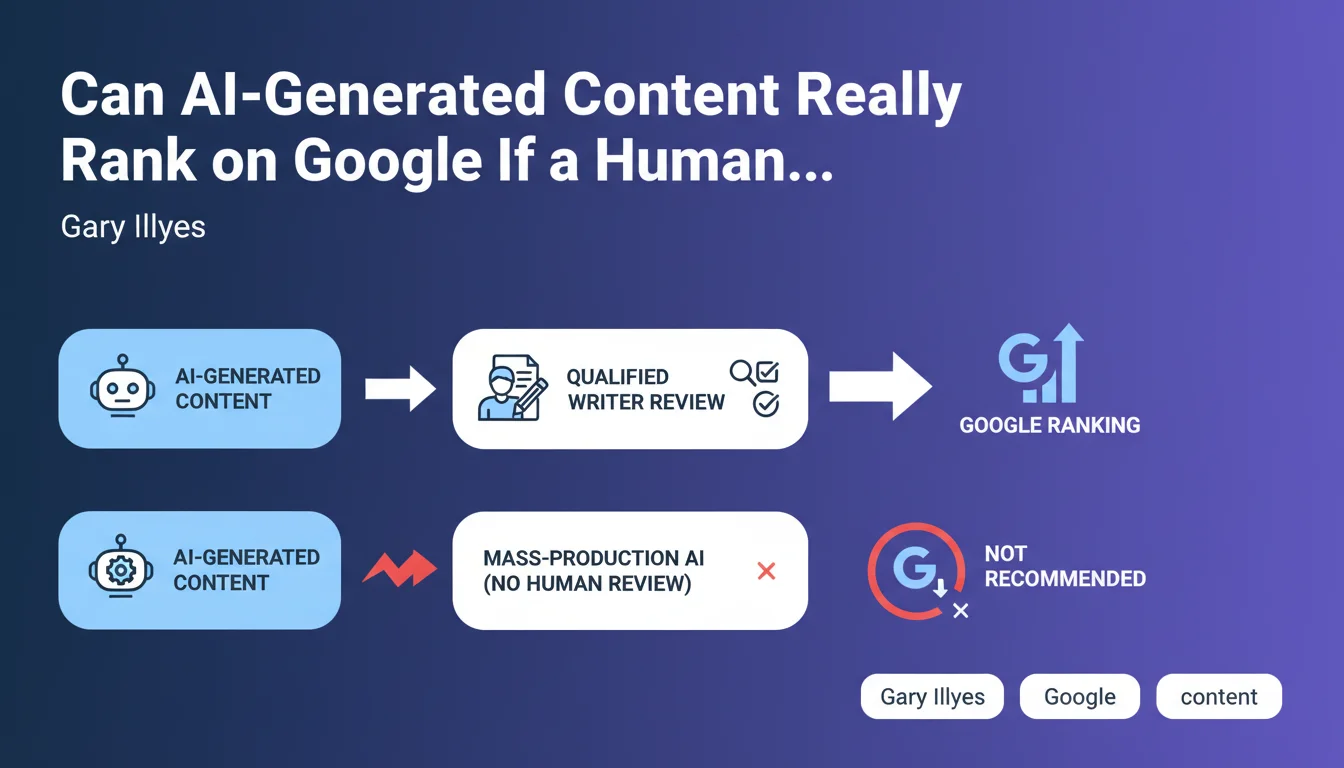
Google tolerates AI-generated content provided a qualified writer revises it to improve grammar and phrasing. Mass-production approaches without human oversight remain inadvisable. The verdict: AI yes, but not just any way.
What you need to understand
What Does Google Mean by "Revised by a Qualified Writer"?
Gary Illyes doesn't mince words about AI — he makes it acceptable under the condition of human oversight. The term "qualified writer" refers to someone who masters the language, understands search intent, and knows how to structure a useful answer.
Concretely, Google doesn't care whether the first draft was written by ChatGPT or Claude. What matters: the final result must meet E-E-A-T criteria (Experience, Expertise, Authoritativeness, Trustworthiness). AI content stuffed with empty sentences and redundancies won't pass the filter — human involvement or not.
Why Does Google Insist on "Mass Production Without Review"?
Because that's exactly what has been polluting the SERPs since the explosion of generative AI. Sites are publishing hundreds of automatically generated articles with no editing, with the sole objective of saturating the index.
Google has rolled out several anti-spam updates (notably the Helpful Content Update) to target these kinds of practices. Illyes' statement confirms that this strategy remains in the algorithmic crosshairs.
Is This Position New or Just a Reminder?
It's a nuanced reminder. From the earliest guidelines on automated content, Google has said: "no matter how it's generated, if it's useful, it passes". The nuance here: Illyes formalizes the idea that AI can be a tool, not a turnkey solution.
But — and this is crucial — he gives no measurable criteria. What constitutes "sufficient" revision? A pass through Grammarly? Partial rewriting? Line-by-line fact-checking? Google remains vague.
- Human review = essential condition for acceptable AI content
- Mass production without oversight = priority target for anti-spam filters
- Final quality > production method
- No precise definition of what constitutes "qualified review"
SEO Expert opinion
Is This Statement Consistent with Real-World Observations?
Yes and no. On paper, Google says "AI OK if human is involved". In practice: full-AI sites without substantial review still rank adequately in certain low-competition niches. The filter isn't uniform.
Sites getting hit hard by Helpful Content Updates share a pattern: high volume + generic content + low user engagement. If your AI content is targeted, thoroughly revised, and provides a genuine answer, it can fly under the radar — or be deemed acceptable.
What Nuances Should Be Added to This Position?
Gary Illyes talks about "grammar and phrasing". That's too reductive. The real problem with AI content isn't syntactic — it's that it lacks factual grounding, personal perspective, lived experience.
A writer who simply corrects errors doesn't add much value. What counts: editorial contribution — concrete examples, exclusive data, differentiated angle. [To verify]: Does Google actually have signals capable of detecting this level of revision? Nothing formally proves it does.
Another point: "qualified writer" might mean a subject-matter expert, not just someone who writes well. In technical verticals (finance, health, law), review must be done by someone who understands the substance, not just the form.
In What Cases Doesn't This Rule Really Apply?
Basic transactional content (standardized product sheets, local service descriptions) can be generated in bulk with light review — as long as structural elements (title, meta, structured data) are optimized.
Google also evaluates the broader site context. An already authoritative site with a solid track record can afford a more automated approach on certain secondary pages without impacting its ranking. A new site doing the same gets flagged immediately.
Practical impact and recommendations
What Should You Do Concretely to Comply?
Implement a clear editorial process: AI generation → human review → enrichment → validation. Review must include fact-checking, adding examples, rephrasing generic passages.
Document your human interventions. Not to show Google (it won't ask you), but to maintain quality consistency as you scale. Use a spreadsheet with: who reviewed, time spent, nature of changes.
What Errors Should You Avoid at All Costs?
Never publish raw AI output, even if it "looks fine". LLMs produce fluent text but often hollow or factually approximate. Simple grammar correction isn't enough to turn mediocre content into useful content.
Also avoid over-optimizing with keywords artificially inserted during revision. Google detects keyword stuffing patterns, whether from human or AI. The goal: natural readability before keyword density.
How Do You Verify Your Approach Is on Track?
Compare engagement metrics (time on page, bounce rate, scroll depth) between AI-revised content and 100% human content. If the gap is significant, your revision isn't thorough enough.
Use Search Console reports to identify pages with high impressions but low CTR — often a sign the content doesn't really answer the intent. If these pages are mostly AI, investigate further.
- Establish a structured editorial workflow: generation → review → enrichment → validation
- Train your writers to identify typical AI content weaknesses (generalities, missing data, lack of perspective)
- Integrate E-E-A-T elements: testimonials, lived examples, proprietary data
- Limit publishing volume to prioritize quality — better 10 solid articles than 100 mediocre ones
- Monitor Core Web Vitals and user engagement signals on your AI pages
- Document human interventions to maintain editorial consistency
❓ Frequently Asked Questions
Un contenu IA simplement relu par Grammarly est-il conforme aux directives Google ?
Puis-je publier massivement du contenu IA si chaque article est relu par un humain ?
Google peut-il détecter qu'un contenu a été généré par IA ?
Qu'est-ce qu'un « rédacteur qualifié » selon Google ?
Les sites e-commerce peuvent-ils générer des fiches produits en masse avec IA ?
🎥 From the same video 4
Other SEO insights extracted from this same Google Search Central video · published on 30/11/2022
🎥 Watch the full video on YouTube →
💬 Comments (0)
Be the first to comment.