
Official statement
What you need to understand
What is the Fred update and why is it controversial?
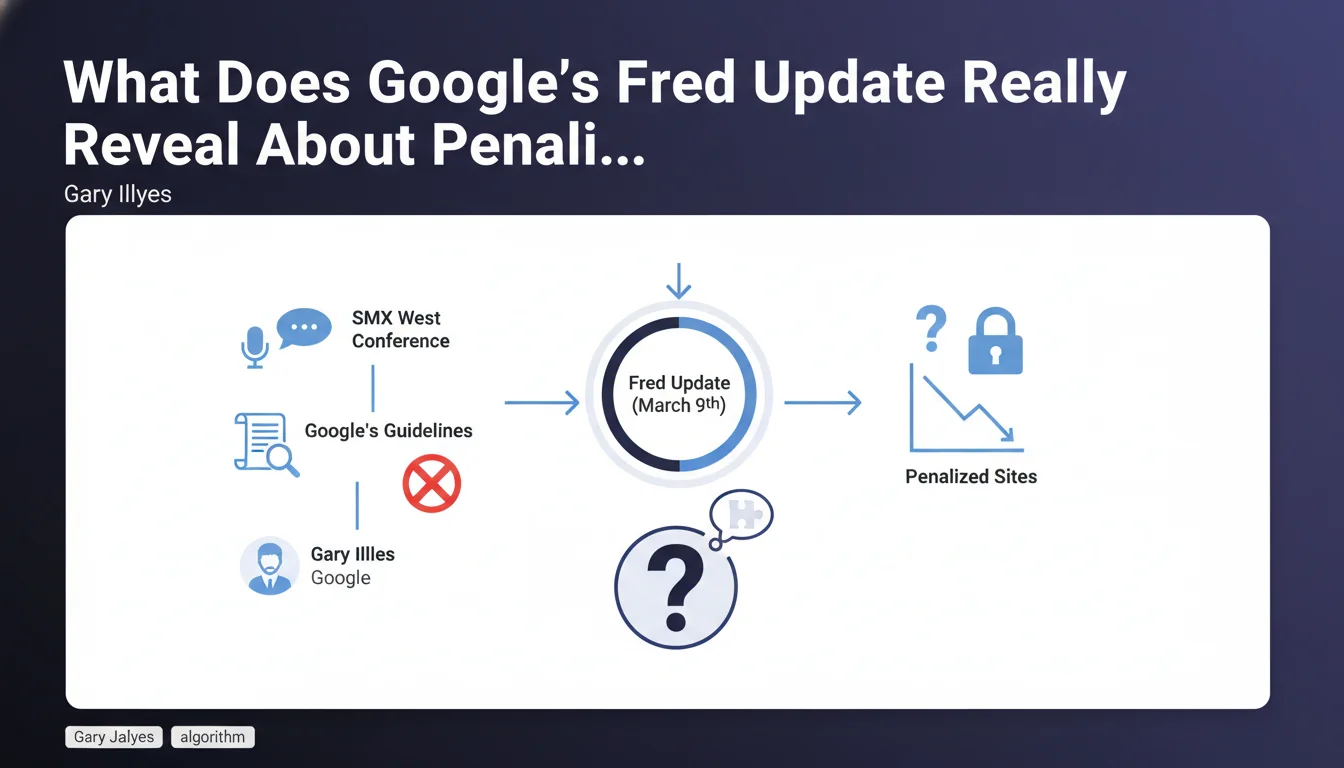
The Fred update is a Google algorithm update rolled out on March 9, 2017. This update caused significant fluctuations in the rankings of numerous websites.
The distinctive feature of Fred lies in the ambiguity maintained by Google: Gary Illyes confirmed that this update was based on guideline recommendations, without ever specifying which ones. This deliberately vague communication left the SEO community in uncertainty.
What types of sites were primarily impacted?
SEO community analyses quickly identified common patterns among affected sites. Sites with low-quality content oriented solely toward monetization were the main victims.
Recurring characteristics included: excessive advertising, superficial content created solely to generate clicks, degraded user experience, and absence of real added value for users.
- Update deployed on March 9, 2017 targeting low-quality sites
- Deliberately evasive communication from Google about precise criteria
- Major impact on sites with high advertising density
- Targets content created solely for monetization
- Consistent with Quality Rater Guidelines on added value
Why does Google remain so vague about its update details?
This vague communication strategy is not specific to Fred. Google systematically favors general recommendations rather than precise technical criteria.
The objective is to prevent webmasters from manipulating the algorithm by simply checking off a list of criteria. Google wants to encourage a holistic approach focused on real quality rather than pure technical optimization.
SEO Expert opinion
Is this evasive communication really problematic for SEO professionals?
From the perspective of an experienced SEO practitioner, this deliberately vague communication is actually very revealing. It confirms that Google doesn't want to provide a technical recipe to follow blindly.
The lack of precise details forces professionals to adopt a comprehensive qualitative approach. This benefits SEOs who prioritize user experience and real added value over purely technical optimizations.
What concrete clues can we deduce from the observed impact?
Analysis of impacted sites reveals a very clear pattern: Fred specifically targets sites whose business model relies on an unbalanced content/advertising ratio. Sites displaying more advertising space than useful content were massively penalized.
Superficial content created solely to rank for high-volume queries, without real expertise or added value, constitutes the second major factor. Fred represents a step in Google's war against modern content farms.
In what cases might a legitimate site be affected by mistake?
A site offering quality content can be impacted if its monetization is too aggressive. Some expert blogs with intrusive advertising experienced drops despite relevant content.
The overall perception matters more than each isolated element. A site may have good content, but if the overall experience is degraded by excessive monetization, Fred can negatively affect it.
Practical impact and recommendations
Which criteria should you audit as a priority on your site?
Start by evaluating the content/advertising ratio on your main pages. Measure the visible space above the fold: useful content must dominate significantly.
Then analyze the depth and quality of your content. Does each page provide real added value or does it merely rephrase information available elsewhere?
- Evaluate the useful content / advertising space ratio on each page type
- Verify that the main content is immediately visible without excessive scrolling
- Audit the depth and real expertise of your content
- Identify pages created solely to capture traffic without added value
- Measure user engagement (time on page, bounce rate, interactions)
- Compare your editorial approach with the Quality Rater Guidelines
- Reduce or better integrate intrusive advertising placements
- Enrich superficial content or remove it if it provides nothing
How do you fix a site impacted by Fred?
The correction requires a qualitative overhaul rather than technical adjustments. Start by identifying and removing or consolidating pages with low added value.
Then reduce advertising density and improve ad integration so they don't harm the reading experience. Prioritize monetization quality over volume.
Enrich your existing content with genuine expertise: original data, in-depth analyses, concrete examples, expert opinions. Transform each page into a reference resource on its subject.
Should you completely rethink your content strategy?
Fred marks a strategic turning point: models based on mass content with low added value are no longer viable. Quantity must give way to quality and demonstrated expertise.
This evolution often requires a profound transformation of the editorial approach and business model. Rather than 100 superficial articles, 20 comprehensive and expert resources are better.
💬 Comments (0)
Be the first to comment.