
Official statement
What you need to understand
Why Does Google Sites Pose Problems for Organic Search Rankings?
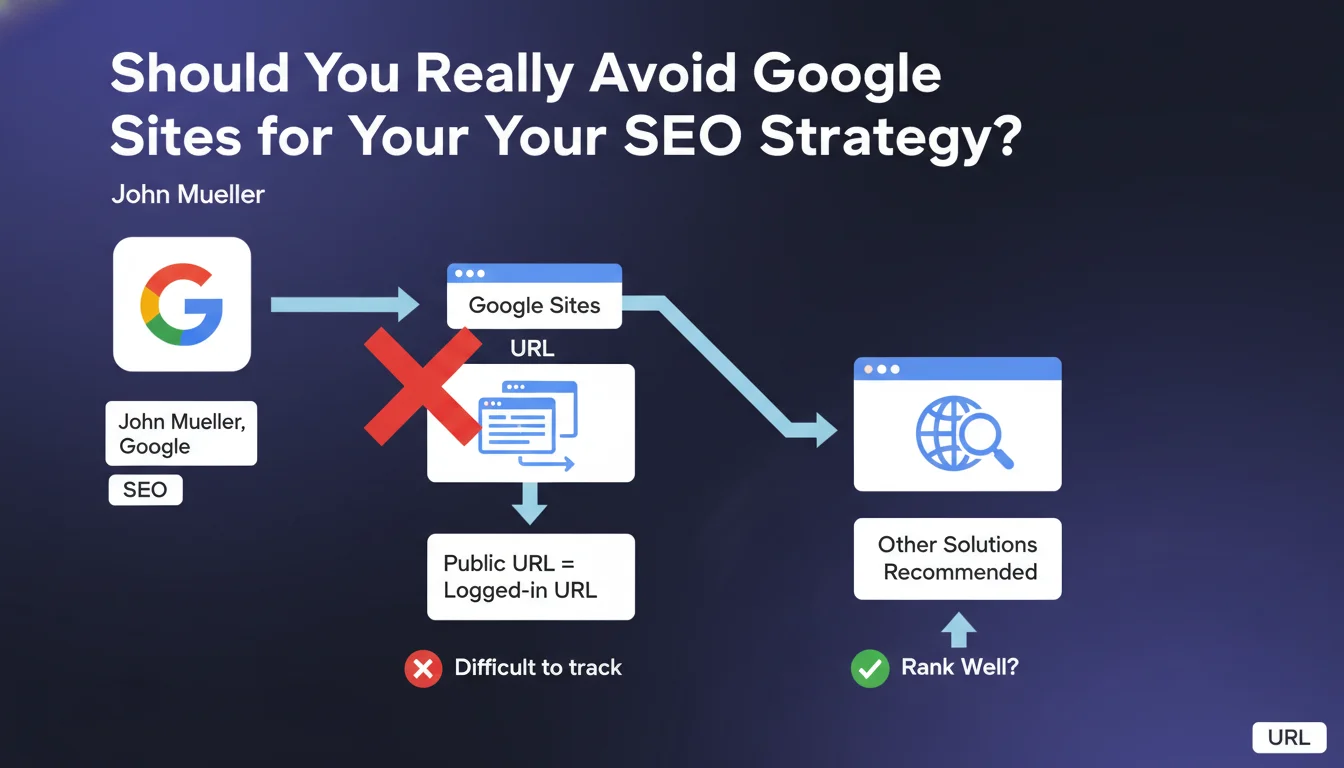
Google Sites, although indexable by Google, has technical limitations that can hinder your SEO ambitions. The main problem lies in URL management: the public version of a page can differ from the one displayed when you're logged in, creating confusion for tracking and optimization.
This peculiarity seriously complicates the use of Search Console. You risk not having a clear view of the actual performance of your pages, making any data-driven optimization strategy difficult.
What Are the Concrete Limitations of This Platform?
Beyond URL problems, Google Sites suffers from several handicaps for SEO. The default sites.google.com subdomains dilute your brand identity and don't allow you to build your own domain authority.
The platform also offers limited technical customization options: restricted control over meta tags, difficulties with schema markup, little flexibility on site architecture and advanced optimizations.
In What Contexts Does Google Sites Remain Acceptable?
Google Sites retains its relevance for projects without SEO ambitions: corporate intranets, internal documentation, simple personal portfolios, or one-time event pages.
- Major problem: URL inconsistency between logged-in and public versions
- Technical limitation: complex tracking in Search Console
- Official recommendation: use a classic domain name if SEO is a priority
- Acceptable use: internal projects or projects without ranking objectives
- Necessary alternative: classic CMS for any serious SEO strategy
SEO Expert opinion
Is This Statement Consistent with Practices Observed in the Field?
Absolutely, and this transparency from Google is even refreshing. In 15 years of SEO experience, I have rarely seen a Google Sites site perform sustainably on competitive queries. The technical limitations are real and not marketing inventions.
What is less talked about is that this platform was never designed with SEO as a priority. Its initial objective was ease of creation for internal use, not performance in organic search. Wanting to use it for SEO is like wanting to win an F1 race with a compact car.
Why Does Google Encourage Abandoning Its Own Tool?
The mention in the editorial comment regarding the use of Google subdomains for authority transfer is particularly relevant. Google has every interest in discouraging the SEO use of Google Sites to avoid abuse and ranking manipulation schemes.
By recommending other solutions, Google also protects the quality of its search results. A web filled with aggressively optimized Google Sites could create conflicts of interest and degrade user experience.
What Nuances Should Be Added to This Official Recommendation?
There are a few marginal cases where a Google Site can temporarily get traffic. For example, for ultra-fresh content on current events where publication speed is paramount, or for very long-tail queries without competition.
But these cases remain the exception that proves the rule. For any sustainable SEO strategy, investing in a classic CMS (WordPress, Webflow, etc.) with your own domain name is essential. The higher initial cost quickly pays for itself through the SEO performance obtained.
Practical impact and recommendations
What Should You Do if You Already Use Google Sites for Your Project?
If your current site is on Google Sites and SEO is important for your business, plan a migration now. Choose a CMS adapted to your needs (WordPress for flexibility, Webflow for design, Shopify for e-commerce) and a reliable host.
Before migrating, document all your current URLs and create a complete 301 redirect plan. Even if Google Sites is problematic, you may already have some indexed pages that need to be preserved.
What Alternative Solutions Should You Prioritize for Your SEO?
For a showcase site or blog, WordPress remains the reference with thousands of SEO plugins. For projects requiring sophisticated design, Webflow offers an excellent balance between creative control and SEO capabilities.
In all cases, invest in your own domain name (yourbrand.com rather than sites.google.com/yourbrand). It's the foundation of your online identity and your long-term SEO authority.
How Can You Verify That Your New Solution Is Optimal for SEO?
Your new platform must allow you to finely control title and meta description tags, customize URL structure, add schema.org markup, and automatically generate an XML sitemap.
Also verify that you can access technical files like robots.txt and .htaccess, and that the platform offers good performance (loading time, Core Web Vitals). These elements have become essential for effective SEO in 2024.
- Plan a migration if you are currently on Google Sites with SEO objectives
- Choose an appropriate CMS: WordPress, Webflow, or other professional solution
- Acquire your own domain name and avoid all generic subdomains
- Prepare 301 redirects to preserve what little equity exists
- Verify the SEO capabilities of the new platform before committing
- Set up Search Console properly from the start on your new site
- Never choose Google Sites for a new project with SEO ambitions
💬 Comments (0)
Be the first to comment.