
Official statement
What you need to understand
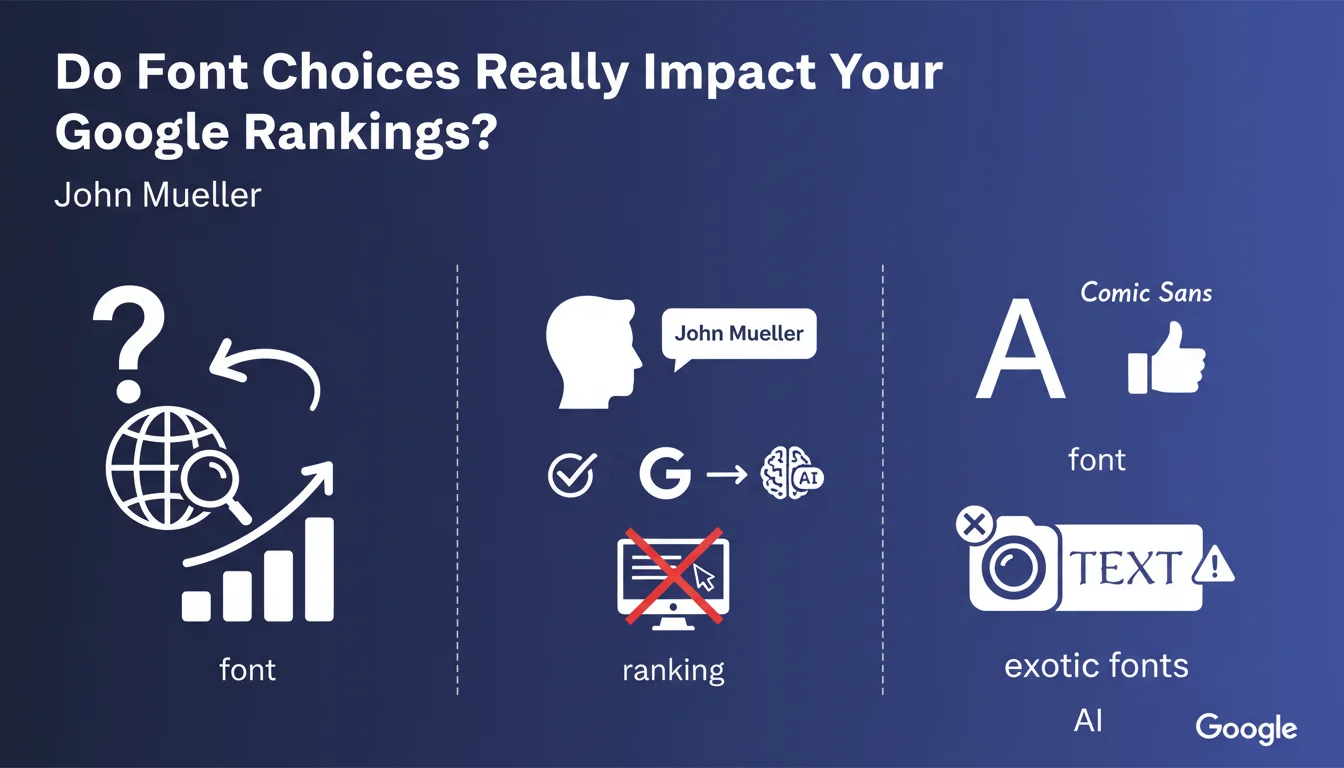
Google has officially confirmed that font choice has no impact on natural search rankings. Whether you use Arial, Times New Roman, or even Comic Sans MS, it will not change the way Google evaluates and ranks your content in its search results.
This clarification puts an end to certain speculations that typographic aesthetics could influence relevance algorithms. In reality, Google focuses exclusively on the textual content itself, not on its visual presentation via fonts.
However, there is one notable exception to this rule: when text is embedded in an image with a particularly stylized or unusual font. In this specific case, Google's OCR (Optical Character Recognition) technology may encounter difficulties in correctly identifying and extracting the text.
- Font type (font-family) is not a ranking criterion
- Typographic aesthetics do not count for Google
- Exotic fonts in images can pose problems for OCR
- Readability for users remains important, but it's a UX factor, not direct SEO
SEO Expert opinion
This statement is perfectly consistent with what we have observed in the field for years. Google essentially operates by analyzing HTML code and textual content, without interpreting purely visual aspects as a human would.
An important nuance concerns the overall user experience. While Google does not directly penalize a poorly chosen font, illegible typography can degrade visitor engagement (high bounce rate, low session time), which can indirectly affect your SEO performance through behavioral signals.
In practice, focus on semantic HTML structure (Hn tags, paragraphs, lists) rather than typographic styling. This is the structure that Google actually analyzes to understand your content.
Practical impact and recommendations
- Choose your fonts based on user experience, not SEO: prioritize readability and accessibility
- Absolutely avoid placing important textual content in images, especially with stylized or artistic fonts
- Use native HTML text for all content that Google needs to index (titles, descriptions, body text)
- If you must use text in images (infographics, banners), systematically add descriptive alt tags and duplicate key content in visible HTML
- Optimize HTML structure instead: heading hierarchy, semantic markup, rich snippets - these are the elements Google analyzes
- Test mobile readability of your fonts: poor mobile UX can indirectly affect your performance through engagement metrics
- Don't waste time testing different fonts for SEO: focus your resources on optimizations that have real impact
In summary: free yourself from SEO constraints regarding fonts and make choices purely oriented toward design and user experience. Your SEO energy should focus on content structure, editorial quality, and technical architecture.
These trade-offs between technical optimization, user experience, and SEO performance can prove complex to balance, particularly when redesigning a site or optimizing an existing content strategy. Working with a specialized SEO agency allows you to benefit from expert perspective on these questions and personalized guidance to prioritize actions that will genuinely generate qualified traffic.
💬 Comments (0)
Be the first to comment.