
Official statement
What you need to understand
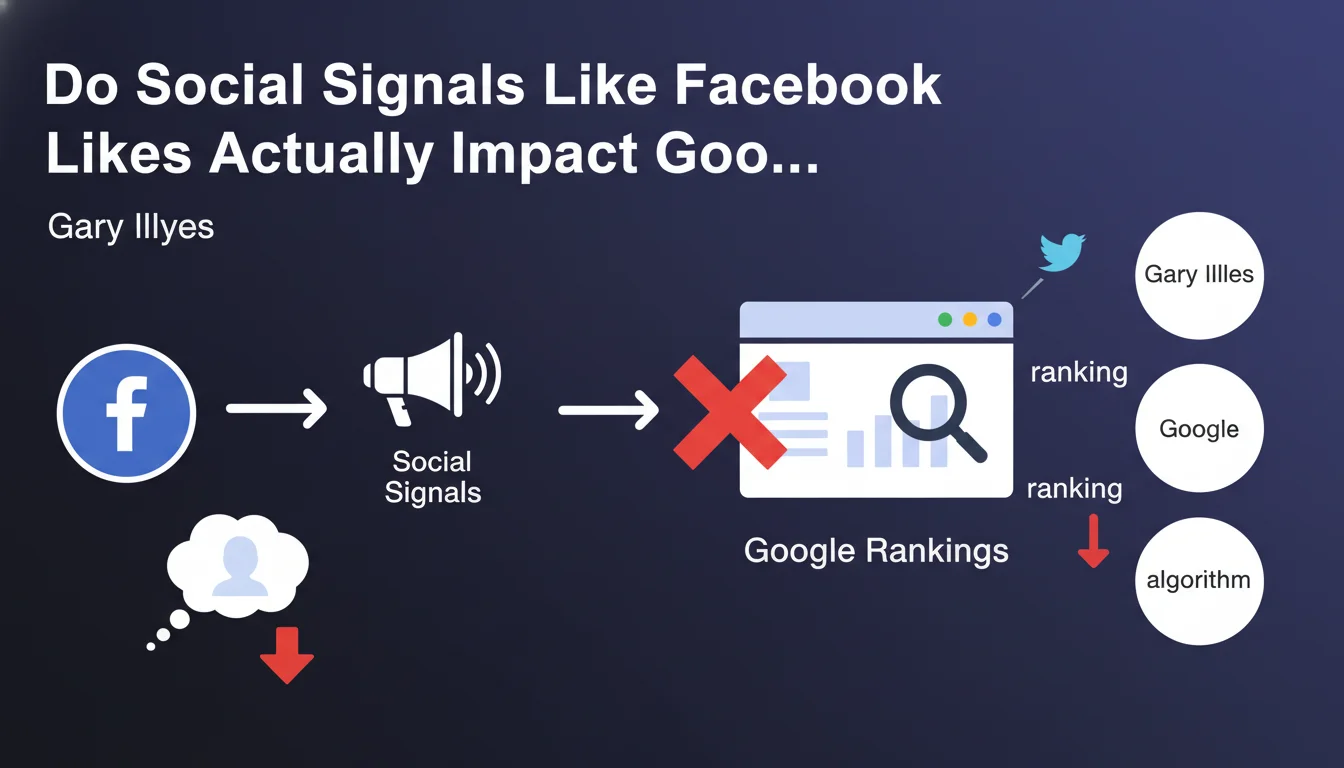
Google officially reaffirms that social media interactions, particularly Facebook likes, are not direct ranking factors in its search algorithm. This clarification aims to dispel a persistent belief within the SEO community.
This confusion stems from the fact that popular content on social networks often generates traffic and natural backlinks. However, correlation does not imply causation: it's not the social signal itself that boosts SEO, but the indirect consequences it may generate.
Google technically cannot access the majority of social data in a reliable and comprehensive manner. Content on Facebook is predominantly private, and the algorithm cannot rely on signals that are inaccessible or easily manipulated.
- Likes, shares, and other social metrics are not ranking criteria
- Google does not crawl social interactions as a direct factor
- Social visibility can generate beneficial indirect effects (traffic, awareness, links)
- This position has been consistent and repeated for years by Google
SEO Expert opinion
This statement is perfectly consistent with the field observations we've been making for years. Tests and correlation studies indeed show that there is no direct causal link between social signals and positioning in the SERPs.
The important nuance lies in the indirect effects of social media. Viral content on Facebook can attract the attention of bloggers, journalists, or webmasters who will subsequently create organic backlinks. It's this external link, not the initial like, that impacts SEO. Similarly, social traffic increases brand awareness, which influences branded searches.
The real challenge is not to over-invest in acquiring social signals thinking you'll improve your SEO, but rather to use them for their genuine benefits: engagement, community, and content amplification.
Practical impact and recommendations
Following this official clarification, here are the concrete actions to implement in your SEO strategy:
- Stop buying likes, shares, or other social signals hoping to improve your organic search rankings
- No longer consider social metrics as SEO KPIs, but as distinct marketing performance indicators
- Focus your SEO efforts on confirmed factors: quality content, natural inbound links, user experience, technical performance
- Use social media for their true value: generating qualified traffic, building community, amplifying content
- Invest in shareable content that can naturally attract backlinks through social virality
- Track conversions from social and those from SEO separately to measure the real impact of each channel
- Optimize your Open Graph tags to improve the appearance of your shared content, without expecting direct SEO benefits
In summary: Integrate social media into your overall digital strategy for their own benefits, but don't confuse them with your SEO strategy. Focus your resources on levers that directly impact organic search rankings.
Implementing a coherent multi-channel strategy, where SEO and social media complement each other without overlapping, requires sharp expertise and an overall vision. These cross-optimizations can prove complex to orchestrate alone, particularly when it comes to efficiently allocating your resources across different levers. Engaging a specialized SEO agency can provide you with personalized support to maximize your digital visibility in a coherent and profitable manner.
💬 Comments (0)
Be the first to comment.