
Official statement
What you need to understand
Why have .edu links long been considered valuable in SEO?
For years, a belief spread throughout the SEO community: links from .edu domains would have greater value than other backlinks. This idea was based on the principle that educational institutions would be more legitimate and credible in Google's eyes.
This misconception led many webmasters to actively seek these links, sometimes through artificial means. Massive spam practices developed, specifically targeting university sites.
What does John Mueller's statement actually mean?
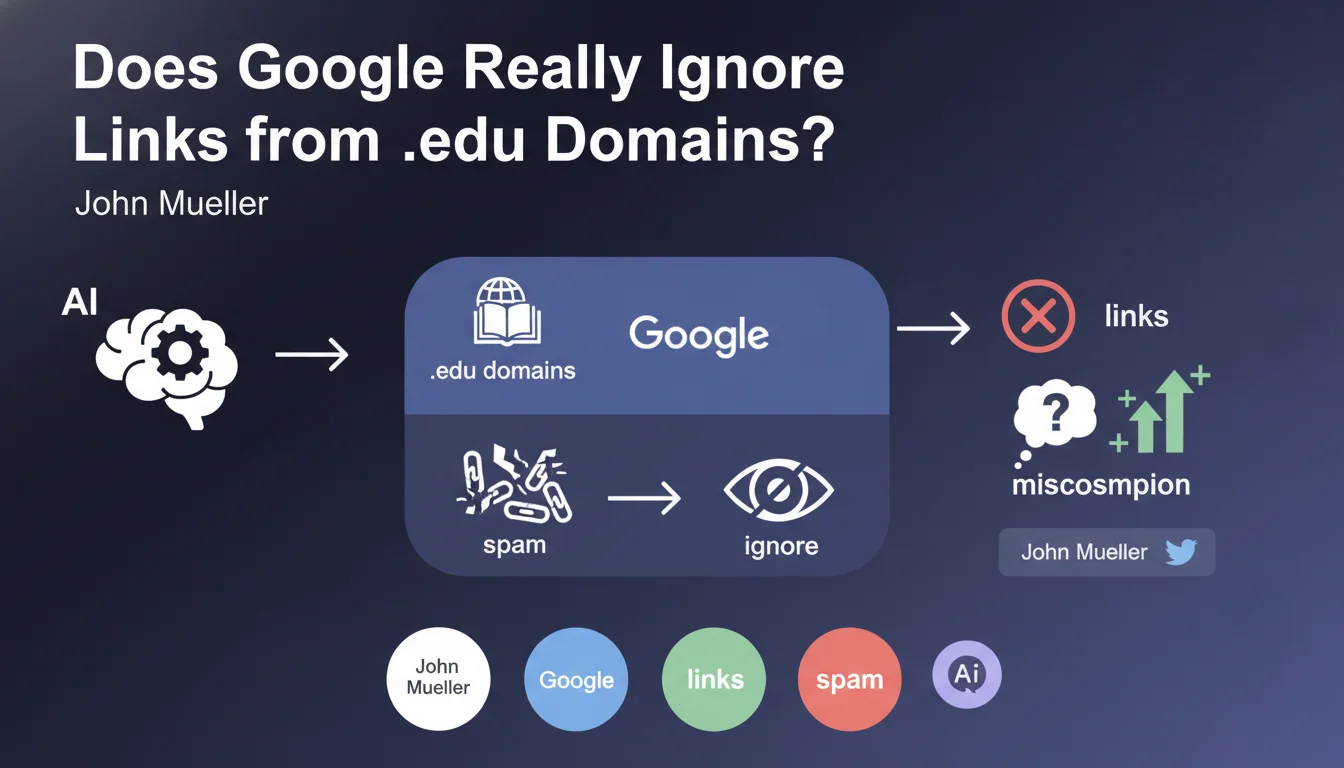
John Mueller reveals major information: Google now massively ignores links from .edu pages, precisely because they are mostly spammy in nature. This is an ironic turn of events.
This approach illustrates the evolution of Google's strategy: rather than penalizing sites that receive or create artificial links, the search engine simply prefers to ignore them. This is a more effective and less punitive method.
What are the key principles to remember about how Google handles links?
- Google does not favor any particular domain extension (.edu, .gov, .org) in its algorithm
- The quality of a link depends on context, relevance, and naturalness, not on the domain extension
- Google now favors ignoring spammy links rather than penalizing sites
- A naturally obtained .edu link retains its value, but the majority are now filtered out
- This approach applies to all types of suspicious links, not just .edu
SEO Expert opinion
Is this Google approach consistent with real-world observations?
Absolutely. For several years, experienced SEO professionals have noticed that the impact of .edu links on rankings has become negligible, even nonexistent. Practical tests confirm this trend.
This statement also validates a broader observation: Google is becoming increasingly sophisticated in its ability to identify and neutralize artificial links without manual intervention. Algorithmic filters are now capable of detecting spam patterns at scale.
What important nuances should be added to this information?
It would be wrong to conclude that all .edu links are worthless. A contextual, editorial, and relevant link from a quality university page probably retains its impact. It's the mass of artificial links that gets filtered.
Similarly, this logic extends far beyond .edu domains. Google applies similar filters to all types of links considered unnatural: blog comments, low-quality directories, widgets, widespread footers, etc.
How does this strategy of ignoring rather than penalizing change the game?
This is an important paradigm shift. Previously, receiving poor-quality links could potentially harm your site. Today, these links are simply ignored, which significantly reduces the risks of negative SEO.
This also means you no longer need to spend hours disavowing all suspicious links via Search Console. Google handles this filtering automatically in most cases.
Practical impact and recommendations
Should you completely abandon the pursuit of .edu links?
The answer is nuanced. You must stop any artificial strategy specifically targeting .edu domains: creating fake student profiles, spamming comments on university blogs, or buying links on these domains.
However, if you create genuinely relevant content for an academic audience (research, case studies, educational resources), naturally obtained links remain legitimate and potentially valued.
What should you do concretely to adapt your link building strategy?
Focus exclusively on obtaining contextual and relevant links, regardless of the source domain extension. A link from a specialized .com blog is generally worth more than a generic footer link from a .edu site.
Prioritize authentic relationships with other sites in your sector: editorial contributions, interviews, collaborative studies, naturally cited resources. This is what Google truly values.
- Stop all artificial link acquisition based on domain extension (.edu, .gov, .org)
- Audit your current link profile to identify truly contextual links versus automated links
- Develop a content strategy that naturally generates citations and references
- Invest in authentic press relations and editorial partnerships
- No longer use the disavow file except in exceptional cases of massive negative SEO
- Prioritize quality and thematic relevance over link quantity
- Measure link impact by their ability to generate qualified referral traffic, not solely by their SEO effect
- Train your teams on the principles of natural and sustainable link building
💬 Comments (0)
Be the first to comment.