
Official statement
What you need to understand
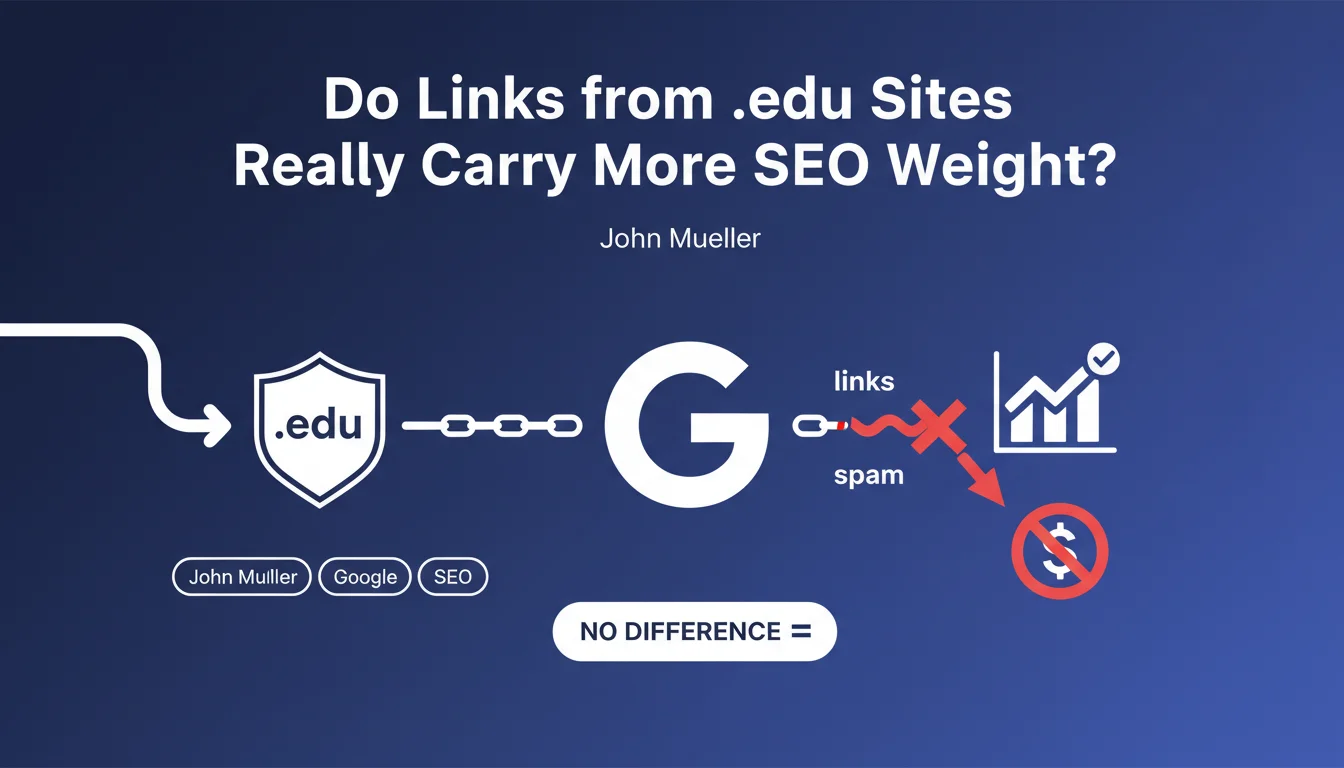
Google has clearly debunked one of the most persistent myths in SEO: links from .edu sites (educational institutions) or .gov sites (government websites) receive no preferential treatment in the ranking algorithm.
This clarification puts an end to a widely held belief that these domain extensions would automatically confer more authority or "SEO juice" to the links they emit. In reality, Google evaluates each link according to the same criteria, regardless of the source domain's extension.
Paradoxically, it's precisely this false belief that has led to a proliferation of spammy links on .edu sites. Many SEO practitioners have attempted to exploit these platforms (student forums, profile pages, comments) thinking they would gain a competitive advantage.
- No algorithmic bonus is granted to .edu or .gov extensions
- Google applies the same anti-spam filters to all domain extensions
- The quality and relevance of a link take precedence over the source domain's extension
- Manipulated links from .edu sites are just as ignored or penalized as those from other extensions
SEO Expert opinion
This statement is perfectly consistent with field observations from recent years. .edu sites that rank well owe it to their quality content, natural authority, and history, not to their extension. A link from a poorly maintained or off-topic .edu site will provide no value.
However, nuance is needed: while .edu sites don't receive a technical bonus in the algorithm, they often possess characteristics naturally favorable to SEO. They accumulate quality organic links, have a long web history, and produce authoritative content in their field. It's this combination that confers authority upon them, not their extension.
Practical impact and recommendations
This clarification should lead you to rethink your link building strategy by prioritizing contextual quality rather than chasing extensions perceived as "prestigious."
- Immediately cease any campaigns specifically targeting links from .edu or .gov sites solely for their extension
- Audit your existing link profile: identify artificial or off-topic .edu links that might be ignored by Google
- Redirect your efforts toward obtaining contextual and relevant links, regardless of the source domain's extension
- Evaluate each link opportunity based on quality criteria: thematic relevance, content quality, real traffic, natural site authority
- Favor authentic partnerships with educational institutions if your sector lends itself to it, but for the partnership's value itself, not for the extension
- Train your teams to no longer consider the extension as a quality criterion for a backlink
- Invest instead in creating content that naturally deserves links from authoritative sites, regardless of their extension
Building a natural and high-performing link profile requires in-depth expertise to properly assess the quality of opportunities and avoid the pitfalls of misconceptions. Given the increasing complexity of link quality criteria and the constant evolution of algorithms, support from a specialized SEO agency can prove valuable in developing a truly effective and sustainable link building strategy, adapted to the current realities of search engine optimization.
💬 Comments (0)
Be the first to comment.