
Official statement
What you need to understand
What's the Real Connection Between EAT and Featured Snippets?
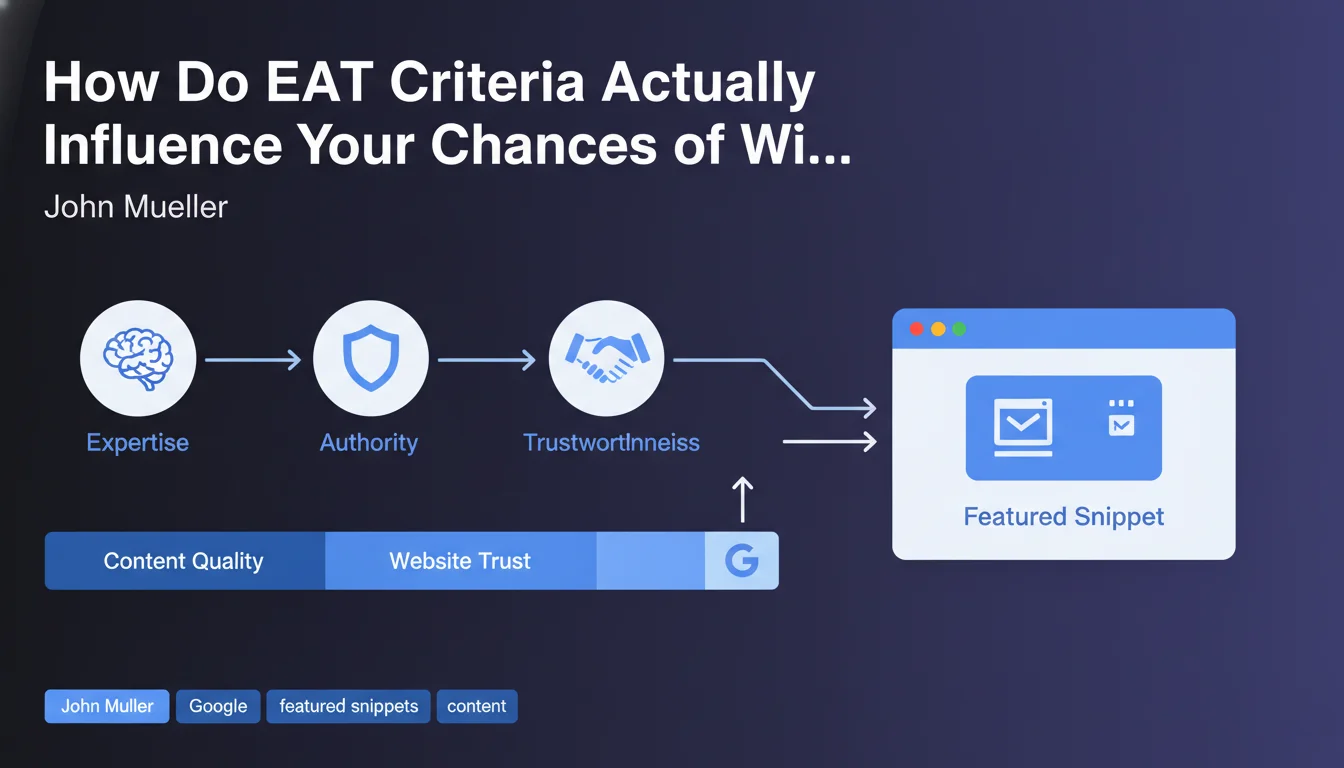
Google has confirmed that obtaining a Featured Snippet (position zero) doesn't solely depend on the technical quality of content. The EAT criteria (Expertise, Authority, Trustworthiness) play a decisive role in selecting content that gets highlighted.
Contrary to common belief, site size or its PageRank are not decisive factors for this feature. Google prioritizes the trust granted to the site and the demonstration of expertise on the topic being addressed.
Why Does Google Apply EAT Criteria to Featured Snippets?
Featured Snippets are direct answers displayed in a privileged position. Google cannot afford to display incorrect information or information from unreliable sources in this strategic placement.
Applying EAT criteria ensures that the information presented comes from credible and expert sources. This is particularly critical for queries related to health, finance, or sensitive topics (YMYL domains).
What Are the Key Takeaways from This Statement?
- EAT criteria are decisive for obtaining a Featured Snippet
- Site size and PageRank are not discriminating factors
- The trust granted by Google to the site is paramount
- Content quality and expertise take precedence over quantitative metrics
- These criteria are aligned with Google's Quality Raters guidelines
SEO Expert opinion
Is This Statement Consistent with Practices Observed in the Field?
Yes, this statement perfectly matches observations made over several years. Numerous small specialized sites obtain Featured Snippets against web giants, simply because they demonstrate sharp expertise in their domain.
We regularly observe that sites with low Domain Authority but content written by recognized experts outperform more powerful generalist sites. Relevance and credibility prevail over raw notoriety.
What Important Nuances Should Be Added to This Claim?
Be careful, EAT criteria are not measured by a single, transparent algorithm. Google uses a combination of signals: author mentions, external citations, quality of the "About" page, presence of detailed biographies, etc.
There is also a notable difference depending on industry sectors. YMYL (Your Money Your Life) domains like health or finance are subject to much stricter EAT criteria than other less sensitive topics.
In Which Cases Does This Rule Apply Differently?
For simple informational queries or non-sensitive factual questions, EAT criteria are less restrictive. Google may then prioritize answer clarity and content structure.
However, for any query related to health, financial advice, legal decisions, or safety, the barriers are significantly higher. A site without established credibility will have virtually no chance of appearing in position zero.
Practical impact and recommendations
What Should You Actually Do to Optimize Your Site According to EAT Criteria?
Start by clearly identifying the authors of your content with detailed biographies including their qualifications and expertise. Create dedicated pages for each contributor with their achievements and professional references.
Develop a comprehensive "About" page explaining your mission, your values, and your legitimacy in your domain. Add legal notices, verifiable contact information, and any proof of your real existence and seriousness.
Actively work on obtaining citations and mentions on reference sites in your sector. Inbound links from authoritative sources significantly strengthen your credibility in Google's eyes.
How Should You Structure Your Content to Maximize Chances of Getting a Featured Snippet?
Answer users' specific questions in a clear and concise manner. Favor paragraphs of 40-60 words for direct answers, as this is Google's preferred format for optimized snippets.
Use adapted structures: bulleted lists for enumerations, tables for comparisons, short paragraphs for definitions. Place the direct answer at the beginning of the content, then expand afterwards.
Integrate appropriate semantic tags (H2, H3) with natural questions reflecting search intents. Schema.org markup of FAQ or HowTo type can also strengthen your chances.
What Critical Mistakes Should You Avoid in Your Featured Snippets Strategy?
- Don't publish content in YMYL domains without demonstrating verifiable expertise
- Avoid anonymous authors or content without clear attribution
- Don't neglect editorial consistency: factual errors destroy trust
- Don't copy or paraphrase existing content, favor original analysis
- Avoid vague "About" pages or incomplete legal notices
- Don't ignore content maintenance: regularly update information
- Don't neglect security signals: HTTPS mandatory, no intrusive ads
- Avoid targeting Featured Snippets in domains where you have no legitimacy
💬 Comments (0)
Be the first to comment.