
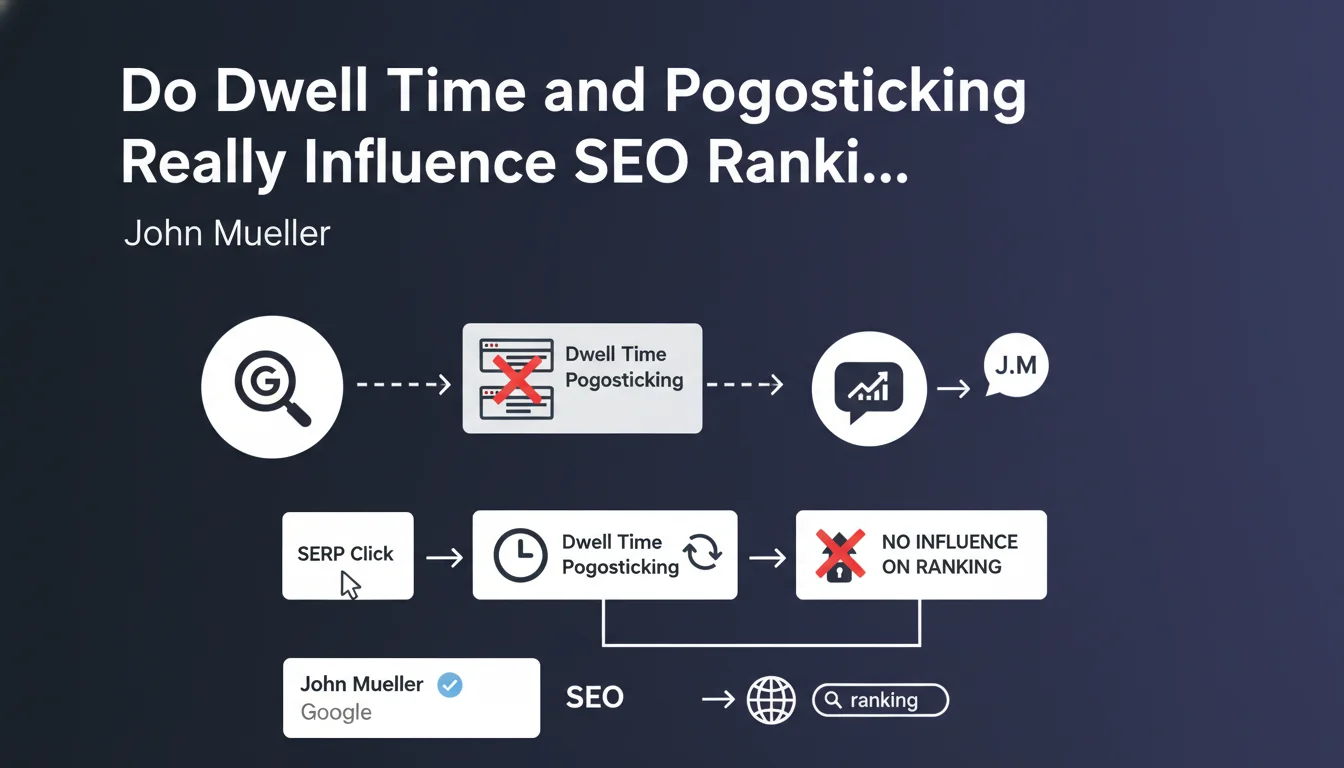
Official statement
What you need to understand
What exactly are Dwell Time and Pogosticking?
Dwell Time refers to the amount of time a user spends on a page after clicking on a search result before returning to the SERPs. Pogosticking refers to the behavior of an internet user who successively clicks on multiple search results without finding satisfaction.
These behavioral metrics logically seem relevant for evaluating the quality of a page. A user who quickly returns to the results could signal disappointing content, while an extended visit time would suggest a satisfactory page.
What exactly does Google say about using these signals?
John Mueller has been categorical and repetitive on this point: clicks in the SERPs do not directly influence the ranking of pages. Neither clicking on a result, nor the time spent before returning, nor the number of results consulted are used as ranking factors.
This official position has been consistent for years. Google regularly reaffirms that these user behaviors are not positioning criteria in the ranking algorithm.
Why doesn't Google use this data for ranking?
The main reason cited is the ease of manipulation of these signals. It would be relatively simple for malicious actors to generate artificial clicks, simulate visit times, or orchestrate pogosticking campaigns to influence results.
Google favors more robust signals that are difficult to manipulate for its ranking algorithm. Using direct behavioral metrics would create vulnerabilities in the system.
- Dwell Time and Pogosticking are not ranking factors according to Google
- Clicks in the SERPs have no direct influence on future positioning
- The easy manipulation of these signals explains their non-use as SEO criteria
- Google may nevertheless use this data for other internal analyses (algorithm improvement, testing)
- This SEO myth persists despite Google's repeated denials over the years
SEO Expert opinion
Is this statement consistent with field observations from SEO professionals?
Google's position creates an apparent paradox for many SEO practitioners. Many empirically observe a correlation between user engagement and ranking performance. Pages that retain visitors often seem to rank better.
However, correlation is not causation. Well-positioned pages generally offer quality content that meets user expectations, hence better engagement. It's the quality of the content that influences ranking, not the time spent as such.
What important nuances should be added to this statement?
Google claims not to use these signals directly as ranking factors, but that doesn't mean they're totally ignored. This data probably serves to refine algorithms, test new features, or evaluate the overall relevance of results.
Moreover, user experience remains crucial for modern SEO. While Google doesn't directly measure Dwell Time, the factors it actually evaluates (content quality, Core Web Vitals, information architecture) are precisely those that naturally influence time spent on a page.
To what extent should we still care about user engagement?
Despite this statement, user engagement remains fundamental for overall SEO success. Content that doesn't retain attention won't generate natural links, shares, brand mentions, or recurring visits - all signals that Google actually values.
The goal is therefore not to optimize for a hypothetical Dwell Time metric, but to create a truly satisfying experience. This qualitative approach naturally produces the positive signals that Google seeks, without artificial manipulation.
Practical impact and recommendations
What should you actually optimize if Dwell Time doesn't count?
Focus on confirmed ranking factors rather than hypothetical behavioral metrics. Content quality, semantic relevance, domain authority, and technical experience remain priorities.
Optimize your search intent: ensure your content precisely answers the user's query. This is what actually influences ranking, and incidentally, it naturally improves engagement.
Work on your Core Web Vitals and UX: these official ranking factors have a direct impact on ranking and indirectly influence user behavior.
What strategic mistakes should you avoid following this statement?
Don't invest in artificial techniques aimed at manipulating Dwell Time or CTR. Click campaigns, dubious Chrome extensions, or click farms are not only ineffective but potentially risky.
Don't neglect behavioral analysis though. Your Analytics data remains valuable for identifying real problems: unsuitable content, confusing navigation, or mismatch between promise and content.
Avoid over-optimizing title tags and meta descriptions with sensational wording (clickbait) solely to increase CTR. If the content doesn't deliver on the promise, you create frustration without SEO benefit.
How do you build an effective SEO strategy in this context?
Adopt a holistic approach centered on real user satisfaction. Create comprehensive, well-structured content with clear headings, relevant visuals, and intuitive navigation.
Measure your success with business indicators: conversions, lead generation, brand awareness. These metrics reflect the true value of your SEO beyond rankings.
- Audit your content to verify alignment with the search intent of each target query
- Optimize your Core Web Vitals (LCP, FID, CLS) to improve technical experience
- Structure your content with a clear hierarchy and internal navigation elements
- Analyze your Analytics metrics to identify pages with high bounce rates and understand why
- Improve the depth of your content on strategic topics to comprehensively answer questions
- Regularly test your pages on mobile to ensure a smooth experience across all devices
- Develop your internal linking strategy to facilitate discovery of related content
- Monitor the SERPs for your main queries and analyze what well-positioned competitors offer
💬 Comments (0)
Be the first to comment.