
Official statement
What you need to understand
What Exactly Is the Official 50,000 URL Limit in an XML Sitemap?
The limit of 50,000 URLs per sitemap file is a well-known rule among SEO professionals. This technical constraint imposed by Google aims to optimize sitemap processing and crawling.
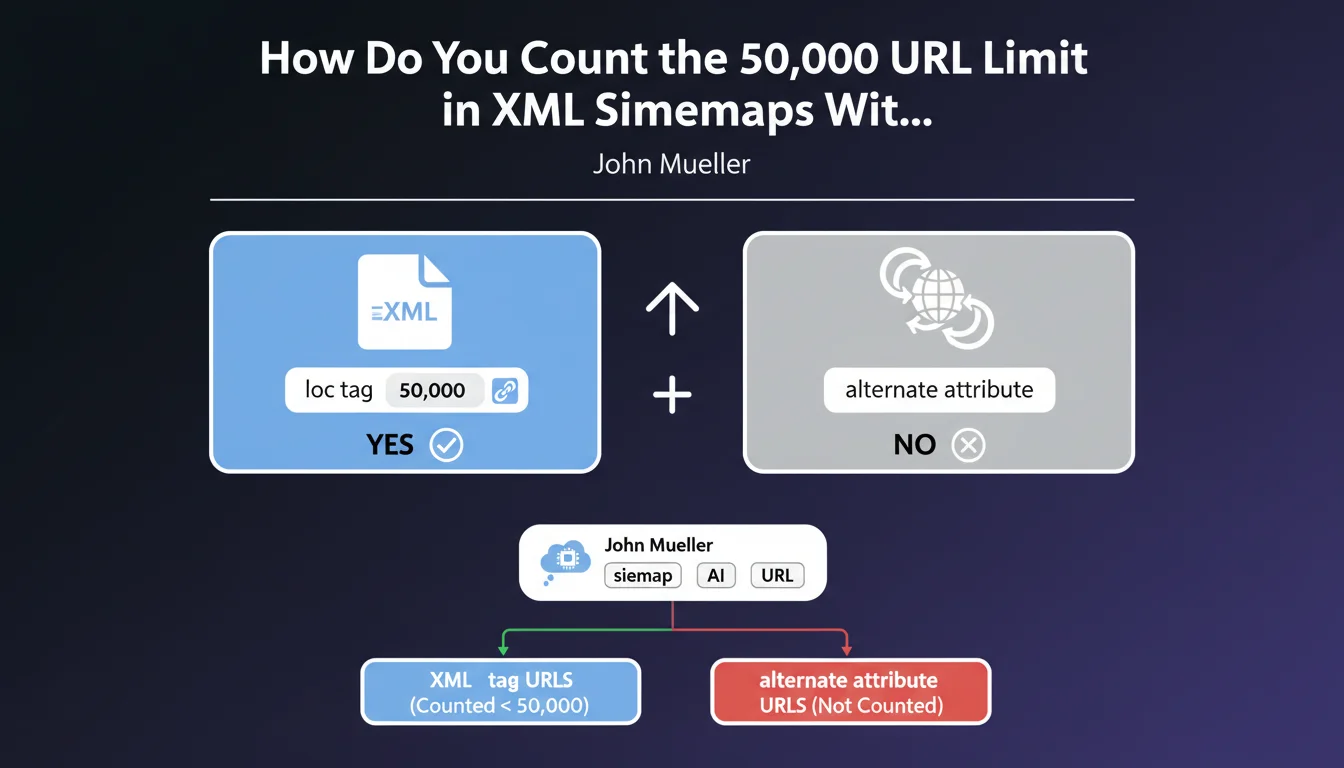
But this clarification from John Mueller provides an important precision: only "loc" tags are counted toward this limit. Other URLs present in the file, particularly via attributes like "alternate", are not included in this count.
Why Does This Distinction Between "loc" Tags and "alternate" Attributes Matter?
This distinction becomes particularly relevant for multilingual or multi-regional sites that use hreflang annotations in their sitemaps. A single sitemap can contain a main URL in the "loc" tag and several language variants via "alternate" attributes.
Concretely, if you have 10,000 pages with 5 language versions each, your sitemap will contain 10,000 "loc" tags and 40,000 alternative URLs. According to this clarification, you remain under the limit because only the 10,000 "loc" tags are counted.
Which Elements Are Considered Alternative URLs?
The "alternate" attributes in sitemaps primarily serve to declare variants of the same page. This includes language versions (hreflang), mobile versions (media="only screen and (max-width: 640px)"), or AMP versions.
- The 50,000 limit applies only to <loc> tags
- Alternate attributes (hreflang, mobile, AMP) don't count toward this limit
- A sitemap can therefore technically contain well over 50,000 total URLs
- This rule facilitates the management of complex international sites
- The 50 MB file size limit still applies
SEO Expert opinion
Does This Clarification Actually Change Established SEO Practices?
This precision confirms what many experienced SEO practitioners were already observing in the field. Multilingual sites with sitemaps containing numerous hreflang annotations generally haven't encountered crawling issues, even with files far exceeding 50,000 total URLs.
However, this official statement provides important legal and technical security. It allows SEO teams to size their sitemaps confidently, without fearing penalties or malfunctions for exceeding the threshold with alternative URLs.
Are There Hidden Limits or Special Cases to Watch Out For?
Even though the 50,000 "loc" tag limit is clear, the file size constraint remains in effect. A sitemap must not exceed 50 MB uncompressed (or 10 MB compressed). With numerous hreflang annotations, this limit can be reached quickly.
Additionally, Google still recommends prioritizing quality over quantity. An overloaded sitemap, even if compliant with technical limits, can slow down processing and crawling. It's often more relevant to divide sitemaps by content type or site section.
Does This Rule Apply the Same Way for All Sitemap Indexes?
Sitemap index files have their own rules: they can reference up to 50,000 individual sitemap files. This limit does apply to the number of file references, not to the URLs they contain.
For very large sites with several million pages and multilingual variations, architecture with nested sitemap indexes remains the recommended solution. This allows logical organization and facilitates maintenance and indexing tracking.
Practical impact and recommendations
How Can I Concretely Optimize My Sitemaps in Light of This Information?
The first step is to audit your current sitemaps to check if you're affected by this distinction. If your site is multilingual with hreflang annotations, you can probably simplify your sitemap architecture.
Instead of fragmenting your sitemaps excessively for fear of exceeding 50,000 total URLs, you can group more main URLs into the same file. This simplifies management and reduces the number of files to maintain.
However, watch out for the 50 MB size limit which can become the main limiting factor for sites with numerous annotations. Test the final size of your XML files before deployment.
What Technical Checks Should Be Performed Regularly?
It's essential to monitor your sitemaps via Google Search Console. Regularly check submission status and the number of URLs crawled versus submitted. Significant gaps may indicate structural problems.
Use XML validation tools to ensure your sitemaps remain technically compliant. A malformed sitemap won't be processed correctly, regardless of its size.
- Count only your <loc> tags for the 50,000 URL limit
- Verify that the total size of each file stays under 50 MB uncompressed
- Group your main URLs by theme or logical section
- Use alternate attributes freely for your language variants
- Test your sitemaps with XML validators before production
- Monitor actual indexing in Search Console
- Document your sitemap architecture to facilitate maintenance
- Compress your sitemaps with gzip to reduce bandwidth
Should You Completely Restructure Your Existing Sitemap Architecture?
If your current architecture works correctly and your pages are properly indexed, there's no urgency to restructure everything. This clarification is primarily useful for optimizing future deployments or resolving existing problems.
However, if you've fragmented your sitemaps excessively out of fear of the limit, you can consider progressive consolidation. Test first on one section of your site before generalizing.
In summary: The 50,000 URL limit in XML sitemaps only concerns main <loc> tags. Alternative URLs (hreflang, mobile, AMP) don't count toward this total. This clarification simplifies the management of multilingual sites and enables more efficient sitemap architecture.
Optimizing XML sitemaps, particularly for complex international sites, requires sharp technical expertise and deep understanding of specifications. These configurations can quickly become complex to manage in-house. Support from a specialized SEO agency helps avoid costly mistakes and optimize your architecture for maximum crawl efficiency.
💬 Comments (0)
Be the first to comment.