
Official statement
What you need to understand
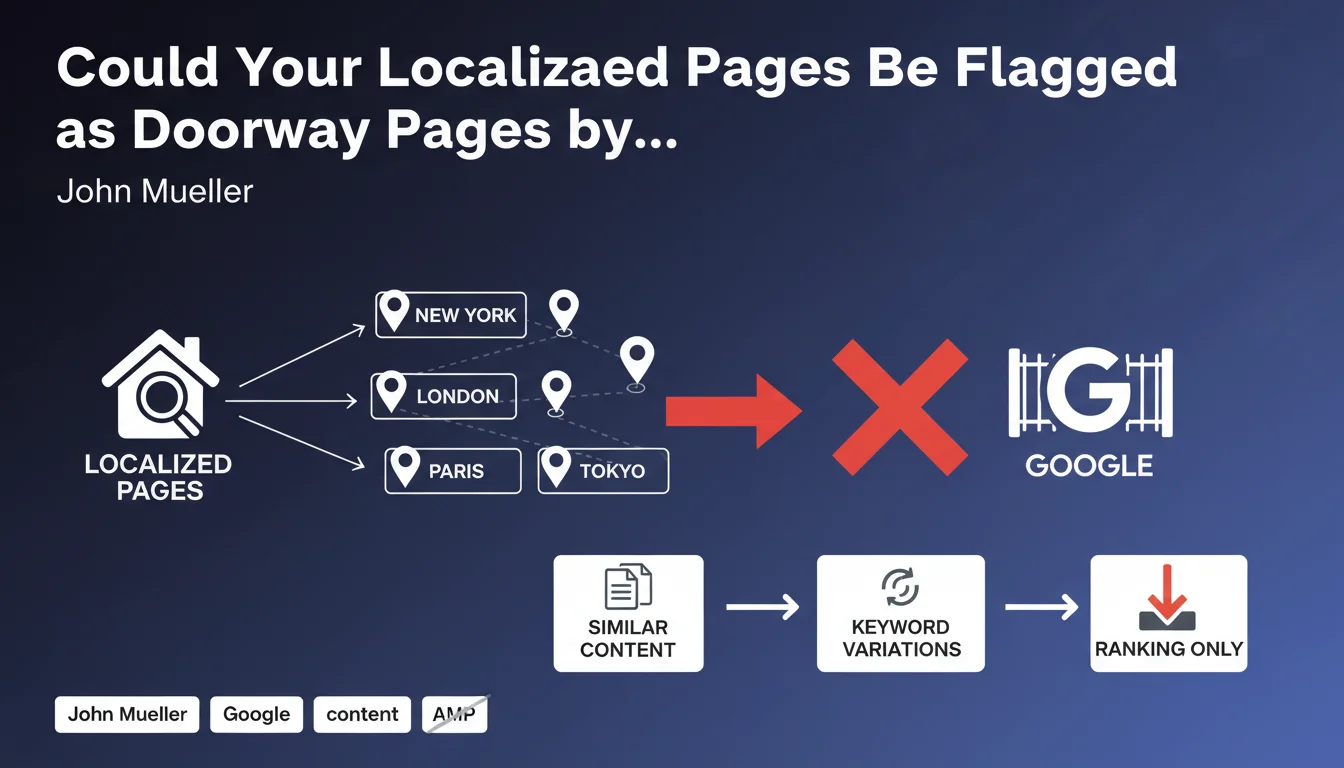
Doorway pages represent one of the riskiest practices in SEO. Google defines them as multiple pages with nearly identical content, where only a few geographic keywords or minor variations change.
The typical example? Creating 50 pages "Plumber Paris 1", "Plumber Paris 2", "Plumber Paris 3"... until exhausting all districts, with the same template content each time. This purely quantitative approach solely aims to multiply entry points from search results.
John Mueller emphasizes a key criterion: the multiplication of very similar pages whose only objective is to cover as many query variants as possible. The problem isn't having localized pages, but artificially creating dozens of variations without real added value.
- The main criterion: numerous pages with identical or nearly identical content
- The superficial difference: only keywords change (city, region, variation)
- The condemnable intent: multiplying rankings without providing unique value
- The sectors concerned: real estate, local services, rentals, tradespeople
SEO Expert opinion
This clarification from Mueller is particularly important as it draws the red line between legitimate localization and spam. In practice, Google perfectly tolerates geolocated pages... provided they bring distinctive value.
The fundamental nuance? A "Plumber Lyon" page that details the specifics of Lyon's water network, local issues, intervention schedules in different neighborhoods, and presents the local team is not a doorway page. However, 20 identical pages where only the city name changes clearly are.
I observe that sites penalized for doorway pages share a pattern: a very low unique content/duplicate content ratio. If 80% of your text is identical from one page to another, you're in the danger zone. The empirical rule: each local page should have at minimum 60-70% truly unique and relevant content for that location.
Practical impact and recommendations
- Audit your existing pages: identify pages with more than 40% duplicate content between them
- Consolidate rather than multiply: 5 rich regional pages are better than 50 poor city pages
- Create authentic localized content: local statistics, customer testimonials from the area, regional specifics, local news
- Differentiate visually: local photos, personalized maps, local teams if relevant
- Validate business relevance: create a local page only if you have actual activity/presence in that area
- Use LocalBusiness structured data: to legitimize your geographic presence
- Avoid mechanical permutations: don't automatically create keyword variations
- Prioritize user intent: each page must respond to a specific local search need
- Monitor organic traffic: a sudden drop can signal doorway page detection
Bringing a local page architecture into compliance requires specialized expertise to balance geographic coverage and content uniqueness. Semantic analysis, creating differentiated content at scale, and deciding between consolidation and page multiplication represent complex technical and strategic challenges. For sites with dozens of geolocated pages, support from a specialized SEO agency helps secure this transition while preserving your organic visibility.
💬 Comments (0)
Be the first to comment.