
Official statement
What you need to understand
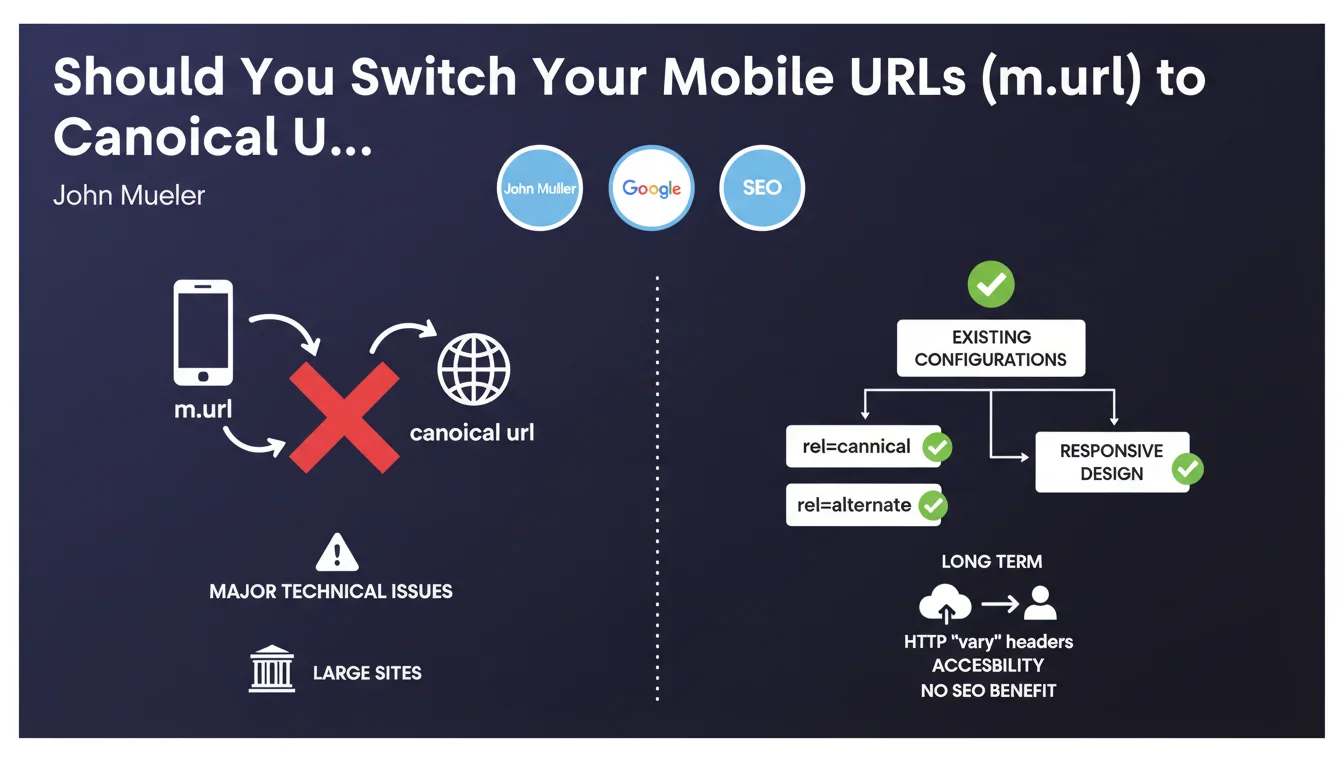
With the transition to mobile-first indexing, some SEO professionals wonder whether they should reverse the logic of canonical URLs. Historically, sites with separate mobile URLs (m.example.com) declare the desktop version as canonical.
Google maintains its position: do not modify this configuration, even though the mobile version is now indexed as a priority. The search engine is perfectly capable of handling this architecture with existing tags.
This recommendation aims to avoid major technical disruptions, particularly for large-scale sites with thousands of pages. A canonicalization change can lead to indexing errors, temporary ranking losses, and complications in redirect management.
- Keep your rel=canonical tags pointing from mobile to desktop
- Maintain your rel=alternate tags indicating the mobile version from desktop
- HTTP Vary headers are not necessary for SEO, only for technical accessibility
- Responsive design remains the recommended long-term solution to simplify architecture
SEO Expert opinion
This recommendation is perfectly consistent with what we observe in the field. Sites that attempted to reverse their canonicals during the mobile-first transition often encountered temporary indexing issues and ranking fluctuations.
Google's logic relies on the stability of historical signals. Even with mobile-first indexing, the search engine perfectly understands the relationship between mobile and desktop versions through existing annotations. Modifying this structure would essentially blur years of accumulated signals.
In the medium term, migrating to responsive remains the most sustainable strategy. It eliminates technical complexity, reduces the risk of implementation errors, and considerably simplifies the site's SEO maintenance.
Practical impact and recommendations
- Audit your current configuration: verify that all your mobile pages have a rel=canonical tag pointing to desktop
- Check rel=alternate tags: ensure that each desktop page correctly indicates its mobile variant
- Do not modify your canonicals even if mobile-first indexing is active on your site
- Verify content parity: ensure that your mobile version contains the essential desktop content (text, images, links)
- Monitor Search Console: regularly consult coverage reports to detect potential mobile indexing issues
- Remove unnecessary Vary headers if they only serve SEO purposes (can be kept for cache/accessibility reasons)
- Plan a responsive migration: establish a medium-term roadmap to unify your URLs and simplify your architecture
- Document your architecture: create clear technical documentation of your current configuration to facilitate maintenance
Managing complex mobile architectures and migrations to responsive require specialized technical expertise and rigorous planning. The stakes in terms of preserving organic traffic are considerable, particularly for e-commerce or high-volume sites. To secure these strategic transitions and benefit from personalized support adapted to your specific context, the intervention of a specialized SEO agency can prove decisive in avoiding technical pitfalls and maximizing chances of success.
💬 Comments (0)
Be the first to comment.