
Official statement
What you need to understand
Does Google Officially Require Contact and About Pages?
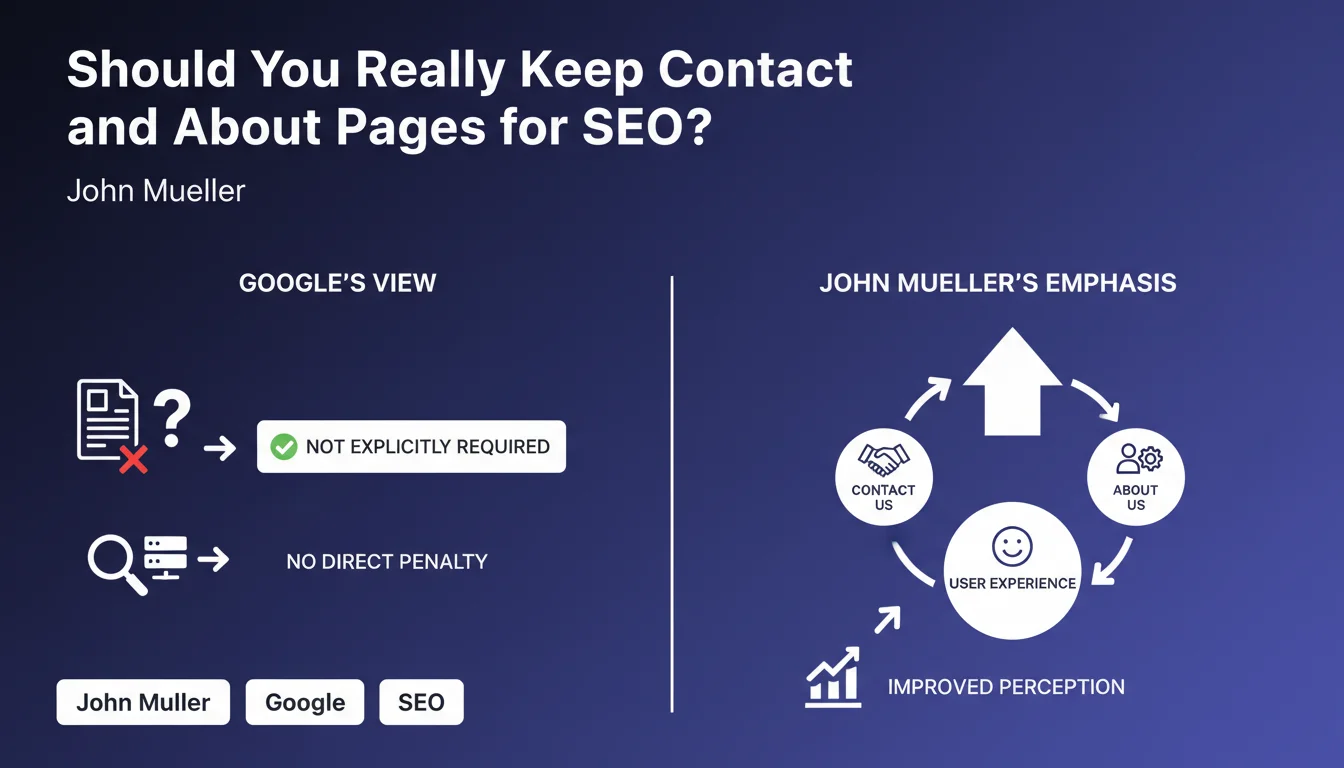
John Mueller's official response is clear: these pages are not explicitly required in Google's technical documentation. Their absence therefore does not trigger any direct algorithmic penalty in organic search results.
However, this clarification does not mean they should be removed. Mueller insists that these pages play a fundamental role in user experience, which remains an important quality criterion for Google, even if it is not measured in a binary way.
Why Do These Pages Remain Important Despite Everything?
Beyond strict SEO, these pages address concrete user needs. They establish the site's credibility, allow visitors to get in touch, and provide reassurance about the company's legitimacy.
For certain Google services like Google Shopping, a contact method even becomes mandatory to appear in product results. This requirement underscores the practical importance of these pages in the Google ecosystem.
What's the Difference Between Technical Obligation and Best Practice?
Google makes an important distinction here: what is not technically mandatory can nevertheless be a strong recommendation. The absence of algorithmic penalty does not mean the practice is neutral.
Authority and trust signals (E-E-A-T) include transparency about the site's identity and contact methods. Without being a direct ranking factor, this contributes to the overall quality assessment.
- No direct SEO penalty for the absence of Contact/About pages
- These pages remain essential for user experience and credibility
- Real obligation for Google Shopping and certain specific services
- Indirect contribution to E-E-A-T quality signals
- Distinction between technical requirements and recommended best practices
SEO Expert opinion
Is This Statement Consistent with Practices Observed in the Field?
Absolutely. In my 15 years of experience, I have found that high-performing sites systematically have these pages, not out of SEO obligation, but out of business logic. Sites without a Contact page generally display higher bounce rates and fewer conversions.
Google's algorithms are evolving toward a holistic understanding of quality. A site without contact information often generates negative behavioral signals: short visit time, quick returns to search results, low engagement.
What Important Nuances Should Be Added to This Recommendation?
The nature of the site greatly influences this recommendation. An e-commerce site or professional services site without a Contact page immediately loses credibility. On the other hand, a personal blog or portfolio site can more easily do without it.
The issue is not only SEO but also legal and regulatory. In Europe, GDPR and mandatory legal notices de facto require certain information. In the United States, the FTC requires contact information for commercial sites.
In What Rare Cases Could You Do Without Them Without Negative Impact?
Certain purely informational sites like community wikis, historical archives, or open source projects can function without these formal pages. Their credibility relies on other mechanisms (identified contributors, cited sources).
Temporary landing pages for specific advertising campaigns can also do without them, as their objective is ultra-targeted and their lifespan limited. But as soon as you aim for sustainable organic positioning, these pages become essential again.
Practical impact and recommendations
What Should You Actually Do with Contact and About Pages?
Don't just create these pages out of obligation. Optimize them so they become real SEO and conversion assets. The About page should tell your story, present your team with photos and expertise, and include semantic keywords related to your field.
The Contact page should offer multiple communication methods: form, email, phone, physical address if relevant, and possibly chat. Add a map with Google Maps for local businesses. Structure this information with Schema.org markup (ContactPoint, Organization).
These pages can generate organic traffic on queries like "contact [company name]" or "about [brand]". They therefore deserve a minimum of on-page optimization: relevant title/meta tags, structured headings, internal links from the main menu.
What Critical Mistakes Should You Absolutely Avoid?
The most common mistake is creating generic and empty pages. A three-line About page or a simple contact form without context provides no value and can even harm the perception of site quality.
Also avoid blocking these pages from indexing or marking them as noindex. Even if they are not your priority pages, they contribute to the completeness of your site and can appear in navigational search results.
Don't neglect the security and spam aspect: protect your contact form with a captcha, use email addresses protected against scraping, and ensure the Contact page works properly (regularly test submissions).
How Can You Verify That These Pages Are Optimal for SEO and UX?
Audit your Contact and About pages with the same criteria as your main pages. Check loading time, mobile compatibility, accessibility, and absence of technical errors.
Analyze behavioral metrics in Google Analytics: bounce rate, visit duration, conversions (form submissions). If the bounce rate is abnormally high on the Contact page, users may not be finding what they're looking for.
- Create a complete About page with history, team, values and expertise
- Implement a Contact page with multiple communication methods
- Add Schema.org markup (Organization, ContactPoint, LocalBusiness if applicable)
- Optimize meta tags and Hn structure of these pages
- Make these pages accessible from the main menu and footer
- Verify mobile compatibility and loading times
- Regularly test the contact form and notifications
- Protect the form against spam with captcha or equivalent protection
- Add legal information compliant with GDPR (privacy policy)
- Measure performance with Google Analytics and Search Console
💬 Comments (0)
Be the first to comment.