
Official statement
What you need to understand
What Is the AVIF Format and Why Hasn't Google Talked About It Until Now?
The AVIF (AV1 Image File Format) format is a modern image format developed by the Alliance for Open Media, a consortium of which Google is a member. It offers superior compression compared to traditional formats like JPEG or PNG, with file sizes up to 50% smaller at equivalent quality.
Paradoxically, although Google is involved in its development, Googlebot did not officially support this format until now. This situation creates ambiguity for webmasters adopting future-forward technologies.
What's the Difference Between Googlebot and Googlebot-Images?
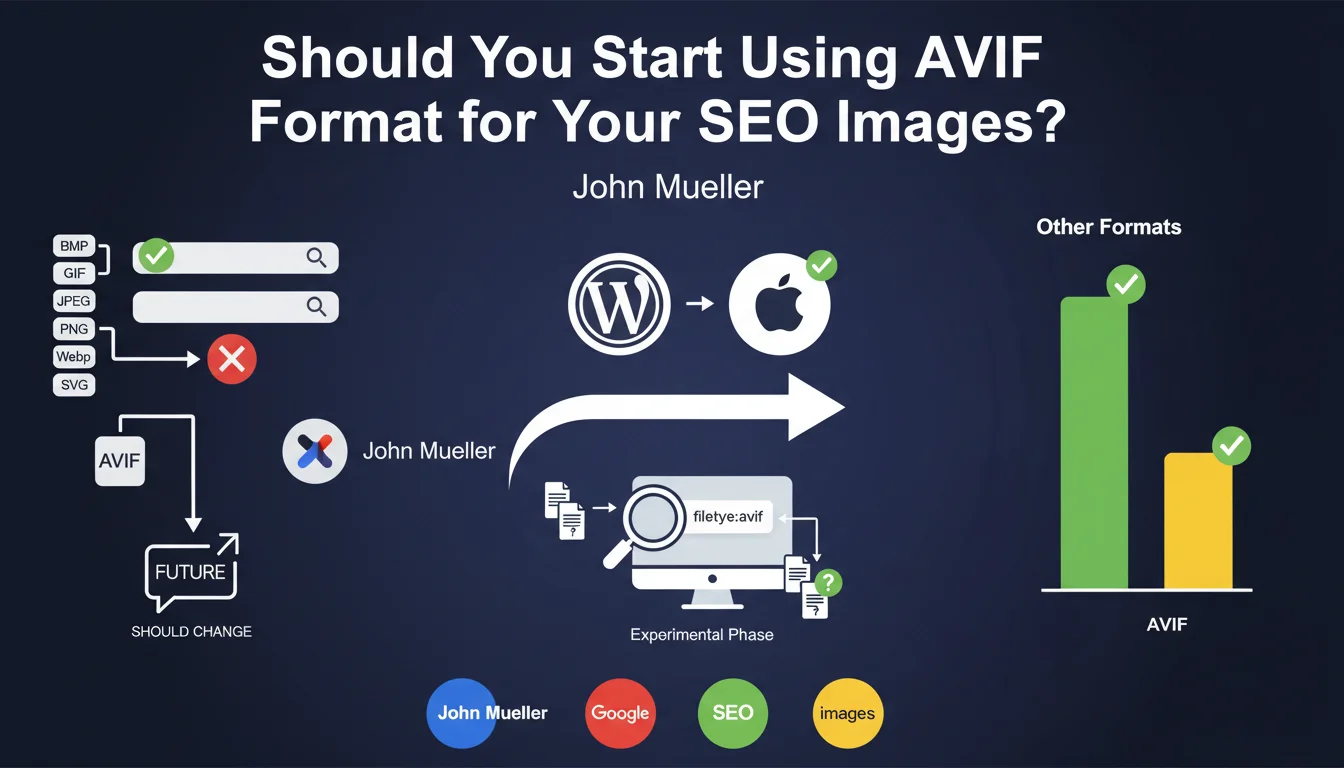
The key revelation of this announcement is that Google uses two distinct crawling systems for content and images. Googlebot-Images, dedicated to Google Images, already supports AVIF and can retrieve these files.
However, standard Googlebot cannot process this format, which means your AVIF images are not visible for indexing the main content of your web pages.
What Does the Upcoming AVIF Support Actually Mean?
John Mueller confirms that full AVIF support is coming to Google Search, without specifying a timeline. Tests using the filetype: operator show that Google is already in an experimental phase.
Adoption by WordPress and Apple is accelerating the generalization of this format, forcing Google to align its infrastructure. For SEO practitioners, this signals a gradual transition toward this standard.
- AVIF offers superior compression compared to classic formats (50% size reduction)
- Googlebot-Images already supports AVIF, but not standard Googlebot
- Full support is confirmed but without a specific date
- WordPress and major web players are already adopting this format
- Google is in testing phase as shown by filetype: results
SEO Expert opinion
Does This Situation Reveal an Inconsistency in Google's Strategy?
There is indeed an apparent contradiction: Google actively develops AVIF through the Alliance for Open Media, but its main search engine didn't support it. This situation illustrates Google's organizational complexity, where different teams progress at different rates.
This gap also highlights the technical separation between Google Images and Google Search, two systems that share certain technologies but maintain distinct infrastructures. For SEO professionals, this confirms that optimizations for classic search and image search must be analyzed separately.
Should You Migrate to AVIF Now or Wait?
The answer depends on your strategy. If your traffic comes mainly from Google Images, AVIF is already functional and can give you a competitive advantage through reduced loading times.
For classic search, the lack of support means Googlebot cannot display these images in content previews or analyze them for the semantic context of the page. A hybrid approach with fallback therefore remains prudent until official rollout.
Which Sites Should Anticipate This Evolution Right Now?
Sites with a large volume of images (e-commerce, portfolios, media) have an interest in preparing their infrastructure. Reducing image weight directly improves Core Web Vitals, particularly LCP (Largest Contentful Paint).
Sites whose SEO strategy relies on Google Images as a traffic source can already benefit from AVIF adoption. Field tests show that these images are indeed indexed in image search, offering a performance advantage.
Practical impact and recommendations
What Should You Actually Do with AVIF Images Today?
The safest strategy currently is to implement a hybrid solution rather than a complete migration. Use the <picture> tag with multiple sources to serve AVIF to compatible browsers while maintaining a WebP or JPEG fallback.
Systematically test that your images are properly visible in search previews and in Google Search Console. Particularly monitor indexing reports to detect potential rendering issues.
Prioritize AVIF for decorative or secondary images, and maintain classic formats for strategic images (flagship products, hero visuals, images carrying important semantic context).
What Mistakes Should You Avoid During the AVIF Transition?
The main mistake would be to completely replace your images with AVIF without a fallback solution. This would create display problems for Googlebot and potentially for some still-incompatible browsers.
Also avoid neglecting the schema.org markup of your images. Even with AVIF, alt attributes, ImageObject structured data, and image sitemaps remain essential for indexing.
Don't underestimate the impact on monitoring tools: verify that your performance analysis solutions and SEO tools properly handle this format to maintain visibility on metrics.
How Can You Prepare Your Infrastructure for the Official Support Arrival?
Start by auditing your current technical stack: your CDN, your CMS, and your plugins must support AVIF. WordPress 6.5+ handles it natively, but check the compatibility of your themes and extensions.
Set up a process for automatic generation of different image formats (AVIF, WebP, JPEG) on upload. Solutions like ImageMagick, Sharp, or cloud services can automate this chain.
Create a specific monitoring system to track support evolution: monitor official announcements, regularly test indexing with Search Console, and prepare a progressive deployment plan once support is confirmed.
- Implement the <picture> tag with AVIF and WebP/JPEG fallback
- Test image display in Google Search Console
- Maintain classic formats for strategic images
- Verify compatibility of your technical stack (CMS, CDN, plugins)
- Automate multi-format image generation on upload
- Systematically optimize alt attributes and schema.org
- Monitor Core Web Vitals after each modification
- Create a progressive deployment plan by content type
- Document comparative AVIF vs other formats performance
- Establish monitoring of Google's official announcements
💬 Comments (0)
Be the first to comment.