
Official statement
What you need to understand
Does Google Consider Advertising a Direct Ranking Factor?
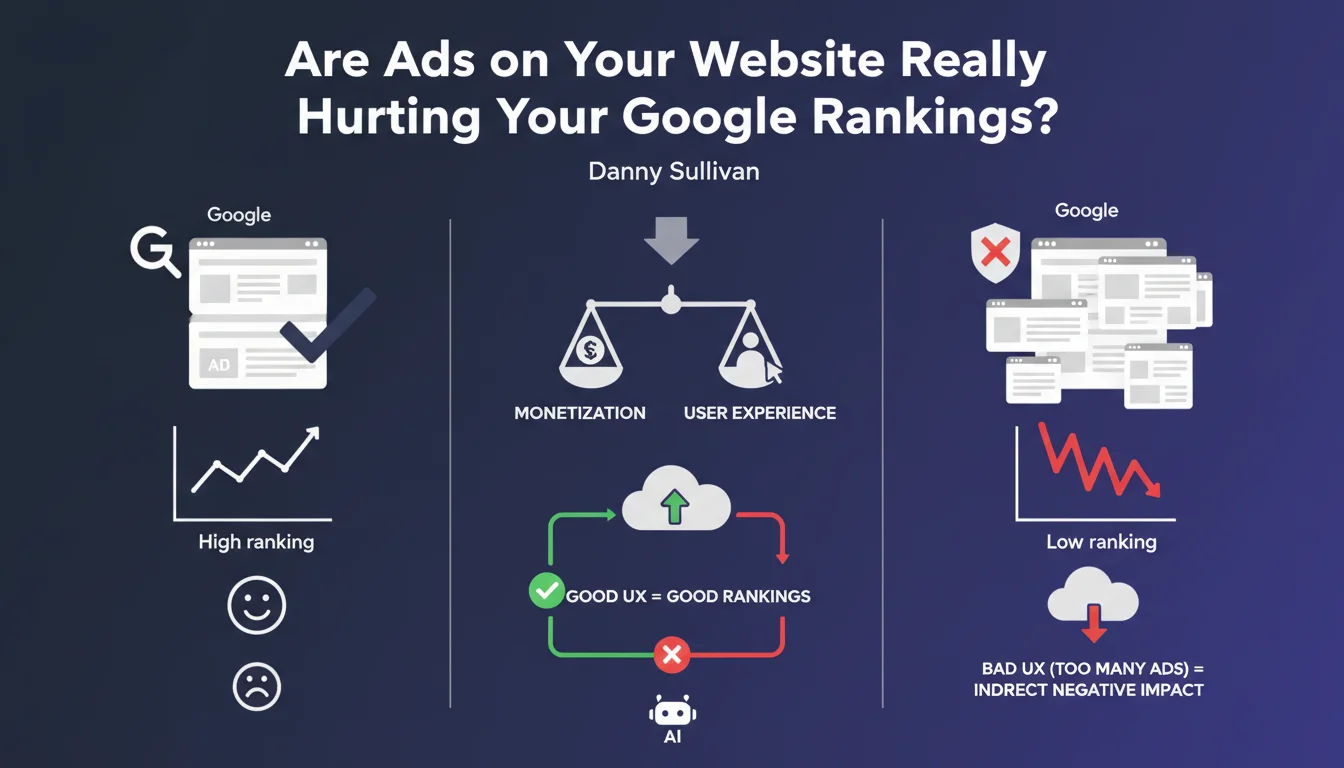
Google officially confirms that the presence of ads is not a direct ranking factor. No algorithm specifically penalizes a site simply because it displays advertisements.
Numerous monetized sites, whether large-scale or more modest, continue to perform excellently in search results. Monetization through advertising therefore remains a practice perfectly compatible with good organic search performance.
Why Is the Balance Between Advertising and User Experience So Crucial?
While advertising is not directly penalizing, its indirect impact on user experience can affect rankings. Excessive or intrusive ads degrade the behavioral metrics that Google monitors.
Core Web Vitals, bounce rates, and user engagement are directly influenced by the quality of the overall experience. A page overloaded with ads slows down loading and disrupts navigation, which impacts these indirect signals.
What Do Recent Google Updates Reveal About This Topic?
Recent Core Updates and Spam Updates have actually favored certain sites with well-integrated advertising. This confirms that smart monetization is not an obstacle to search rankings.
What truly matters is the quality of implementation: strategic ad placement, optimized loading times, and preservation of main content visible without major distractions.
- Advertising is not a direct ranking factor in Google's algorithm
- Indirect impact through user experience remains decisive
- Core Web Vitals and engagement metrics are the real indicators being monitored
- Well-monetized sites can perfectly rank at the top of results
- The balance between monetization and UX is the key to success
SEO Expert opinion
Is This Position from Google Consistent with What We Observe in Practice?
Absolutely. In my daily practice over the past 15 years, I observe that well-monetized sites often dominate their niches. Major media outlets, comparison sites, and successful affiliate sites all massively integrate advertising.
The crucial nuance lies in the professionalism of integration. Sites that suffer are generally those that completely sacrifice experience in favor of short-term revenue, with invasive interstitials, aggressive pop-ups, or aberrant ad densities.
What Are the Limitations and Gray Areas of This Statement?
Google deliberately remains vague on the exact definition of a "good balance." This ambiguity leaves room for interpretation and can create uncertainty for publishers.
Certain ad formats are almost systematically problematic: non-compliant full-page interstitials, ad redirects, autoplay videos with sound. These elements often violate official guidelines on mobile experience in particular.
In What Contexts Does This Advertising Tolerance Reach Its Limits?
Sites where main content is relegated "below the fold" due to massive ads at the top of the page regularly experience visibility losses. Google prioritizes immediately accessible content.
Pages with unbalanced ad-to-content ratios (more than 30% of visible space dedicated to ads) are also vulnerable. Page quality algorithms detect these configurations and may adjust rankings accordingly, even without manual action.
Practical impact and recommendations
How Can You Concretely Optimize Advertising on Your Site Without Risking Your SEO?
Start by measuring your Core Web Vitals with PageSpeed Insights under real conditions. Identify the specific impact of your ad scripts on LCP, CLS, and FID.
Prioritize lazy loading for ads located at the bottom of the page. Use fixed-size placeholders to avoid layout shifts (CLS). Implement asynchronous loading of AdTech scripts to avoid blocking rendering.
Test your site with and without advertising on tools like GTmetrix. If the performance difference exceeds 40-50%, your ad implementation requires a redesign.
What Critical Mistakes Should You Absolutely Avoid?
Never use intrusive interstitials on mobile that cover main content, except for legal exceptions (cookies, age verification). Google has explicitly penalized this practice since 2017.
Avoid excessive ad densities in the "above the fold" area. Main content must be immediately visible and accessible without excessive scrolling.
Never integrate ads that slow down initial loading time beyond 3 seconds. Mobile users massively abandon beyond this threshold, which degrades all your behavioral signals.
- Audit your Core Web Vitals specifically with ads enabled
- Keep main content visible without scrolling in the top 60% of the screen
- Limit the number of ads to 3-4 maximum per standard page
- Implement lazy loading for all non-critical ads
- Use fixed container sizes to avoid layout shift
- Regularly test mobile experience with 3G/4G connections
- Monitor your bounce rate and time on page after each ad modification
- Avoid intrusive formats (interstitials, aggressive pop-ups, autoplay video)
- Ensure your advertising partners comply with security standards
- Document before/after performance for each advertising strategy change
💬 Comments (0)
Be the first to comment.