
Official statement
What you need to understand
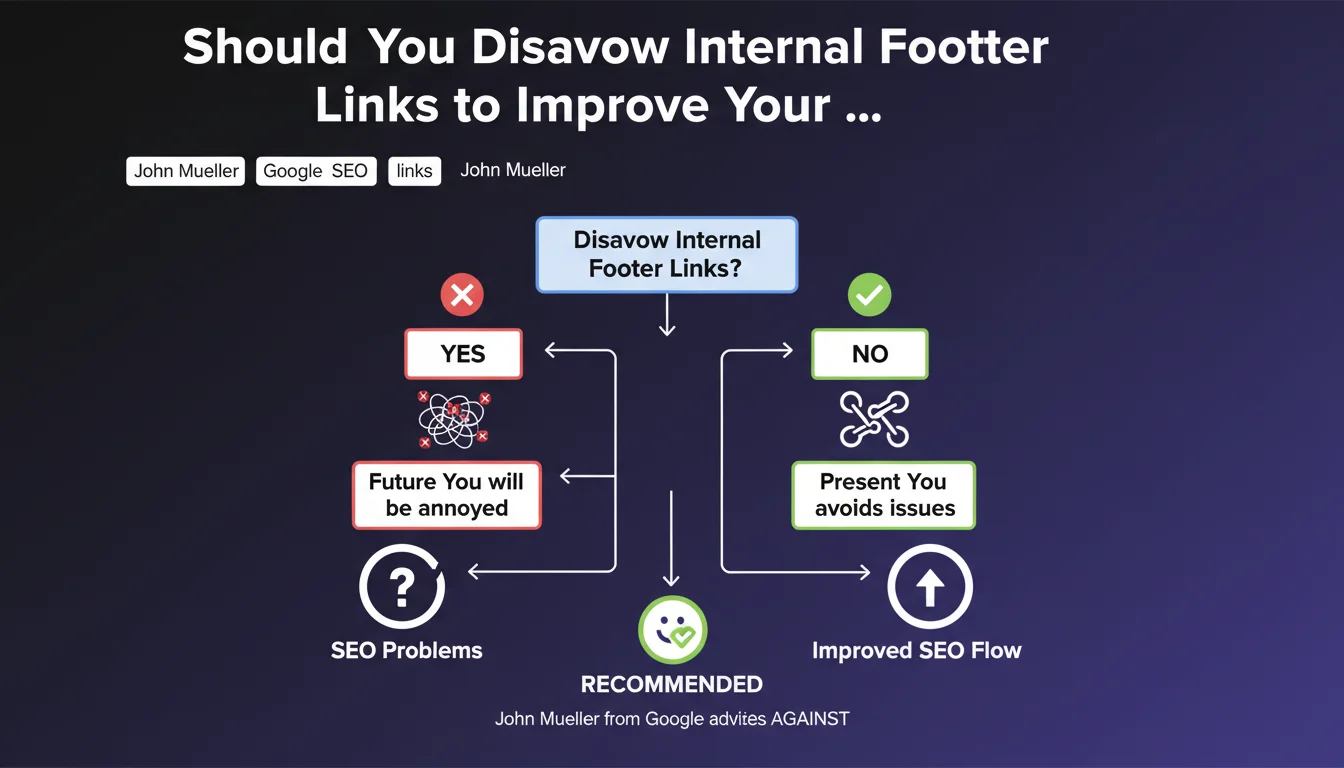
Why does Google advise against disavowing internal footer links?
The disavow links tool (Disavow Tool) was designed exclusively to neutralize toxic external links pointing to your site. Applying it to internal links, particularly those in the footer, goes against its intended purpose.
Google recommends never disavowing your own internal links because it disrupts the natural flow of PageRank through your architecture. The footer plays an important structural role in distributing SEO juice to your strategic pages.
What exactly is PageRank sculpting and why doesn't it work?
PageRank sculpting was a technique consisting of manipulating PageRank flow by adding nofollow attributes to certain internal links. The objective was to concentrate SEO juice on priority pages.
For several years now, Google has modified its algorithm to make this practice completely ineffective. The PageRank that should have flowed to a nofollow link is now simply lost, not redistributed to other links on the page.
What future problems can arise from disavowing internal links?
Disavowing internal links creates technical debt that complicates future management of your site. You risk forgetting these disavowals and ending up with a broken SEO architecture without understanding its origin.
Future structural modifications (redesign, migration, adding sections) can conflict with these disavowals, causing indexing and SEO performance issues that are difficult to diagnose.
- The disavow tool is reserved exclusively for toxic external backlinks
- Disavowing internal links disrupts the natural distribution of PageRank
- PageRank sculpting with nofollow has been obsolete and ineffective for years
- These practices create technical complications for future site evolutions
- Google considers these manipulations as a waste of time and counterproductive
SEO Expert opinion
Does this recommendation align with real-world observations?
Absolutely. After 15 years of SEO practice, I have never observed any measurable benefit from disavowing internal links or applying nofollow to footer links. On the contrary, these practices have systematically created unnecessary complications.
Sites with the best organic performance generally have a simple and natural architecture where all internal links are dofollow. A well-structured footer contributes positively to the overall internal linking without requiring any manipulation.
When might someone be tempted to manipulate footer links?
Some practitioners worry about having "too many links" in the footer, fearing PageRank dilution. This concern was justified before 2010, but modern algorithms handle this situation perfectly well.
Others want to avoid passing juice to "useless" pages like legal notices or terms and conditions. This is flawed reasoning: these pages are part of a site's normal ecosystem and Google expects to find them.
What are the real priorities for optimizing your footer for SEO?
Rather than manipulating link attributes, focus on the relevance and organization of the footer. Include only links to pages important for the user and your business strategy.
A high-performing footer typically contains 15 to 40 links maximum, organized into logical categories. It should facilitate navigation to service pages, main categories, and legal information without cluttering the space.
Practical impact and recommendations
What should you actually do with your footer links?
The recommendation is simple: leave all your internal links as dofollow, including those in the footer. Never touch the disavow tool for links you control on your own site.
Focus on structural optimization rather than technical manipulations. Your footer should serve the user first, and SEO will naturally follow with a coherent architecture.
What critical mistakes must you absolutely avoid?
Never use the disavow tool for your internal links, regardless of their position. This tool must remain reserved exclusively for external backlinks that you cannot remove by other means.
Also avoid applying nofollow to internal links in hopes of optimizing PageRank flow. This PageRank sculpting practice is not only ineffective but can create algorithmic inconsistencies.
Don't overload your footer with hundreds of links thinking it will improve internal linking. An overly dense footer harms the user experience and can be perceived negatively by Google.
How can you audit and correct your internal link configuration?
Start by checking your disavow file in Search Console to ensure it contains no internal URLs. If it does, immediately remove these entries and submit a new cleaned file.
Then audit your templates to identify all internal links marked as nofollow, particularly in the footer and navigation. Change them back to dofollow except for legitimate exceptions like login or signup links.
- Check the disavow file and remove any disavowed internal URLs
- Audit templates to identify internal links with nofollow
- Change all internal links back to dofollow by default
- Limit the footer to 15-40 links maximum, well organized
- Include only links useful for users and strategically important
- Organize footer links into logical and readable categories
- Test footer navigation on mobile for user experience
- Document footer architecture for future modifications
💬 Comments (0)
Be the first to comment.