
Official statement
What you need to understand
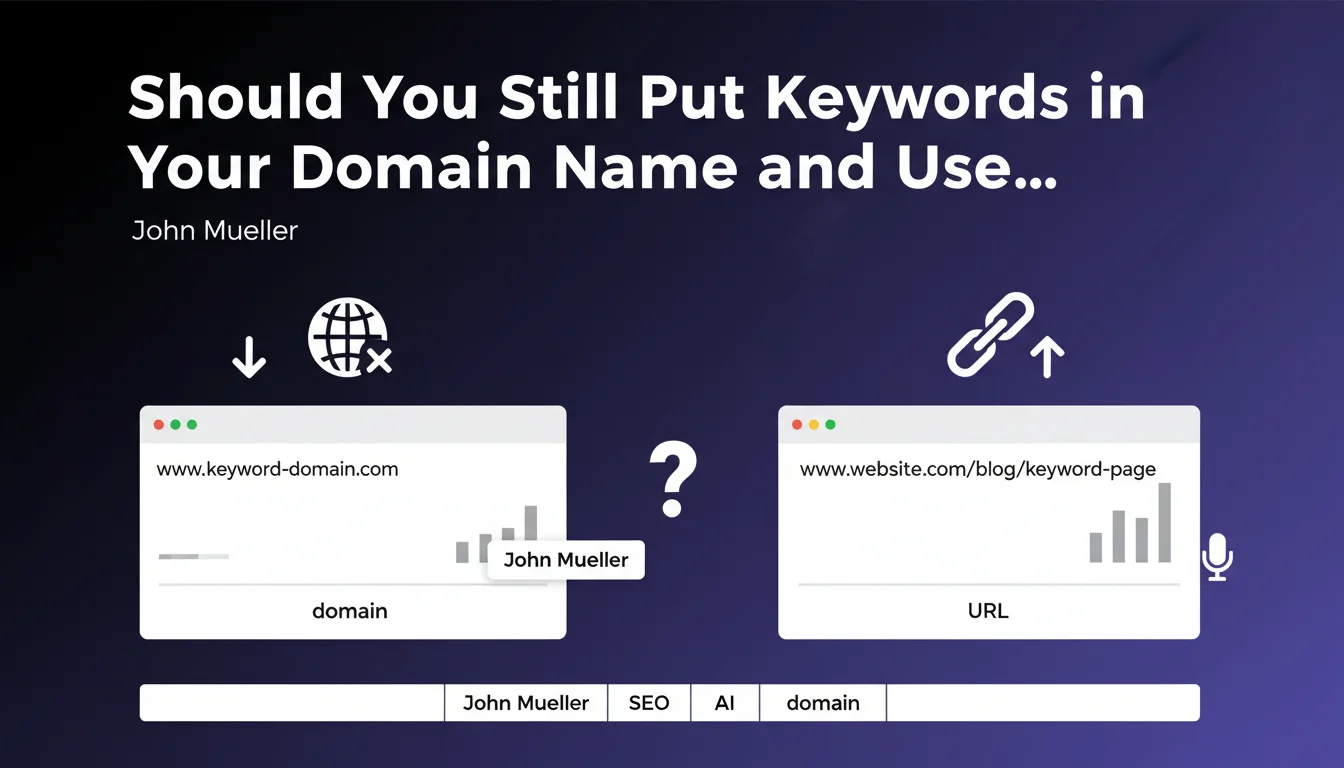
Google reiterates two fundamental principles regarding URL structure and domain names. These clarifications aim to correct sometimes over-optimized practices in the SEO community.
Regarding keyword-rich domain names (EMD - Exact Match Domain), John Mueller confirms that their impact on rankings is minimal. The era when owning "cheap-red-shoes.com" guaranteed good positioning has been over for several years.
On the technical side, Gary Illyes specifies that Google doesn't efficiently segment underscores (_) in URLs. The search engine interprets "seo_key_word" as a single block, whereas "seo-key-word" is correctly broken down into three distinct terms.
- Keywords in the domain carry only negligible SEO weight
- Hyphens (-) are the recommended separator for URLs
- Underscores (_) prevent proper segmentation of words by Google
- These principles apply to complete URLs, not just slugs
SEO Expert opinion
This statement confirms what we've been observing in the field since 2012, when Google deployed the EMD Update algorithm. Sites positioned solely thanks to their exact match domain name saw their visibility drop drastically.
In practice, a branded and memorable domain name offers far more long-term advantages than an EMD stuffed with keywords. Branding, brand signals, and user memorization generate direct searches and recurring traffic, factors much more valued today.
Regarding separators, the situation is more nuanced. While hyphens remain the universal standard, some CMS or frameworks impose underscores in certain structures. In these rare cases, the negative impact remains limited if the rest of the optimization is solid.
Practical impact and recommendations
- Favor a branded domain name rather than an EMD if you're launching a new project
- Don't buy a domain solely for its keywords, it doesn't justify the investment
- Systematically use hyphens as separators in your URLs and slugs
- Audit your existing URL structure to identify potential underscores
- Replace underscores with hyphens via 301 redirects if technically possible
- Properly configure your CMS (WordPress, Shopify, etc.) to generate URLs with hyphens by default
- Keep your URLs short and readable: maximum 3-5 words separated by hyphens
- Don't over-optimize by stuffing your URLs with keywords, naturalness comes first
In summary: Focus your efforts on building a strong brand rather than optimizing the domain name. Adopt hyphens as the standard for your URLs and progressively correct problematic existing structures.
These technical optimizations, while conceptually simple, often require a methodical approach and an overall vision of your SEO architecture. URL structure auditing, redirect management, and arbitration between technical constraints and best practices can prove complex depending on your site's size. Support from a specialized SEO agency allows you to secure these structural modifications without traffic loss and integrate these corrections into a comprehensive and coherent SEO strategy.
💬 Comments (0)
Be the first to comment.