
Official statement
What you need to understand
What Does Google Actually Say About Acceptable Speed Thresholds?
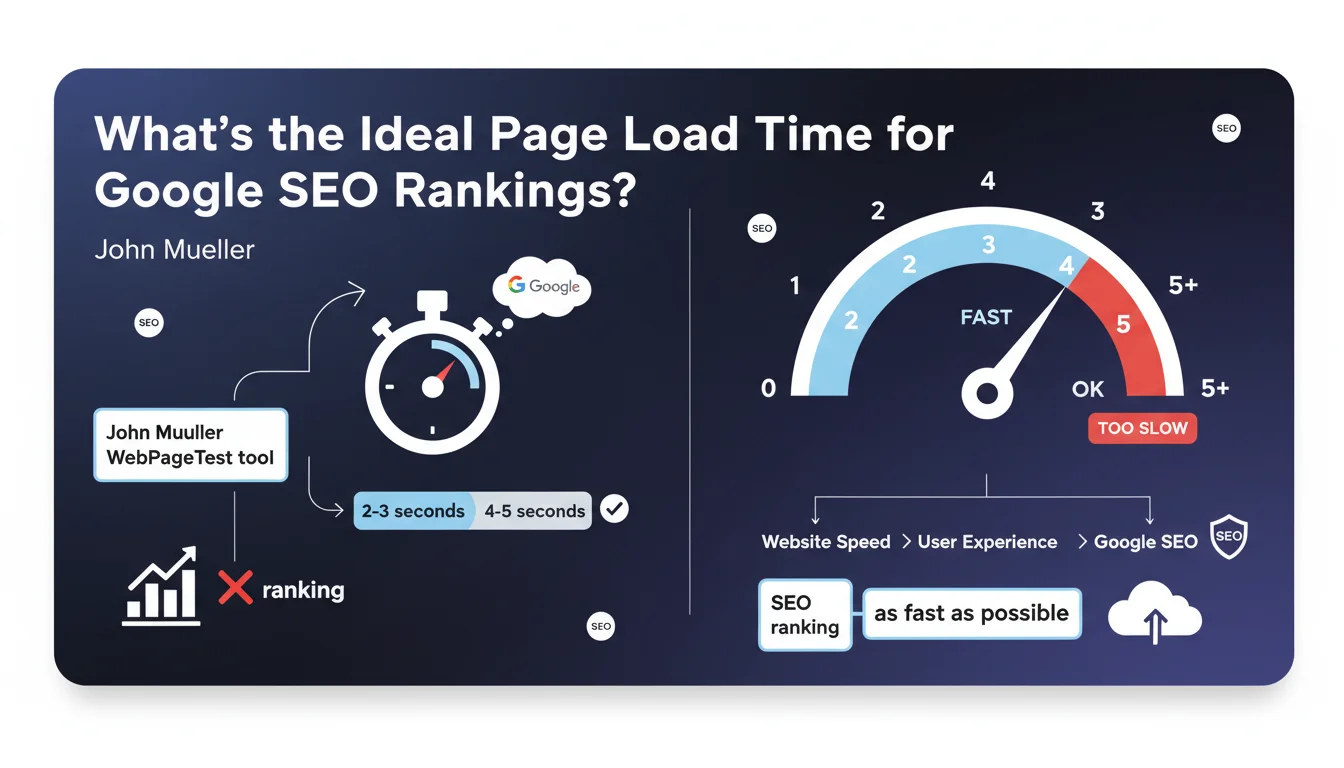
John Mueller from Google shared a specific recommendation regarding web page display speed. According to him, loading time should ideally remain below 2-3 seconds when measured with the WebPageTest tool.
However, he immediately qualifies this position by specifying that a loading time of up to 4-5 seconds shouldn't overly concern website owners. More importantly, he states that this criterion won't directly influence rankings in Google search results.
Why This Apparent Contradiction Between Recommended Speed and SEO Impact?
The distinction is fundamental: Google clearly differentiates between the optimal performance recommended for user experience and what constitutes a penalty factor in the ranking algorithm.
Loading speed primarily affects user experience, which can indirectly influence behavioral metrics like bounce rate or time spent on site. These signals can then impact SEO, but indirectly.
How Does Display Time Differ from Core Web Vitals?
It's crucial not to confuse the overall loading time Mueller discusses with Core Web Vitals, which have been official ranking factors since 2021.
Core Web Vitals measure specific aspects: LCP (Largest Contentful Paint), FID (First Input Delay), and CLS (Cumulative Layout Shift). These metrics evaluate perceived performance rather than total loading time.
- A loading time of 2-3 seconds is ideal for optimal user experience
- Up to 4-5 seconds remains acceptable without direct negative impact on ranking
- Speed influences indirectly via user behavior, not directly through the ranking algorithm
- Core Web Vitals are official ranking factors distinct from overall loading time
- WebPageTest is recommended by Google to measure actual speed
SEO Expert opinion
Is This Statement Consistent with Real-World Observations?
Mueller's position indeed reflects what we observe across thousands of website analyses. Sites with loading times of 4-5 seconds can perfectly rank on the first page if their content, backlinks, and authority are solid.
However, the reality is more nuanced. While raw speed isn't a major direct ranking factor, it considerably influences engagement metrics. A slow site generates more bounces, fewer pages per session, and these behavioral signals do indeed affect SEO.
What Essential Nuances Should Be Added to This Recommendation?
Google's tolerance for loading times up to 4-5 seconds doesn't apply uniformly across all contexts. On mobile, where users are less patient and connections sometimes unstable, a site exceeding 3 seconds significantly loses conversions.
Additionally, industry sector changes the equation. For an e-commerce site, each additional second can reduce conversion rate by 7% according to studies. For an informational blog, the impact is less critical but still measurable.
Competitive landscape also plays a determining role. If your direct competitors all display loading times under 2 seconds, a 4-5 second site will be disadvantaged by comparative user signals, even if Google doesn't directly penalize it.
When Is the 4-5 Second Rule Not Sufficient?
For sites targeting high-value transactional queries, this tolerance is insufficient. Users looking to buy, book, or register massively abandon beyond 2 seconds of loading time.
Sites in international competition or ultra-competitive niches must also aim for excellence. When 50 sites compete for the same keywords with similar content, micro-differences in user experience become decisive.
Finally, for any site dependent on mobile traffic (over 60% of global web traffic), 4-5 seconds is already too slow. Mobile standards demand significantly superior performance to maintain engagement.
Practical impact and recommendations
How Should You Properly Measure Your Site's Speed?
Google explicitly recommends WebPageTest, which offers detailed analysis with different connection conditions and geographical locations. This tool simulates real usage conditions far better than synthetic tests.
Complement this analysis with Google PageSpeed Insights to obtain Core Web Vitals scores directly from real browsing data (Field Data). Search Console also provides a dedicated Core Web Vitals report showing problematic URLs.
Always test from multiple geographical locations and connection types (3G, 4G, fiber). A site that's fast in France may be slow for your international visitors depending on your server location.
Which Actions Should You Prioritize to Optimize Loading Speed?
Start with image optimization, responsible for 50 to 70% of web page weight. Compression, modern formats (WebP, AVIF), lazy loading, and appropriate dimensions are essential.
Implement a high-performance caching system both at server and browser level. A CDN (Content Delivery Network) distributes your content from servers geographically close to your visitors.
Minimize and defer non-critical JavaScript. Render-blocking JavaScript is the main cause of poor LCP and FID scores. Load visible content first, then secondary features.
- Measure regularly with WebPageTest and PageSpeed Insights
- Target under 2.5 seconds for LCP (Largest Contentful Paint)
- Optimize all images with compression and modern formats
- Implement an effective multi-level caching system
- Use a CDN for geographical content distribution
- Minify and defer non-critical JavaScript loading
- Monitor Core Web Vitals in Search Console monthly
- Test on mobile with 3G/4G connection in real conditions
- Prioritize strategic pages (home, categories, flagship products)
- Eliminate render-blocking resources in the critical rendering path
What Should You Do If Your Site Exceeds Recommended Thresholds?
Establish a comprehensive technical audit precisely identifying bottlenecks: server, database, code, media, third-party scripts. Each site has its specific problem profile requiring personalized diagnosis.
Prioritize fixes according to their impact versus effort. Some optimizations deliver 80% improvement with 20% effort, while others require major technical overhauls for marginal gains.
💬 Comments (0)
Be the first to comment.