
Official statement
What you need to understand
Does Google Define a Precise Speed Threshold for SEO?
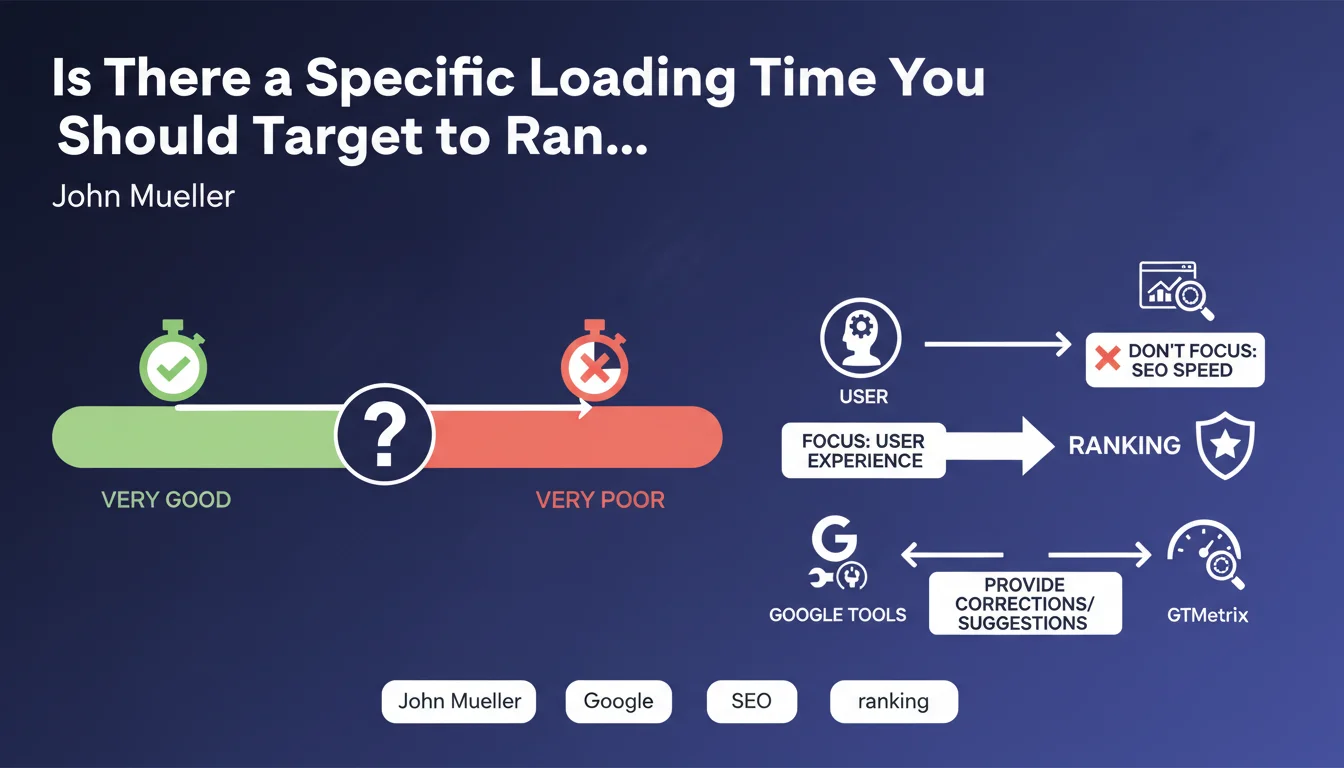
The answer is no. John Mueller and Martin Splitt confirm that there is no "ideal loading time" to achieve to optimize your ranking. Google does not work with precise values in milliseconds.
The algorithm works rather by qualitative categories: a page is considered "very fast," "acceptable," or "very slow." Moving from one level to another matters, but trying to gain a few extra milliseconds will not bring any measurable SEO benefit.
What Is the Real Purpose of Performance Measurement Tools?
Tools like PageSpeed Insights, Lighthouse, or GTMetrix should not be considered as SEO graders. Their main role is to provide a technical diagnosis to identify areas for improvement.
These tools detect concrete technical issues: unoptimized images, render-blocking JavaScript, lack of caching. They guide corrections, but the score itself is not a direct ranking factor.
Why Should User Experience Take Priority Over SEO Metrics?
Google emphasizes a fundamental principle: optimize for the user rather than for the search engine. A page that loads quickly from the perspective of the actual user is more important than a perfect score in a tool.
Real browsing conditions vary enormously depending on devices, connections, and usage contexts. An effective performance strategy must therefore prioritize perceived experience and interaction fluidity.
- No magic threshold: Google works by qualitative levels, not by milliseconds
- Diagnostic tools: use them to identify problems, not to aim for a perfect score
- Limited SEO impact: speed influences ranking in a marginal way
- User priority: real experience matters more than technical metrics
- Overall performance: speed mainly facilitates crawling and improves engagement
SEO Expert opinion
Is This Statement Consistent with Field Observations?
Absolutely. My 15 years of experience confirm that the direct impact of speed on rankings is marginal. I've seen sites with mediocre PageSpeed scores dominate their SERPs thanks to exceptional content and strong authority.
On the other hand, performance plays an indirect but real role: it influences bounce rate, time on site, and especially Google's ability to crawl your pages effectively. A slow site with a limited crawl budget will have fewer pages indexed.
The important nuance: e-commerce sites and pages generating direct revenue see a significant business impact from every millisecond gained, even though the pure SEO effect remains modest.
When Does Speed Become Truly Critical for SEO?
Three situations make performance crucial. First, very large sites (thousands of pages) where slowdown prevents Google from crawling all the content during its session.
Second, mobile-first indexing amplifies the importance of mobile speed. A catastrophic page on smartphone can be penalized, particularly through Core Web Vitals which became an official signal since 2021.
Third, in ultra-competitive sectors where all other factors are equal between competitors, speed can serve as a tiebreaker.
What Performance Strategy Should You Adopt in 2024?
The pragmatic approach is to aim for the "good" level without seeking perfection. Focus on high-impact optimizations: image compression, effective caching, reducing render-blocking JavaScript.
Pay particular attention to Core Web Vitals (LCP, FID, CLS) as these are the only performance metrics explicitly confirmed as ranking signals. But even there, their weight remains low compared to content and backlinks.
The real value of web performance lies in improving conversions and engagement. It's this virtuous circle (better UX → better behavioral signals → better indirect SEO) that makes the difference, not the technical score itself.
Practical impact and recommendations
What Should You Concretely Optimize as a Priority?
Focus your efforts on optimizations with direct user impact. Start by compressing and lazy-loading your images, which often represent 60 to 70% of page weight. Use modern formats like WebP.
Implement an effective caching system server-side and browser-side. Minify your CSS and JavaScript, and defer loading of non-critical scripts. These actions genuinely improve experience without requiring a complete overhaul.
Monitor your Core Web Vitals in Search Console. If URLs are flagged in red, prioritize their correction. But don't try to get green everywhere: orange is generally sufficient from an SEO perspective.
What Mistakes Should You Absolutely Avoid?
Error number one: sacrificing functionality for performance. Don't remove useful elements (chatbots, recommendations, videos) solely to improve a PageSpeed score.
Second trap: obsession with the perfect score. Going from 85 to 95 on PageSpeed often requires disproportionate investment for zero SEO gain. Aim rather for 70-80, that's largely sufficient.
Third mistake: neglecting real-world conditions monitoring. Lab testing tools don't always reflect your actual users' experience. Use RUM (Real User Monitoring) data from Search Console.
How Do You Implement a Balanced Performance Strategy?
Adopt a progressive approach rather than a total overhaul. First identify your strategic pages (landing pages, best-selling product pages, pillar articles) and optimize them as a priority.
Establish realistic benchmarks: compare yourself to your direct competitors rather than a theoretical ideal. If your sector averages 3 seconds loading time, aiming for 2 seconds gives you a competitive advantage.
- Conduct a performance audit with PageSpeed Insights and GTMetrix on your key pages
- Identify the 3-4 highest impact optimizations (typically images, cache, scripts)
- Implement these corrections on a sample of strategic pages
- Measure the impact on business metrics (bounce rate, conversions) and Core Web Vitals
- Gradually extend validated optimizations to the rest of the site
- Monitor Core Web Vitals reports monthly in Search Console
- Maintain a balance between technical performance and functional richness
Loading speed has no ideal threshold for Google. The algorithm works by qualitative levels, and the direct impact on ranking remains very limited. The real benefits lie in user experience, crawl budget, and conversions.
Aim for the "good" level without obsessing over the perfect score. Prioritize optimizations with real user impact: image compression, cache, deferred scripts. Monitor your Core Web Vitals but never sacrifice functionality for performance.
Implementing a balanced performance strategy requires sharp technical expertise and a fine understanding of trade-offs between optimization and functionality. Each site presents architectural specificities that require a personalized approach. For complex projects or sites with high business stakes, support from a specialized SEO agency helps avoid costly mistakes and maximize return on investment from performance optimizations.
💬 Comments (0)
Be the first to comment.