
Official statement
What you need to understand
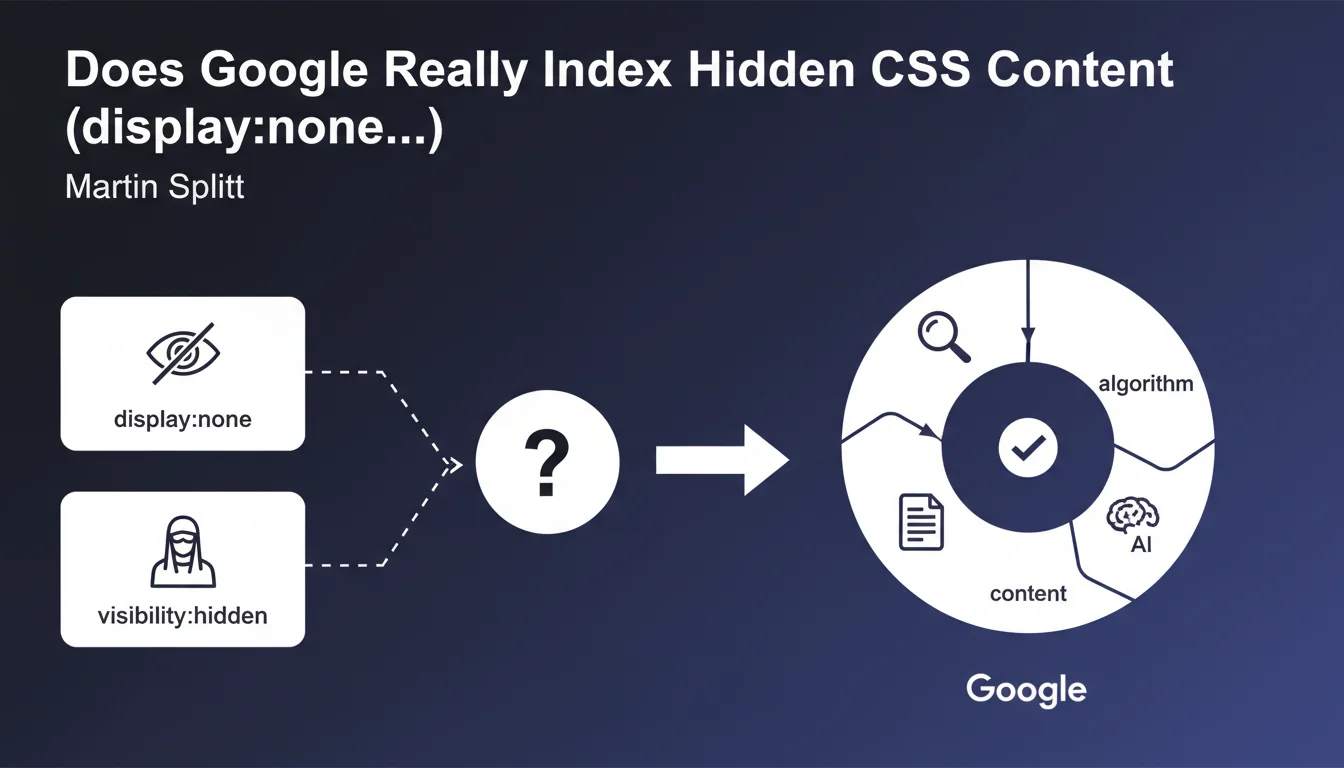
This official statement sheds light on a recurring question in SEO: how Google treats content hidden by CSS properties. Martin Splitt confirms that Google reads and analyzes hidden text via display:none or visibility:hidden, and may even display it in search results.
Concretely, this means that tabs, accordions, dropdown menus, and click-to-reveal content are indeed indexed by Google. The search engine does not systematically penalize this type of implementation, contrary to a persistent misconception in the SEO community.
The crucial information here is that display:none and visibility:hidden are treated identically by the algorithm. Therefore, there is no CSS technique that is "better" than the other for hiding content from an SEO perspective.
- CSS-hidden content is indexed by Googlebot
- Both properties (display:none and visibility:hidden) have the same SEO impact
- This technique is particularly relevant for modern and mobile interfaces
- Content may appear in search results if Google deems it relevant
- No automatic penalty is applied to this type of implementation
SEO Expert opinion
This statement is consistent with real-world observations from recent years. Websites using accordions or tabs to structure their content generally do not experience visibility loss, provided the implementation is clean and the content remains relevant.
However, an important nuance must be added: Google evaluates the context of use. If hidden content serves to improve user experience (mobile navigation, structured FAQ), it will be treated normally. On the other hand, if the intention is to manipulate rankings by hiding text stuffed with irrelevant keywords, Google may consider this as cloaking or deceptive content.
In practice, we observe that Google may give slightly less weight to hidden content compared to immediately visible content, which makes sense from a UX perspective. Content "above the fold" and directly visible retains paramount importance.
Practical impact and recommendations
- Use accordions and tabs to structure long content, particularly on mobile
- Ensure hidden content is relevant and consistent with the main visible content
- Avoid hiding text stuffed with keywords that provides no added value to the actual user
- Use either display:none or visibility:hidden interchangeably based on your technical needs, without SEO considerations
- Optimize mobile experience by intelligently hiding less priority sections
- Don't place strategic content exclusively in hidden areas: visible content remains priority
- Test rendering with Google Search Console to verify content is accessible to Googlebot
- Document your hidden content strategy to justify implementation choices
These optimizations, although clarified by Google, require thorough analysis of your architecture and careful technical implementation. The balance between visible and hidden content, accordion structure, and actual impact on your performance demand sharp expertise. For a tailored strategy perfectly aligned with your business objectives and Google's requirements, guidance from a specialized SEO agency can prove invaluable to maximize your results without risk of misinterpretation.
💬 Comments (0)
Be the first to comment.