
Official statement
What you need to understand
What does "cultivating a difference" really mean in SEO?
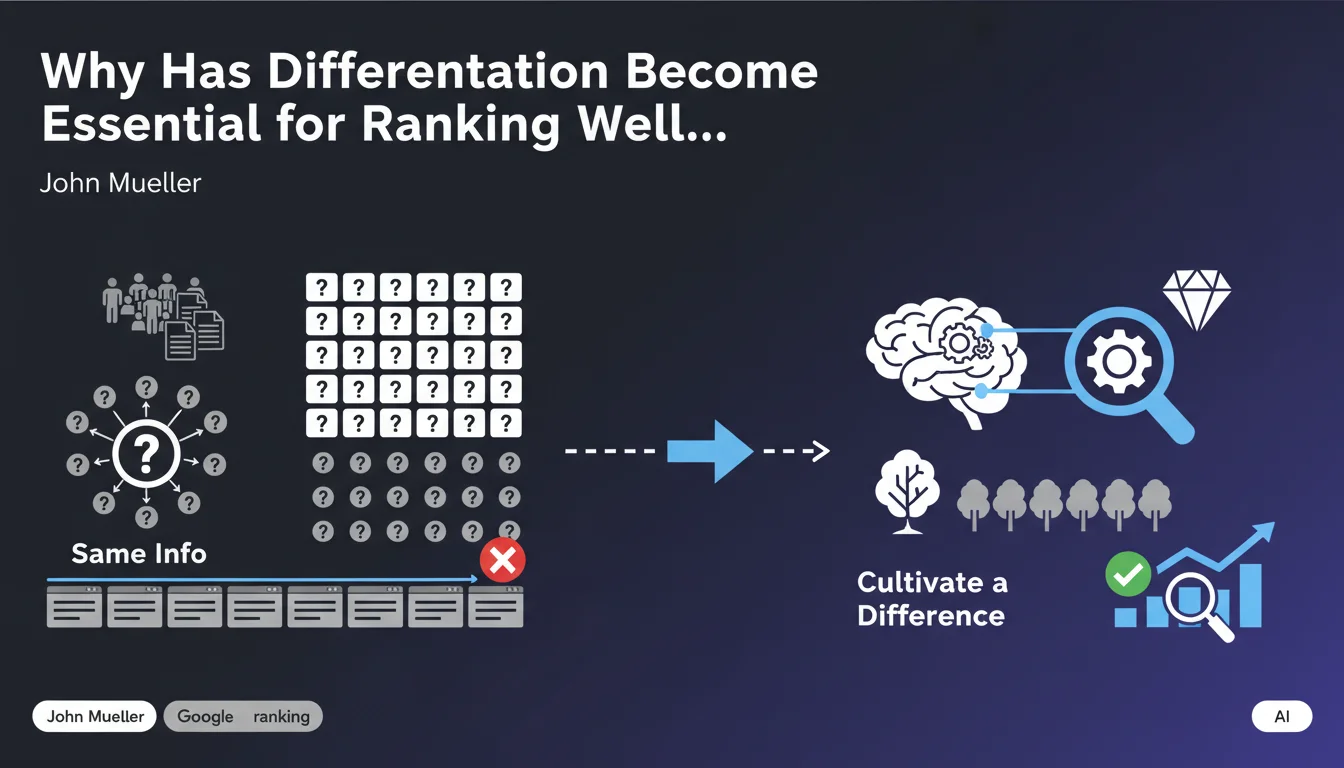
John Mueller clearly expressed that reproducing the same content as dozens of other websites makes ranking on Google extremely difficult. This statement aligns with the logic of Google's relevance algorithms that seek to offer users the best possible answer.
In the case mentioned (a phone ringtone site), the problem was obvious: hundreds of sites offered exactly the same audio files with the same descriptions. Google had no objective reason to favor one site over another.
Why does Google penalize identical or similar content?
Google doesn't seek to "penalize" in the strict sense, but rather to intelligently prioritize results. If ten sites offer strictly the same information, the algorithm will naturally favor the one that presents superior quality signals: domain authority, user experience, content freshness.
Arriving last in a saturated market means you must compensate for this temporal disadvantage with significant added value. Without differentiation, your content is perceived as redundant and therefore not very useful to the user.
What are the key takeaways from this statement?
- Similarity is a major handicap: reproducing what already exists drastically limits your ranking chances
- Seniority matters: sites established for a long time have a natural advantage if the content is identical
- Added value is mandatory: you must bring something that others don't offer
- Differentiation can take multiple forms: format, depth, editorial angle, user experience
- This applies to all sectors: not just ringtones, but also news, e-commerce, services
SEO Expert opinion
Is this statement consistent with practices observed in the field?
Absolutely. After 15 years of experience, I observe daily that sites that succeed in breaking through in competitive niches are those that bring a unique perspective. This observation applies to all sectors, from e-commerce to informational content.
Google's algorithms, particularly Helpful Content Update, have further reinforced this trend. Sites that merely rephrase what exists elsewhere see their traffic stagnate or decline. Conversely, those who invest in originality gain positions even against established competitors.
What nuances should be added to this recommendation?
Differentiation doesn't necessarily mean revolutionizing your sector. Sometimes, small touches are enough: concrete examples where competitors remain theoretical, updated data, a more accessible format, or simply better structuring.
It's also important to understand that certain types of content have limited room for maneuver. For a technical definition or standardized product sheet, differentiation then comes through adjacent elements: explanatory videos, detailed reviews, integrated comparisons, interactive tools.
In which cases does this rule apply most acutely?
The most impacted sectors are those where content is easily duplicable: news aggregators, download sites, generic comparison sites, general information blogs. The more saturated your niche, the higher the differentiation requirement.
Conversely, in very specialized niche markets, simply creating relevant content may suffice if competition is virtually non-existent. But these situations are becoming increasingly rare with the maturity of the web.
Practical impact and recommendations
How can you concretely create this differentiation on your site?
The first step is to thoroughly analyze what your competitors ranked in the top 10 offer. Identify recurring patterns, angles covered, formats used. This mapping reveals differentiation opportunities.
Then, develop your unique value proposition: exclusive data, field expertise, real testimonials, detailed case studies, original infographics, interactive calculators. The goal is for the user to find something on your site they won't find elsewhere.
For an e-commerce site, this might mean rewritten product descriptions with your expertise, personalized buying guides, unboxing videos, or detailed comparisons. For a blog, favor experience feedback, data from your own tests, or unprecedented editorial angles.
What mistakes should you absolutely avoid?
The most common mistake is believing that simple rephrasing is enough. Rewriting in your own words what ten competitors have already said doesn't constitute differentiation in Google's eyes. The algorithm detects semantic similarity beyond variations in wording.
Another pitfall: investing heavily in quantity at the expense of quality. Publishing 100 average articles that resemble existing content will always be less effective than 10 truly differentiating and in-depth pieces.
How can you verify that your differentiation is sufficient?
Perform this simple test: display your content side by side with that of your three main competitors. If a user or colleague cannot immediately identify what makes your version superior or different, your differentiation is insufficient.
Use semantic analysis tools to compare your content with that of the top 10. Measure your similarity rate and identify concepts, data, or angles that only you cover. Aim for at least 30% truly unique content.
- Audit the top 10 results for each of your target queries
- Identify angles, formats, and information absent from the competition
- Develop exclusive expertise or data in your field
- Create varied formats (text, video, infographics, interactive tools)
- Integrate concrete examples, case studies, and real experience feedback
- Completely rewrite all generic or duplicated content on your site
- Test the perception of your differentiation with real users
- Measure the evolution of your ranking on your strategic keywords
- Regularly update your content with new exclusive data
💬 Comments (0)
Be the first to comment.