
Official statement
What you need to understand
When Does Google Decide Not to Display Your Meta Description?
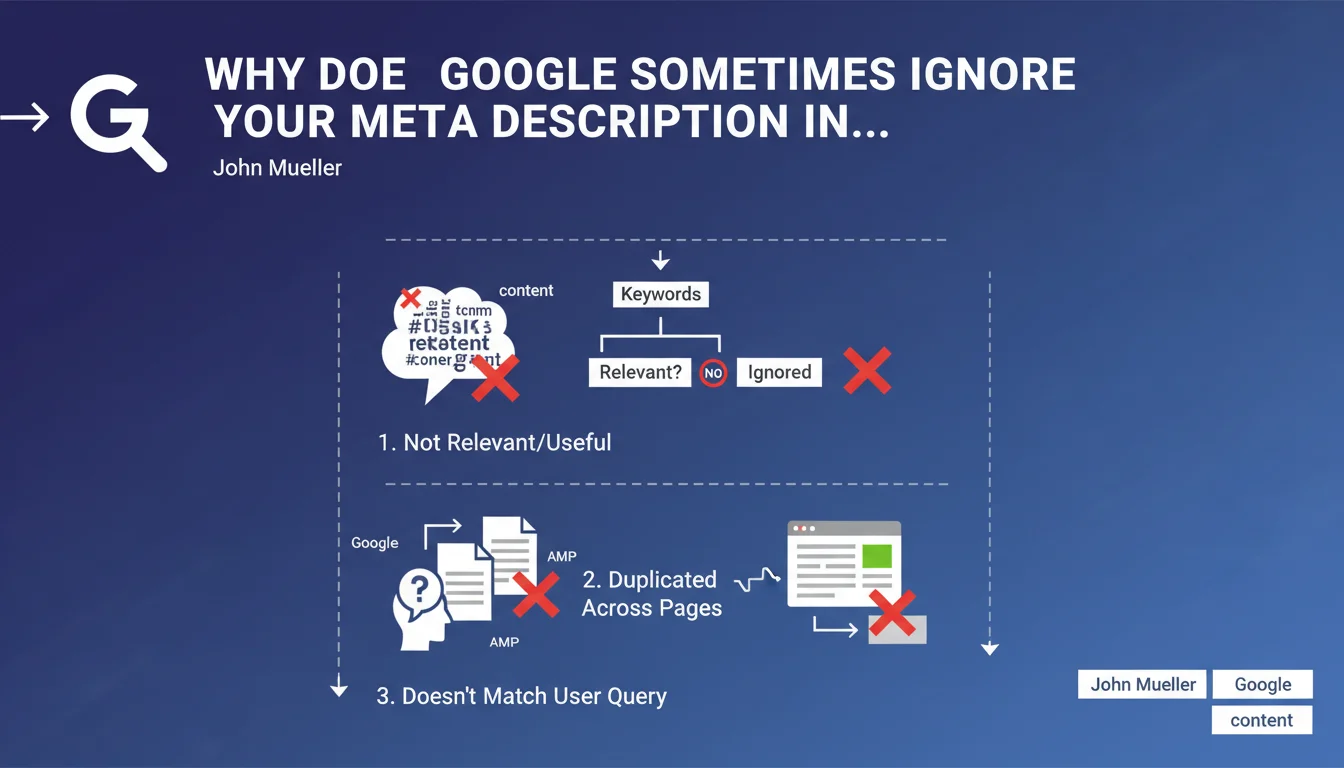
Google may choose to replace your meta description with another content excerpt in search results for three main reasons. First, if your description is stuffed with keywords without forming coherent and useful text for the user.
Second, when the same meta description is duplicated across multiple pages of your site. Third, and this is the most frequent case, when your description does not contain the terms searched by the user, but other passages of your page match their query better.
Does Meta Description Actually Influence Ranking in Google?
No, meta description is not a ranking factor. It does not help you rank better in search results.
Its role is solely to entice the user to click on your result rather than on a competitor's. It is a conversion element, not a ranking element strictly speaking.
Why Should You Still Include Your Target Keywords in It?
Including your priority keywords in the meta description increases the chances that Google will actually display it. When searched terms appear in your description, Google displays them in bold in the snippet.
This catches the user's eye and reinforces the perceived relevance of your page relative to their search. Even though it doesn't boost your position, it can significantly improve your click-through rate.
- Google replaces your meta description if it's not relevant, duplicated, or unrelated to the query
- Meta description doesn't impact SEO ranking but influences click-through rate
- Including target keywords increases the chances of your custom description being displayed
- Search terms appear in bold in the snippet, attracting attention
SEO Expert opinion
Does This Statement Match What We Actually Observe in Practice?
Absolutely. After 15 years of SEO practice, I see daily that Google massively rewrites meta descriptions. Studies show that in 60 to 70% of cases, Google generates its own snippet rather than using the one you defined.
The main reason indeed remains the absence of search terms in the proposed description. Google systematically prioritizes content excerpts that match the user's specific search intent, even if your meta description is well written.
What Important Nuances Should Be Added to This Statement?
First crucial point: even if Google rewrites your description, this doesn't mean you should neglect this tag. For the main queries you explicitly target, a well-optimized description will generally be displayed.
Second nuance: length matters enormously. Google truncates descriptions that are too long (generally beyond 155-160 characters). A description that's too short leaves space that Google will fill with other excerpts.
In What Cases Does This Logic Not Apply the Same Way?
For brand searches or navigational queries, Google generally displays your meta description as is. The user is explicitly looking for your site, so your description is presumed relevant.
Featured Snippets and rich results also follow different rules. Google may extract specific portions of structured content, completely ignoring the meta description. On mobile, descriptions are often shorter and Google rewrites them even more frequently to adapt to the reduced screen.
Practical impact and recommendations
What Should You Actually Do to Optimize Your Meta Descriptions?
Write unique descriptions for each strategic page of your site. Focus first on your priority pages: flagship product pages, main blog articles, important category pages.
Naturally integrate 1 to 2 main keywords that you're targeting for that specific page. Formulate a clear value proposition in 150-155 characters maximum. Include a subtle call-to-action when relevant.
For large-scale sites with thousands of pages, create dynamic templates that generate personalized descriptions based on each page's attributes. Absolutely avoid identical generic descriptions.
What Critical Mistakes Must You Absolutely Avoid?
Never duplicate the same meta description across multiple pages. Google will consider it non-relevant and will systematically replace it. Regularly check for duplications with tools like Screaming Frog or Google Search Console.
Don't write descriptions that are too technical or stuffed with jargon. Think about the end user, not robots. Avoid lists of keywords separated by commas: this is exactly what Google qualifies as "not useful".
Don't exceed 160 characters, otherwise your message will be truncated with ellipses. Never leave important pages without a meta description: Google will generate a random one, often not very engaging.
How Can You Check and Improve Your Existing Meta Descriptions?
Use Google Search Console to identify pages with duplicated or missing descriptions. Check the "Coverage" report then analyze the suggested HTML improvements.
Compare your descriptions with what Google actually displays in the SERPs. If Google systematically rewrites your descriptions, analyze the excerpts it chooses to understand what it considers more relevant.
Test different formulations and measure the impact on your click-through rate. A variation of a few words can make the difference. Monitor your CTR in Search Console by page and by query.
- Write unique meta descriptions of 150-155 characters for all strategic pages
- Naturally integrate 1-2 main keywords targeted by the page
- Create dynamic templates for large-scale sites
- Check for duplications with Screaming Frog or Search Console
- Avoid keyword stuffing and unnatural formulations
- Regularly compare your descriptions with what Google actually displays
- Analyze click-through rates in Search Console to identify performing descriptions
- Update descriptions on pages with low CTR
💬 Comments (0)
Be the first to comment.