
Official statement
Other statements from this video 17 ▾
- 1:02 Pourquoi intégrer Page Experience dans votre stratégie SEO desktop ?
- 2:08 Comment le rapport Page Experience pour desktop influence-t-il le SEO ?
- 4:03 Comment les clics sur 'Autres questions posées' influencent-ils vos stats SEO?
- 7:54 Faut-il s'inquiéter des variations d'URL pour le référencement ?
- 18:45 Pourquoi les rapports de couverture de Search Console sont-ils parfois à la traîne ?
- 20:08 Faut-il obligatoirement mentionner les sources externes pour AggregateRating ?
- 25:45 Pourquoi la relation entre sites d'un même groupe ne garantit-elle pas les avis SEO ?
- 27:47 Comment Google utilise-t-il réellement vos rapports de spam ?
- 32:29 Comment Google utilise-t-il réellement les Spam Reports pour améliorer ses algorithmes ?
- 35:52 Pourquoi privilégier robots.txt pour bloquer le crawl ?
- 39:18 Pourquoi miser sur le canonical plutôt que de bloquer le crawl ?
- 42:07 Pourquoi privilégier le DMCA pour le contenu copié plutôt que Search Console ?
- 44:00 Pourquoi les demandes DMCA pourraient-elles impacter votre strategie SEO ?
- 46:06 Pourquoi Google limite-t-il les demandes DMCA à 1000 URLs ?
- 48:41 Pourquoi optimisons-nous encore pour Google au lieu des lecteurs ?
- 54:27 Les campagnes de commentaires clients sont-elles devenues un piège à pénalité Google ?
- 56:02 Pourquoi l'attribut UGC est-il crucial pour vos liens de commentaires de blog ?
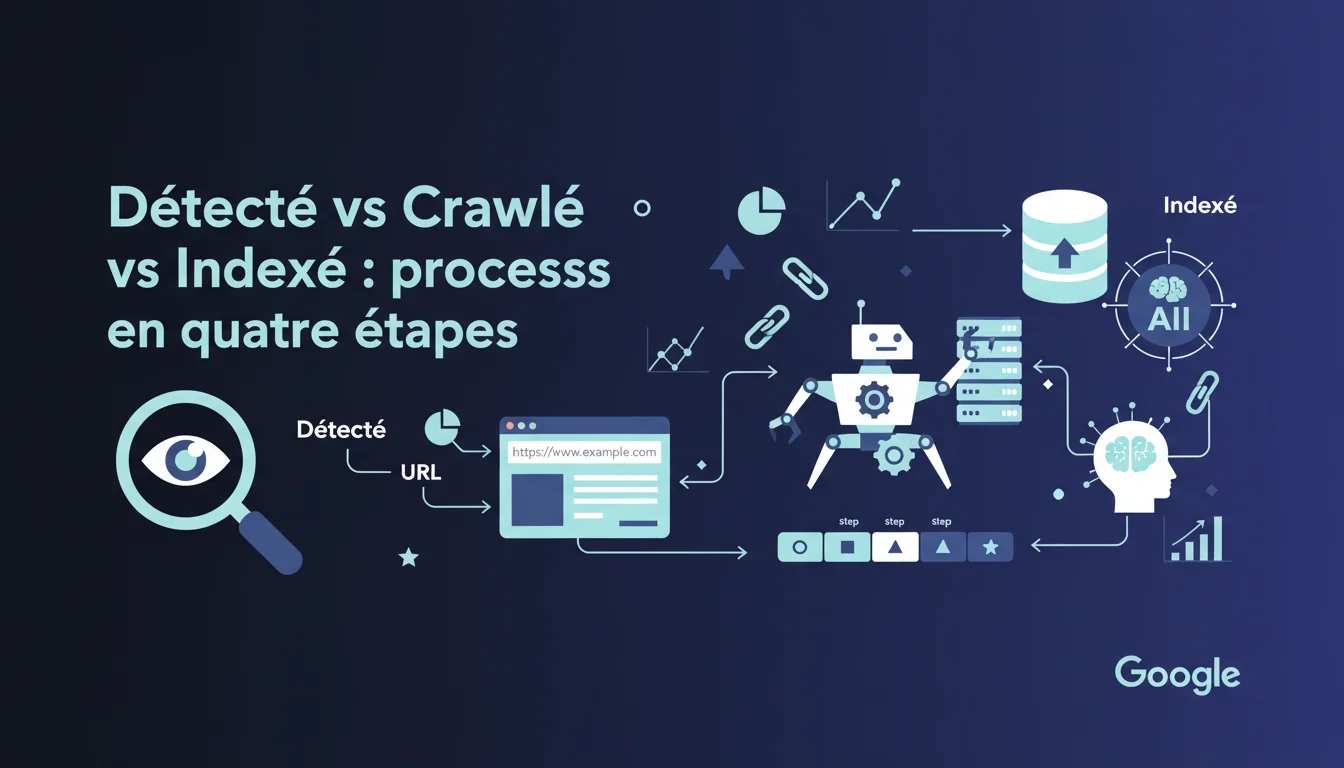
Indexing in four steps: discovery, crawl, indexing, display. 'Detected - not indexed' and 'Crawled - not indexed' illustrate critical phases where the URL is not progressing in the process. Mastering these steps is crucial for any SEO.
What you need to understand
What’s the difference between detected and crawled? <\/h3>
'Detected' means that the URL is identified by Google but not yet explored. 'Crawled' indicates that the content of the URL has been retrieved.<\/p>
- Detection: The first steps of the URL towards visibility.<\/li>
- Crawl: Retrieval of content, essential to move towards indexing.<\/li><\/ul>
Why do some URLs fail to be indexed? <\/h3>
Several reasons can explain this: low-quality content, technical errors, or restrictions in the robots.txt file. Identifying the problem is key.<\/p>
Reminder: Not all crawled content is automatically indexed.<\/p>
- Check for errors via Google Search Console.<\/li>
- Ensure that the content deserves indexing.<\/li><\/ul>
SEO Expert opinion
Is the statement realistic considering the practices observed? <\/h3>
Often, the gap between theory and practice reveals itself. Many professionals report that some URLs remain stuck in 'crawled - not indexed' without any obvious explanation. [To be verified]<\/strong><\/p> Not always. While the general order of operations is clear, the ground reality shows nuances. Sometimes, excellent content stagnates.<\/p>Is Google transparent about these steps? <\/h3>
Practical impact and recommendations
What concrete actions can I take to improve indexing? <\/h3>
Optimize pre-crawl steps. Ensure that URLs are easily accessible and that robots.txt files do not block crawling.<\/p>
- Regularly review XML sitemaps.<\/li>
- Manage crawl budget.<\/li>
- Analyze server logs to detect anomalies.<\/li><\/ul>
What mistakes should I avoid to prevent stagnation? <\/h3>
Avoid duplicate content. Ensure a strong internal linking structure that facilitates the work of the bots.<\/p>
How can I check that my site remains indexed? <\/h3>
Use Google Search Console. Monitor alerts and reported issues. Adjust your strategies based on concrete feedback.<\/p>
In summary, identifying and resolving any indexing obstacles upstream can be complex. Getting support from a specialized agency can be wise to avoid costly mistakes and benefit from a tailored strategy.<\/div>
❓ Frequently Asked Questions
Qu'est-ce que signifie 'Détecté - non indexé' ?
Pourquoi certaines URL restent-elles 'Crawlé - non indexé' ?
Comment améliorer la découverte de mes URL ?
🎥 From the same video 17
Other SEO insights extracted from this same Google Search Central video · duration 1h01 · published on 27/01/2022
🎥 Watch the full video on YouTube →Related statements
Get real-time analysis of the latest Google SEO declarations
Be the first to know every time a new official Google statement drops — with full expert analysis.
💬 Comments (0)
Be the first to comment.