
Official statement
What you need to understand
Why does this question about dates in URLs keep coming up?
For many years, including a date in the URL was a common practice, especially for news sites wanting to be indexed in Google News. This technical requirement created a habit among SEO professionals.
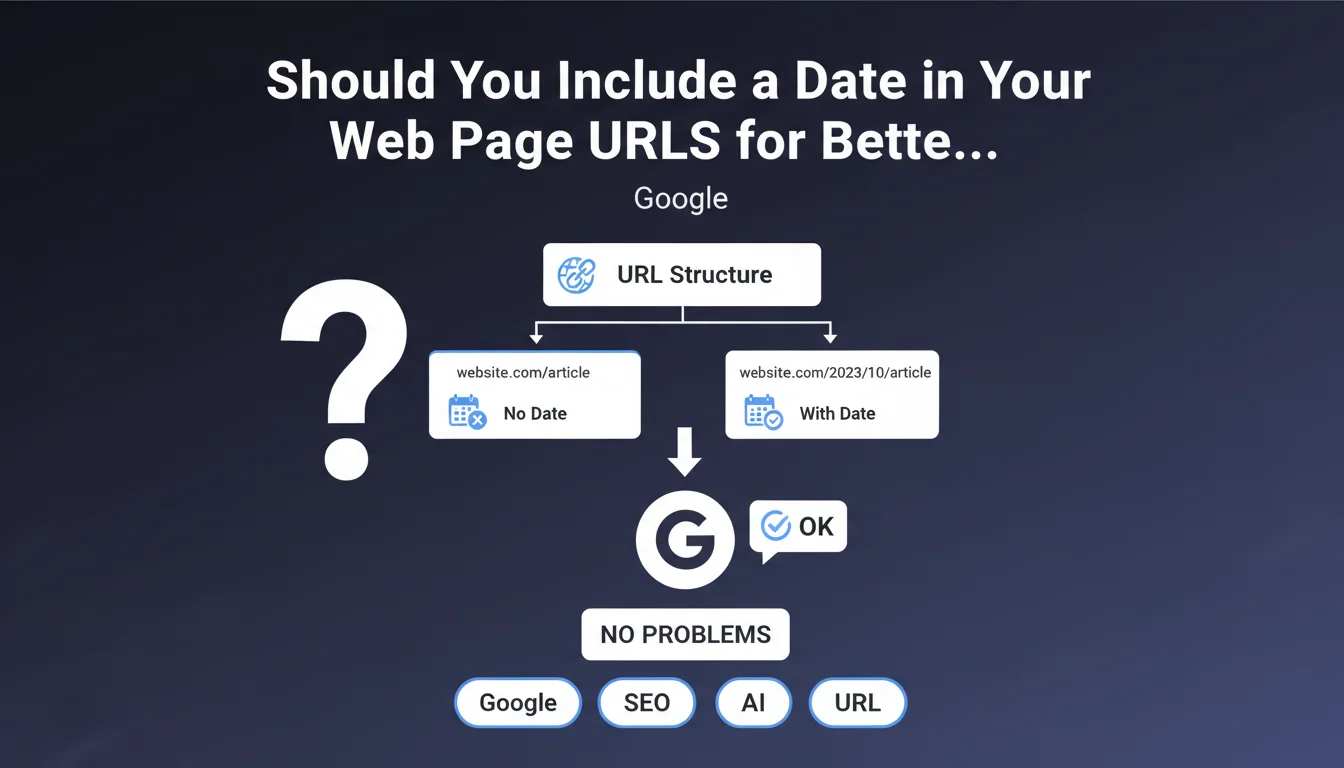
Today, Google has clarified its position: the presence of a date in the URL has no SEO impact, neither positive nor negative. This statement aims to clear up doubts and simplify the technical choices of webmasters.
What does this neutrality of dates in URLs actually mean in practice?
Google treats URLs with or without dates in a strictly identical manner for ranking in search results. The search engine neither favors nor penalizes this particular structure.
The date visible in the URL does not replace the structured metadata that Google actually uses to understand content freshness, such as date tags or schema.org data.
What are the key takeaways from this statement?
- No SEO advantage: including a date in the URL does not improve your ranking
- No penalty: keeping this structure does not negatively impact your search engine optimization
- Google News requirement removed: this historical constraint has been gone for a long time
- Freedom of choice: you can decide according to your technical and editorial preferences
- Content freshness is evaluated through other signals that are more relevant
SEO Expert opinion
Is this statement consistent with what we observe in the field?
After 15 years of practice, this position from Google does indeed correspond to what we observe. Sites with dates in their URLs show no measurable advantage in terms of ranking compared to cleaner URL structures.
A/B tests conducted on sites migrating from a structure with dates to a structure without dates (or vice versa) show an almost perfect stability of organic positions, confirming this stated neutrality.
What nuances should be considered regarding this claim?
While the direct SEO impact is null, there are important indirect implications to consider. A date in the URL can affect user perception: an article dated 2018 visible in the URL may discourage clicks, even if the content has been updated.
This structure can also complicate editorial management. Updating old content with a date frozen in the URL creates a noticeable inconsistency between the URL and the refreshed content.
In which cases does this structure with dates remain relevant?
For pure news sites where timeliness is at the heart of the content (sports events, breaking news), keeping the date can make organizational and editorial sense, even without SEO benefits.
Similarly, if your CMS automatically generates these URLs and your site is performing well, there is no urgency to modify this structure. Your energy would be better invested in optimizations with real impact.
Practical impact and recommendations
What should you actually do with your current URLs?
If your site already includes dates in URLs: don't change anything by default. This structure doesn't penalize you and a migration carries technical risks if poorly executed.
If you're launching a new site: favor a simple and sustainable URL structure, without dates. Opt for URLs based on the title or category, which remain valid even after content updates.
Focus instead on the real freshness signals: lastmod tag in the XML sitemap, structured dates in schema.org, and visible indication of last update in the content itself.
What mistakes should you avoid during a potential migration?
Never remove dates from URLs without a complete redirection plan. Each old URL must point to the new one via a permanent and properly configured 301 redirect.
Avoid migrating solely to remove dates. A migration should be part of a broader overhaul that brings real improvements: architecture, user experience, performance.
- Audit your current URL structure and its impact on CTR
- If migration is considered, plan a complete old/new mapping
- Test redirects on a sample before general deployment
- Implement structured data to indicate content freshness
- Clearly display publication and update dates in the visible content
- Monitor KPIs for 3 months post-migration to detect any anomalies
- Document your decision for future team consistency
How can you optimize the perception of freshness without relying on the URL?
Use meta tags and schema.org to communicate precisely to Google the publication and modification dates. This data is actually used by the algorithm to evaluate freshness.
Visually display in your content the last update date to reassure users about the current relevance of the information, regardless of the URL structure.
💬 Comments (0)
Be the first to comment.