
Official statement
What you need to understand
Why does this misconception persist in the SEO community?
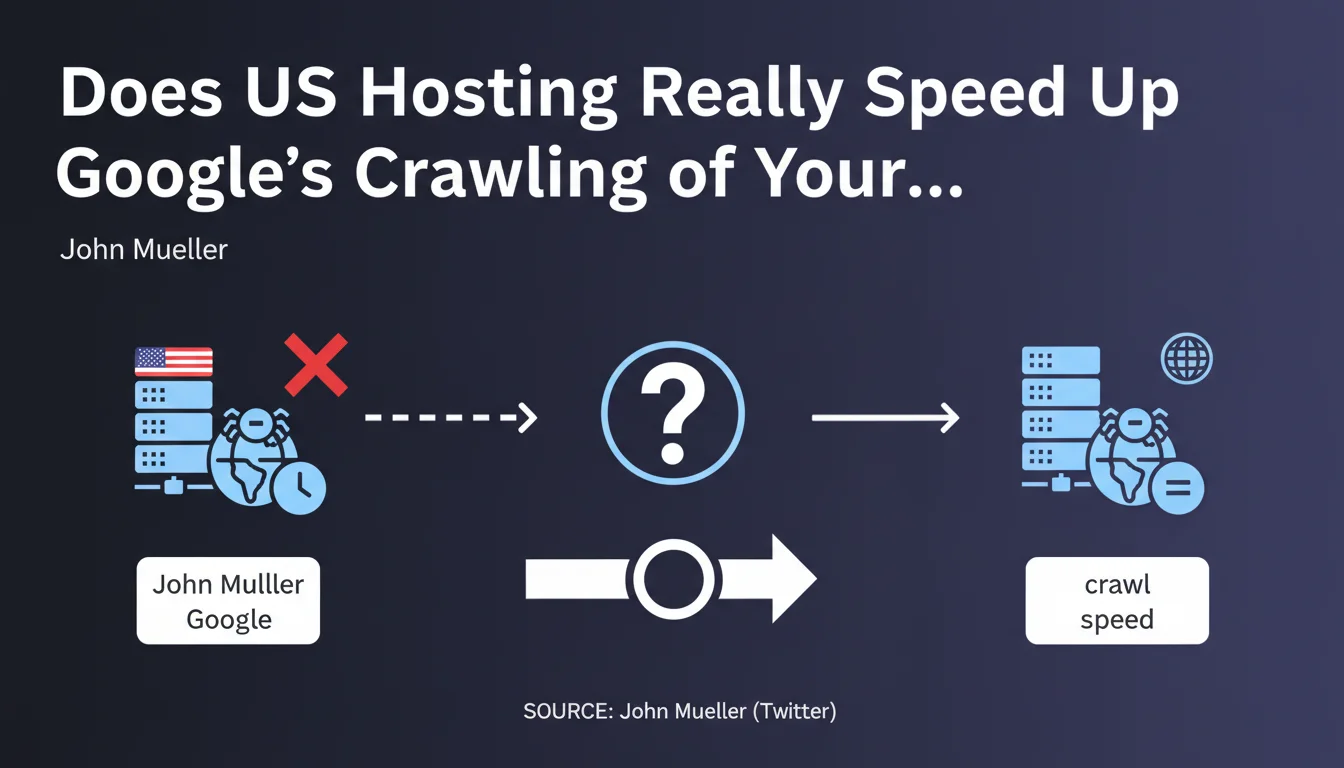
Many SEO professionals still believe that server geographic location influences the speed and frequency of Googlebot crawling. This belief stems particularly from the era when Google was primarily based in the United States.
Some thought that US hosting would reduce latency with Google's servers and thus promote faster crawling. However, this hypothesis does not reflect the technical reality of Google's modern infrastructure.
What does Google actually prioritize for crawling?
Google has confirmed that server geolocation is not a prioritization criterion for crawling. Google's crawling robots are distributed globally across numerous datacenters.
What really matters is the frequency of content updates and PageRank (or more precisely the site's overall authority). A regularly updated site with good authority will be crawled frequently, regardless of where it is hosted.
What are the real factors that influence crawl budget?
The crawl budget allocated to a site primarily depends on three factors: site popularity, content freshness, and overall technical health.
- Domain authority: the more quality backlinks and authority your site has, the more frequently Google crawls it
- Update frequency: a site that regularly publishes new content encourages Google to return more often
- Technical quality: server response time, absence of errors, clear architecture promote efficient crawling
- Content relevance: quality and useful content encourages Google to explore more pages
SEO Expert opinion
Is this statement consistent with practices observed in the field?
Absolutely. After 15 years of experience with hundreds of international sites, I observe that hosting geographic location has no measurable impact on crawl frequency. Sites hosted in Europe or Asia are crawled just as efficiently as US-based sites.
What really makes a difference is the overall server performance (response time) and not its location. A fast European server will always outperform a slow US server in terms of crawl efficiency.
What nuances should be added to this statement?
Server location does not influence crawling, but it can have a slight impact on geo-targeted ranking. Google uses other signals to determine a site's geographic target: domain extension (.fr, .de, .co.uk), Search Console settings, and linguistic content.
Furthermore, network latency between the server and end users can affect user experience and therefore indirectly impact SEO through Core Web Vitals. A CDN (Content Delivery Network) solves this problem much better than a simple hosting change.
In what cases might server location still matter?
For sites with an exclusively local audience and legal compliance requirements (GDPR, data sovereignty), hosting locally may be relevant. But this is a legal and business decision, not an SEO one.
For international e-commerce sites, using a CDN with multiple geographic points of presence optimizes loading speed for all users, which improves experience and can indirectly benefit SEO.
Practical impact and recommendations
What should you do concretely to optimize your site's crawling?
Rather than moving your hosting to the United States, focus on genuinely effective optimizations. Improve your current server's response speed and optimize your technical architecture.
Invest in high-performance hosting with fast response times (ideally under 200ms for TTFB). Ensure your server can handle bot traffic spikes without slowdown.
Implement a regular content strategy that gives Google a reason to return frequently to your site. The more fresh and relevant content you publish, the more crawl budget Google will allocate.
What mistakes should you avoid regarding hosting and crawling?
Don't invest in a geographic hosting change hoping to improve your crawling. It's a waste of time and resources that will bring no measurable benefit.
Don't neglect the robots.txt file and XML sitemap. These tools are far more effective for guiding crawling than any geographic consideration.
Avoid low-quality servers that generate 500 errors or timeouts. An unstable server, whether in the USA or elsewhere, will penalize your crawl budget.
How can you verify and improve your site's crawl efficiency?
- Analyze crawl stats in Google Search Console to identify crawl trends
- Check that your server response time (TTFB) is below 200-300ms from different locations
- Optimize your internal linking architecture to facilitate discovery of all your important pages
- Remove duplicate and low-quality content that wastes your crawl budget
- Regularly update your XML sitemap and submit it in Search Console
- Properly configure your robots.txt to block unnecessary sections (admin, internal search, etc.)
- Implement a global CDN if you're targeting an international audience to optimize performance
- Monitor crawl errors and quickly fix detected technical issues
💬 Comments (0)
Be the first to comment.