
Official statement
What you need to understand
Why does this question about image file names come up in multilingual SEO?
On a multilingual website, every content element can potentially be translated: text, URLs, meta tags, and even file names. The question of image names frequently comes up among SEO practitioners wondering whether they need to duplicate and rename each file for each language.
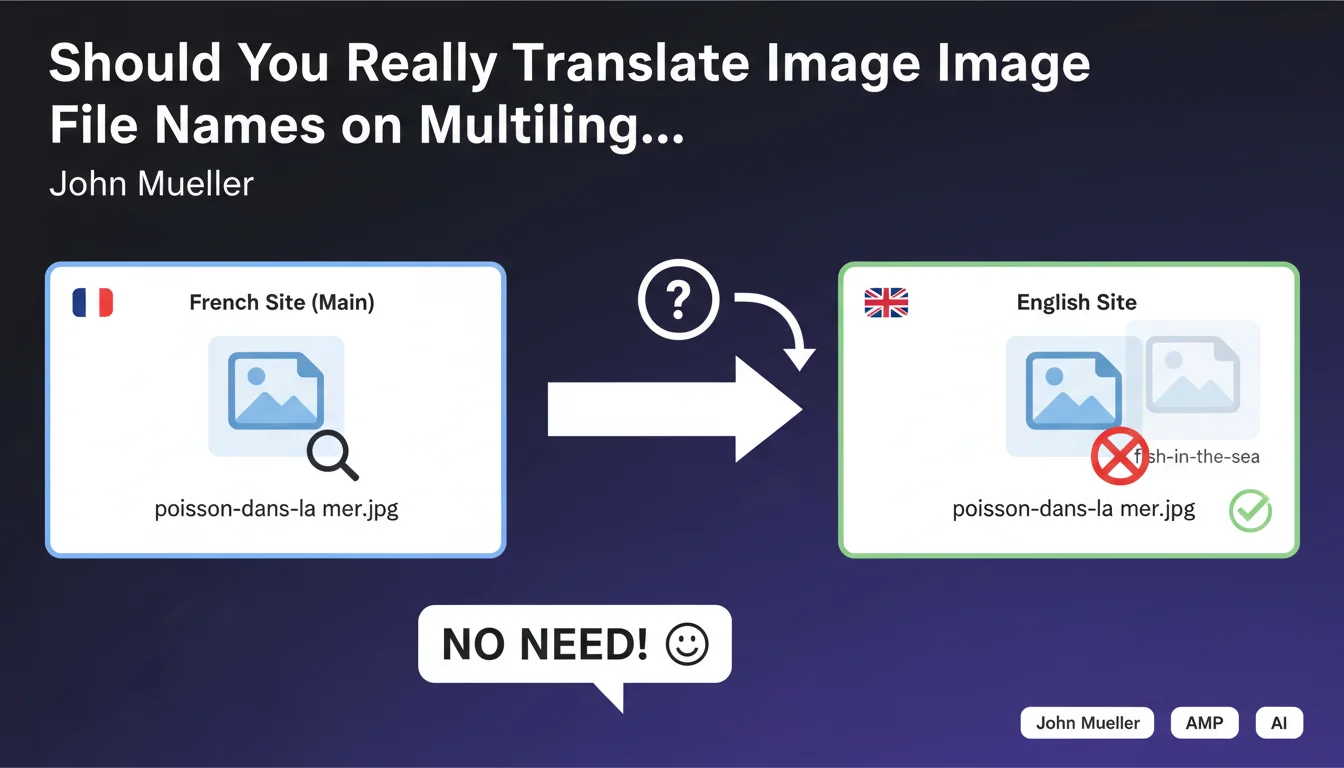
Google has clarified this practice: it is not necessary to create multiple versions of the same image with translated names. An image named "poisson-dans-la-mer.jpg" can be used as-is on the English version of the site, without needing to copy it as "fish-in-the-sea.jpg".
What is the actual weight of keywords in image file names?
The image file name is indeed an SEO signal, but its weight remains very low in the overall algorithm. Google primarily uses other elements to understand an image's content: the alt text, page context, captions, and now AI-powered visual analysis.
Investing time in duplicating and translating all file names represents a disproportionate effort compared to the potential SEO gain. This clarification therefore helps optimize resources.
What are the truly priority elements for multilingual image SEO?
- Translated alt tag: this is the most important signal for Google
- Textual context around the image on each language version
- Image captions and titles adapted to each language
- Descriptive file name in any language remains a small bonus
- URL structure and image folder organization
SEO Expert opinion
Is this recommendation consistent with what we observe in practice?
After 15 years of practice, I can confirm that Google's position corresponds perfectly to what we observe. Sites that use image names in a single language suffer no penalty and rank just as well as those that systematically translate their files.
I've conducted comparative tests on several client sites: the difference in SEO performance between translated and non-translated images is statistically negligible, if not nonexistent. The effort of translating files generates no measurable ROI.
What important nuances should be added to this recommendation?
Be careful though: this rule applies to files that are already well-named with descriptive terms. An image named "IMG_1234.jpg" remains problematic in all languages. The principle is that a descriptive name, even in a foreign language, is better than a generic name.
Additionally, for sites with autonomous local teams managing their own assets, having separate files may be more practical for organizational reasons, even if it's not an SEO imperative.
In what specific cases might this approach need reconsidering?
For very large-scale e-commerce sites, some Digital Asset Management (DAM) systems use file names as identifiers. In this case, a multilingual naming logic may make sense for technical and organizational reasons, not SEO.
Similarly, if your site works with geo-localized CDNs or complex distribution strategies, separating files by language may be necessary for infrastructure reasons, regardless of SEO.
Practical impact and recommendations
What should you actually implement on your multilingual site?
The absolute priority is to focus on high-impact SEO elements. For each language on your site, ensure that alt tags are properly translated and contextualized. That's where the real optimization leverage lies.
Opt for a centralized image library with descriptive file names in a pivot language (usually English or your primary language). These files will be reused across all language versions without duplication.
Establish a consistent naming process for new images: use descriptive terms separated by hyphens, avoid special characters, and favor short but explicit names.
What common mistakes should you absolutely avoid?
- Not translating alt tags thinking the file name is sufficient
- Wasting time duplicating and translating all existing file names
- Using generic names like "image1.jpg" even in monolingual contexts
- Forgetting to translate captions and textual context around images
- Not optimizing image compression and format (WebP, AVIF)
- Neglecting the title attribute or ImageObject structured data
How can you effectively audit and optimize your multilingual images?
Conduct an audit of your alt tags across all language versions with tools like Screaming Frog. Identify images without alt tags or with untranslated alts—that's your number one priority.
Verify that your images are properly indexed in Google Images for each language market. Use Search Console to analyze performance by language and identify improvement opportunities.
Document your naming conventions in an editorial guide to ensure long-term consistency. Train your teams on best practices and automate what can be automated during upload.
💬 Comments (0)
Be the first to comment.