
Official statement
What you need to understand
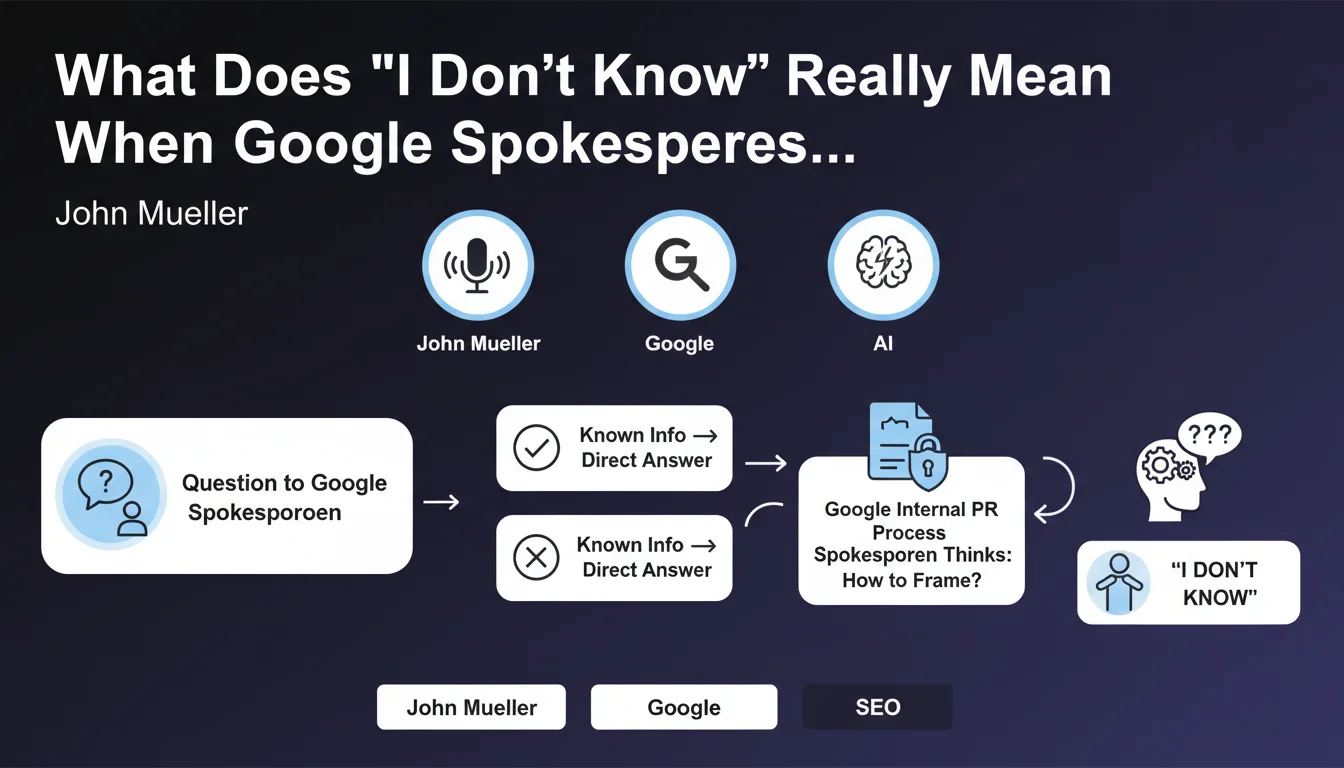
Why do Google representatives sometimes respond with "I don't know"?
When an official Google representative claims not to know something, it doesn't necessarily reflect technical ignorance. This response may simply mean they don't have authorization to communicate on that topic.
The internal communication constraints imposed by the public relations department limit what can be publicly disclosed. An engineer may perfectly well know the answer, but hasn't validated the message with legal and PR teams.
What are the real reasons behind these non-answers?
Google operates like any large organization with complex validation processes. Every piece of public information must pass through several filters before being officially communicated.
Spokespeople must also avoid creating dangerous precedents. An overly precise answer could be interpreted as a promise or reveal sensitive strategic elements.
- Strategic protection: Avoiding disclosure of details exploitable by competitors
- Legal constraints: Certain information could have legal implications
- Global consistency: Maintaining uniform communication across all channels
- Expectation management: Not creating false promises to SEOs
How can you distinguish genuine ignorance from filtered communication?
Observe the context of the question. If it concerns a strategic or sensitive topic, the likelihood of a filtered response increases. Basic technical questions generally receive clear answers.
Body language and hesitations can also reveal that a person knows the answer but chooses not to share it. Evasive answers followed by redirections to official documentation are also an indicator.
SEO Expert opinion
Does this revelation change our approach to official SEO information?
This statement confirms what many experienced SEOs already suspected. Google's official communications must be analyzed through the lens of organizational constraints, not just technical ones.
This doesn't mean Google systematically lies. The company simply operates with strict communication rules like any publicly traded corporation with major competitive stakes.
Which information sources remain reliable for SEO practitioners?
Google patents and official documents like guidelines remain the most reliable sources. They are legally validated and reflect assumed official positions.
Empirical testing and field observations remain irreplaceable. What you observe on your own sites takes precedence over any ambiguous official statement.
Should we give less credence to statements from Google spokespeople?
Above all, you should contextualize each statement. A precise technical answer on a documented point has more value than a vague assertion on a strategic topic.
Develop a multi-criteria approach: cross-reference official statements with your observations, SEO community case studies, and correlation analyses. Never rely on a single source of information.
Practical impact and recommendations
How should you adapt your SEO monitoring strategy given this reality?
Implement multi-layered monitoring that doesn't rely solely on official statements. Integrate diverse sources: community studies, patent analyses, A/B tests, and field observations.
Develop your own testing methodology to validate hypotheses. What actually works on your sites matters more than official statements filtered through PR constraints.
- Create a reliability scoring system for each SEO information source
- Prioritize empirical data and controlled tests on your own sites
- Systematically document discrepancies between official communications and actual observations
- Participate in SEO communities to compare your experiences with other practitioners
- Archive official statements to identify discourse evolution over time
What interpretation mistakes should you absolutely avoid?
Don't fall into conspiracy thinking. Google isn't systematically trying to deceive you. The company simply navigates between transparency and protection of its strategic interests.
Also avoid rejecting all official communication. Some information is perfectly reliable, particularly that concerning already deployed features or documented general principles.
How can you build a robust SEO strategy despite this partial opacity?
Focus on timeless fundamentals: content quality, user experience, solid technical architecture, and topical authority. These pillars work independently of official communications.
Adopt an iterative and measurable approach. Test, measure, adjust. This scientific methodology protects you against erroneous interpretations of official statements.
💬 Comments (0)
Be the first to comment.