
Official statement
What you need to understand
What does this Google statement about blockquotes actually mean?
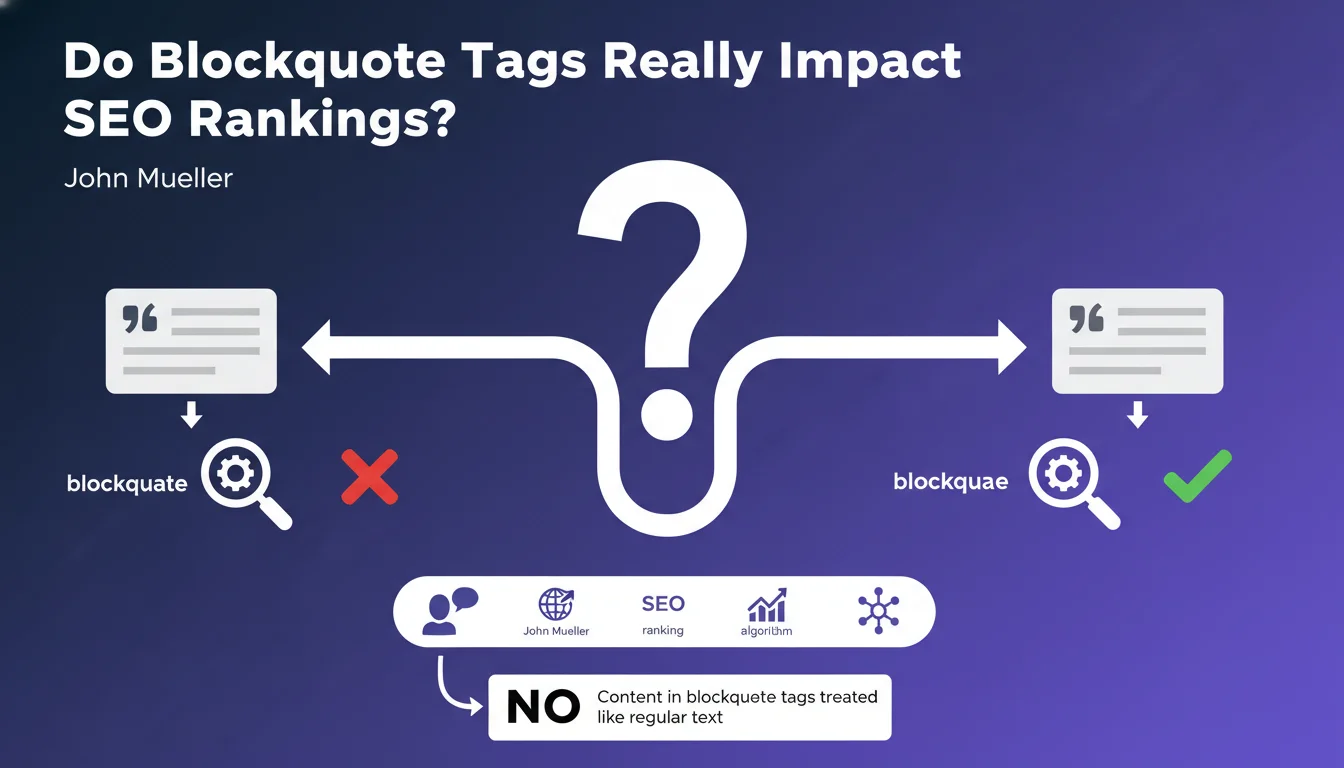
John Mueller clarified on Reddit that content placed within blockquote tags receives no special algorithmic treatment from Google. The search engine neither boosts nor devalues text present in these quote elements.
Concretely, this means that Google treats blockquote content exactly like standard text. There is no SEO bonus for quotes, nor any penalty or reduction in the semantic weight of this content.
Why does this tag exist if it doesn't influence SEO?
The blockquote tag is primarily a semantic HTML element designed to improve user experience and accessibility. It allows browsers and screen readers to clearly identify that this is a quotation.
Its role is purely structural and visual: it helps to visually organize content for the human reader, without influencing how indexing bots evaluate the quality or relevance of the text.
What are the common misconceptions about using blockquotes in SEO?
Some SEO practitioners believed that placing content in blockquotes could reduce its algorithmic weight, considering that a third-party citation would be less valued than original content. This theory is disproven by this statement.
Others believed, on the contrary, that using blockquotes to highlight important passages could give them more weight. This approach provides no direct SEO advantage according to Google.
- Blockquotes don't influence the SEO weight of the content they contain
- They serve only to visually and semantically structure quotes
- Google treats text in blockquotes like any other content on the page
- No algorithmic bonus or penalty is applied to these elements
SEO Expert opinion
Is this statement consistent with real-world observations?
After 15 years of practice, I can confirm that this Google position is perfectly consistent with what we observe in ranking analyses. Pages using blockquotes extensively perform neither better nor worse than others, all things being equal.
This neutrality fits into Google's overall logic of seeking to understand content in its entirety rather than overweighting certain HTML tags. The engine is more interested in the quality, relevance, and originality of content than in its technical formatting.
What important nuances should be added to this statement?
Although blockquotes have no direct algorithmic impact, they can have a measurable indirect effect on SEO. A well-structured page with clearly identified quotes improves user experience, which can reduce bounce rate and increase time spent on the page.
Moreover, the correct use of semantic tags like blockquote contributes to the overall accessibility of the site, a factor that Google increasingly takes into account in its quality assessment. Therefore, these elements should not be neglected on the grounds that they have no direct SEO impact.
In what contexts does this rule take on its full importance?
This clarification is particularly useful for editorial sites and blogs that regularly cite external sources. They can do so without fearing diluting their own content or transferring "SEO juice" to quoted texts.
For e-commerce sites displaying customer reviews in blockquotes, this is also reassuring: these testimonials are fully indexed and counted as standard text content, thus contributing to the volume and semantic richness of the product page.
Practical impact and recommendations
What should you actually do with blockquote tags?
Continue using blockquotes in a semantically correct way, meaning only to identify quotations. Don't try to manipulate this tag for SEO reasons, as it will bring no benefit.
Focus instead on the quality and originality of your content, whether in a blockquote or not. Google evaluates the overall added value of your page, not how you technically mark up your paragraphs.
What optimization mistakes should you avoid?
Never place strategic content in blockquotes hoping to "highlight" it in Google's eyes. This technique has no positive effect on your rankings and could even harm the semantic coherence of your page.
Conversely, don't avoid blockquotes for fear they'll dilute your content. If you're legitimately citing a source, use this tag to respect HTML standards and accessibility. Google won't penalize you for having well-structured content.
How can you verify that your site uses blockquotes correctly?
Perform an HTML audit of your main pages to identify current usage of blockquote tags. Verify that each blockquote actually contains a quotation or testimonial, and not disguised original content.
Also ensure that your important quotations include the cite attribute or a link to the source when relevant. This improves credibility in users' eyes, even if Google doesn't specifically value this element.
- Use blockquote only for actual quotations
- Don't manipulate this tag for SEO optimization purposes
- Maintain a semantically correct HTML structure
- Always prioritize content quality over technical formatting
- Regularly audit your markup to detect inappropriate uses
- Train your writers in HTML and semantic best practices
💬 Comments (0)
Be the first to comment.