
Official statement
What you need to understand
Why is this clarification from Google so important?
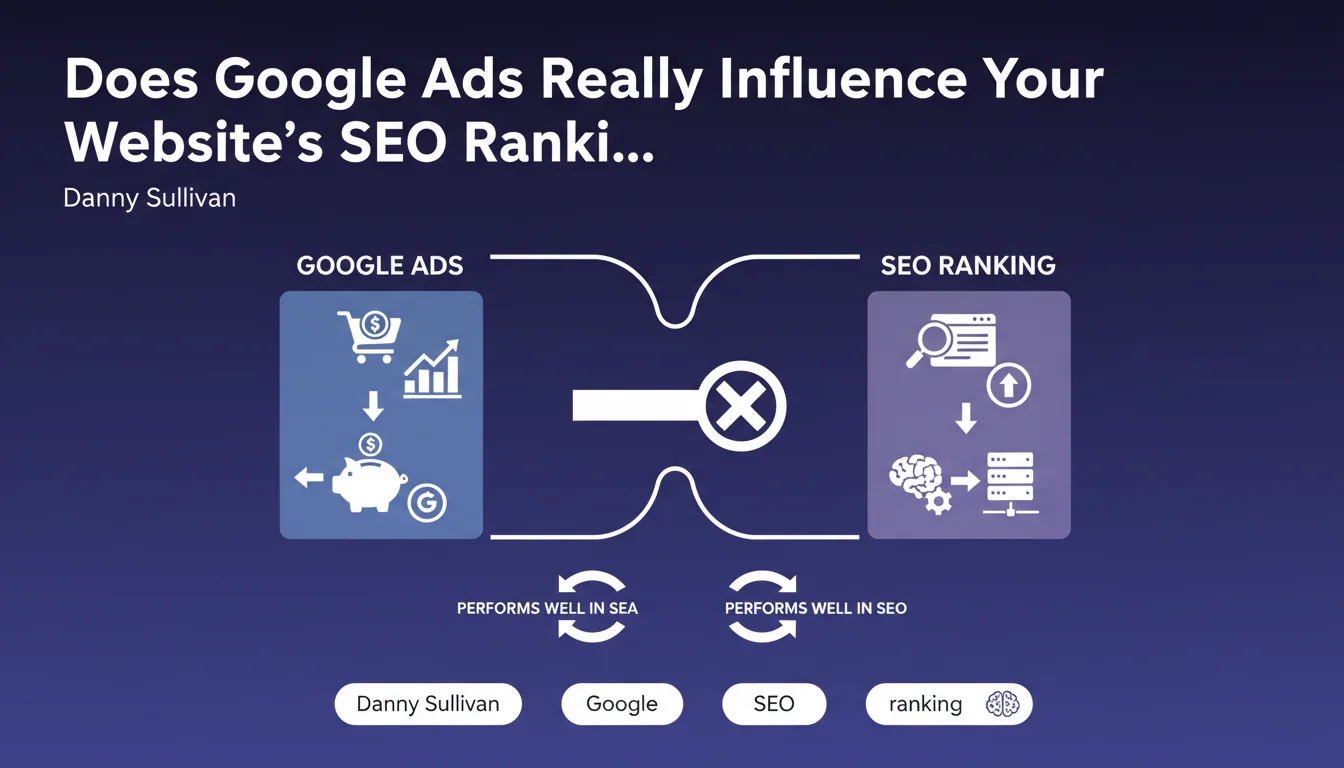
Danny Sullivan, Google's spokesperson, had to repeat once again that Google Ads advertising (SEA) and organic search (SEO) are completely independent. This statement aims to dispel a persistent myth that investing heavily in paid advertising would automatically improve organic positions.
This confusion has persisted for years in the industry, fueled by apparent but misleading correlations. Major brands that dominate in both SEA and SEO often do so because they invest globally in their digital presence, not because one channel helps the other.
What does this independence between SEA and SEO actually mean?
Concretely, this means that the Google Ads budget you spend sends no positive signal to the organic ranking algorithm. The Google Ads and Google Search teams operate with separate systems and distinct evaluation criteria.
SEO relies exclusively on quality factors such as content, user experience, backlinks, and relevance. SEA, on the other hand, works according to a bidding system and advertising Quality Score.
What concrete evidence supports this separation?
Google has always maintained a strict separation between its divisions for legal and credibility reasons. Favoring advertisers in organic results would constitute market manipulation that would expose the company to major antitrust lawsuits.
Numerous independent tests have confirmed this independence: sites with no advertising budget can dominate the SERPs, while major advertisers can have mediocre SEO performance.
- SEA and SEO use completely distinct algorithms with no communication between them
- Advertising budget is not a ranking factor for organic search
- Performance can be excellent in one channel and weak in the other
- Google would risk major legal sanctions if it favored advertisers
- This separation is verifiable through tests and empirical observations
SEO Expert opinion
Is this statement consistent with practices observed in the field?
After 15 years of observation, I can confirm that SEA/SEO independence is real and verifiable. I've supported hundreds of sites that abruptly stopped their Google Ads campaigns without seeing any negative impact on their organic positions. Conversely, sites with no advertising budget regularly dominate competitive markets.
The confusion often stems from a misleading correlation: companies that invest heavily in SEA generally also have the resources to do good SEO. It's the overall quality of their digital strategy that explains their success, not a direct influence of one channel on the other.
What nuances should be added to this official position?
Even though SEA doesn't directly influence SEO, there are indirect benefits that shouldn't be overlooked. Advertising campaigns generate qualified traffic that can improve behavioral signals (bounce rate, time on site, pages per session) if your content is relevant.
Furthermore, increased advertising visibility can boost branded searches and click-through rates on your organic results (CTR), which are indirect ranking factors. SEA can also serve to test keywords before targeting them in SEO, thus optimizing your overall strategy.
In what cases might this rule appear not to apply?
There are situations where the apparent correlation between SEA and SEO can be confusing. For example, when a company simultaneously launches massive advertising campaigns and improves its site, it may see its organic positions improve at the same time.
This improvement actually comes from technical and content optimizations carried out in parallel, not from the advertising budget. Similarly, branded searches stimulated by advertising can indirectly strengthen the authority signals and popularity of your domain.
Practical impact and recommendations
What should you actually do to optimize SEA and SEO?
The right approach is to treat SEA and SEO as two complementary but independent levers in your acquisition strategy. Each must be optimized according to its own performance criteria, without expecting one to mechanically boost the other.
Focus your SEO efforts on organic search fundamentals: quality content, technical optimization, user experience, relevant link building. For SEA, focus on Quality Score, strategic bidding, and advertising relevance.
What mistakes should you avoid in your digital strategy?
Never reduce your SEO budget thinking that your Google Ads investments will compensate in organic results. This is the most costly mistake observed in the field. Both channels require distinct and sustained investments.
Also avoid neglecting SEO on the grounds that your SEA is working well. Organic positions offer superior long-term ROI and independence from cost-per-click which keeps increasing.
How can you build an effective and balanced digital strategy?
The best approach is to use SEA data to identify keywords with high conversion potential, then target them in SEO to progressively reduce your advertising dependency. This strategic synergy maximizes your overall return on investment.
Implement precise tracking for each channel to measure their respective contributions. This will allow you to allocate your budgets optimally between paid and organic acquisition.
- Maintain separate and appropriate budgets for SEA and SEO
- Never count on Google Ads to improve your organic positions
- Optimize each channel according to its own performance criteria
- Use SEA to quickly test keyword hypotheses
- Invest in SEO to reduce your dependence on rising advertising costs
- Leverage behavioral data from paid traffic to improve your content
- Precisely measure the ROI of each channel with attribution tools
- Develop a brand building strategy that will indirectly benefit both channels
💬 Comments (0)
Be the first to comment.