
Official statement
What you need to understand
What is Google's official position on using CTR?
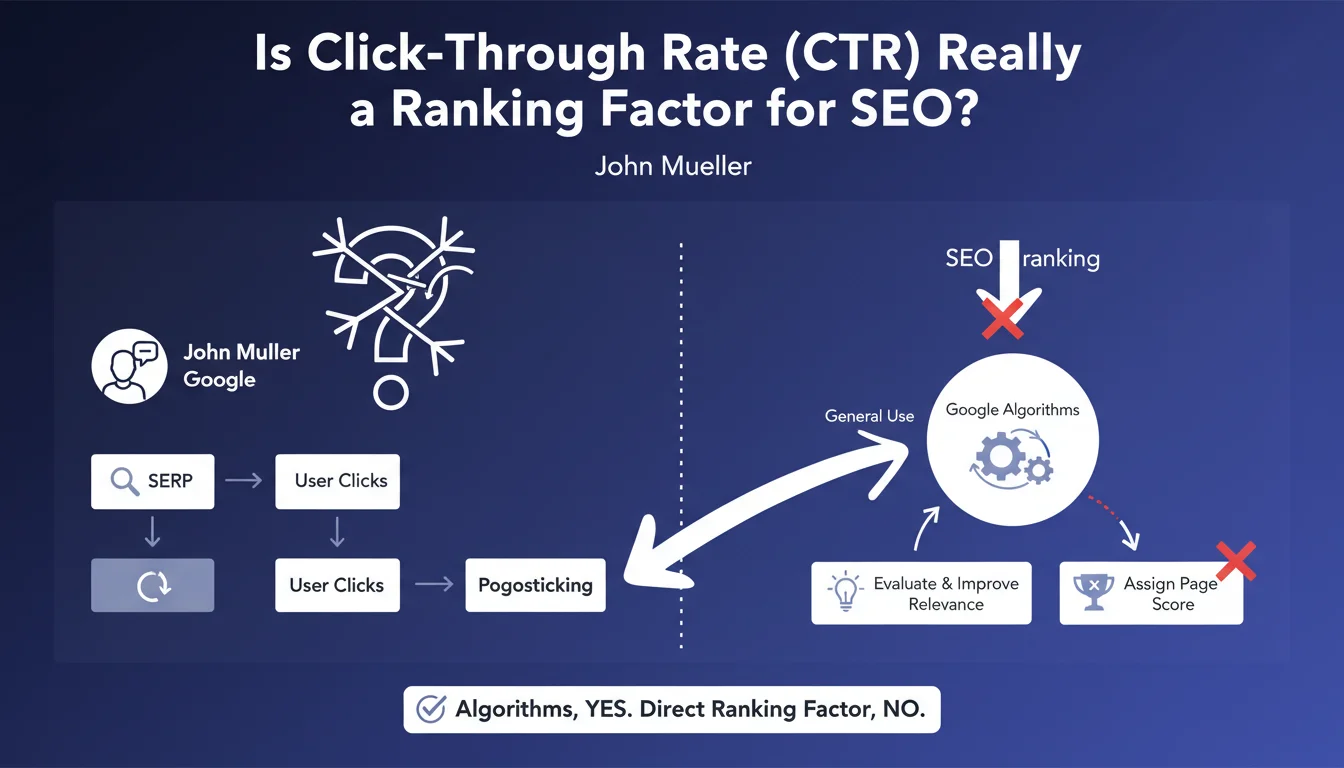
John Mueller has clarified Google's position regarding click-through rate in search results. Google does indeed use this data, but not in the way many SEO professionals imagine.
CTR and pogosticking (rapid return to results) serve to evaluate the overall quality of relevance algorithms. Google seeks to verify whether its systems are recommending the right results to users.
What's the difference between general use and specific use?
The key distinction lies in the scale of analysis. Google uses these signals in an aggregated and global manner to improve its algorithms, not to assign an individual score to your site.
Concretely, if no one clicks on results for a certain category of queries, Google identifies an algorithmic problem to correct. But your site specifically won't be penalized for low CTR on a given query.
Why does this clarification matter for SEO professionals?
This statement puts an end to many myths in the search engine optimization industry. Many practitioners have invested time and resources attempting to manipulate CTR to improve their rankings.
Google confirms that this approach is ineffective. Behavioral signals serve machine learning and continuous algorithm improvement, not direct ranking.
- CTR is used by Google, but to evaluate its own algorithms
- There is no CTR score assigned individually to websites
- Attempts to manipulate CTR are useless for ranking
- This position is consistent with statements from other Google representatives
- Pogosticking serves as a results quality indicator at the macro level
SEO Expert opinion
Is this statement consistent with what we observe in the field?
After 15 years of experience, I confirm that this Google position is consistent with empirical observations. Attempts to manipulate CTR (click farms, orchestrated campaigns) have never produced lasting results.
On the other hand, we observe that sites that naturally generate good organic CTR perform better. But it's a symptom, not a cause: these sites rank well because they're relevant, and their relevance generates clicks.
What important nuances need to be added to this statement?
Google is telling the truth, but not the whole truth. While CTR isn't a direct ranking factor, it indirectly influences other metrics that do matter.
Good CTR generates more traffic, which increases brand signals, navigational searches, and potentially natural backlinks. These elements are proven ranking factors.
In which contexts does this rule deserve reconsideration?
For branded queries and local search, user behavior probably has more impact. If no one ever clicks on your business in the local Knowledge Panel, Google might draw conclusions.
Similarly, in Google Discover and YouTube (which belongs to Google), behavioral signals play an explicit role in recommendations. Google's general principle applies differently depending on context.
Practical impact and recommendations
What should you do concretely following this clarification?
Abandon any strategy aimed at artificially manipulating CTR. Click farms, click incentive campaigns, and other similar techniques are ineffective and potentially risky.
Instead, focus on natural CTR optimization by improving your title tags and meta descriptions. Good CTR is a relevance indicator for you, even if it's not a direct ranking factor.
Invest in real user satisfaction. If your pages perfectly answer search intents, Google will detect it through its multiple quality evaluation systems, not solely through CTR.
What mistakes should you absolutely avoid?
Don't fall into the clickbait trap to artificially inflate your CTR. Sensationalist titles that generate clicks but disappoint users harm your reputation and increase bounce rate.
Avoid using tools or services promising to improve your ranking through orchestrated click campaigns. Google detects these abnormal patterns and these investments are completely unproductive.
- Optimize your titles and descriptions for clarity and relevance, not sensationalism
- Use structured data to enrich your results display (rich snippets)
- Analyze your CTR in Search Console as an indicator of perceived relevance, not as an end in itself
- Test different title formulations via A/B tests over long periods
- Focus your efforts on content quality and post-click experience
- Monitor bounce rate and time on page as better satisfaction indicators
- Align your titles with users' actual search intent
How should you integrate this understanding into a comprehensive SEO strategy?
CTR should be considered a SEO health indicator, not an isolated optimization target. It reveals whether your current positioning matches user expectations.
Integrate CTR analysis into a holistic dashboard that also includes conversions, time spent, pages per session, and user satisfaction signals. It's the combination of these metrics that guides an effective strategy.
💬 Comments (0)
Be the first to comment.