
Official statement
What you need to understand
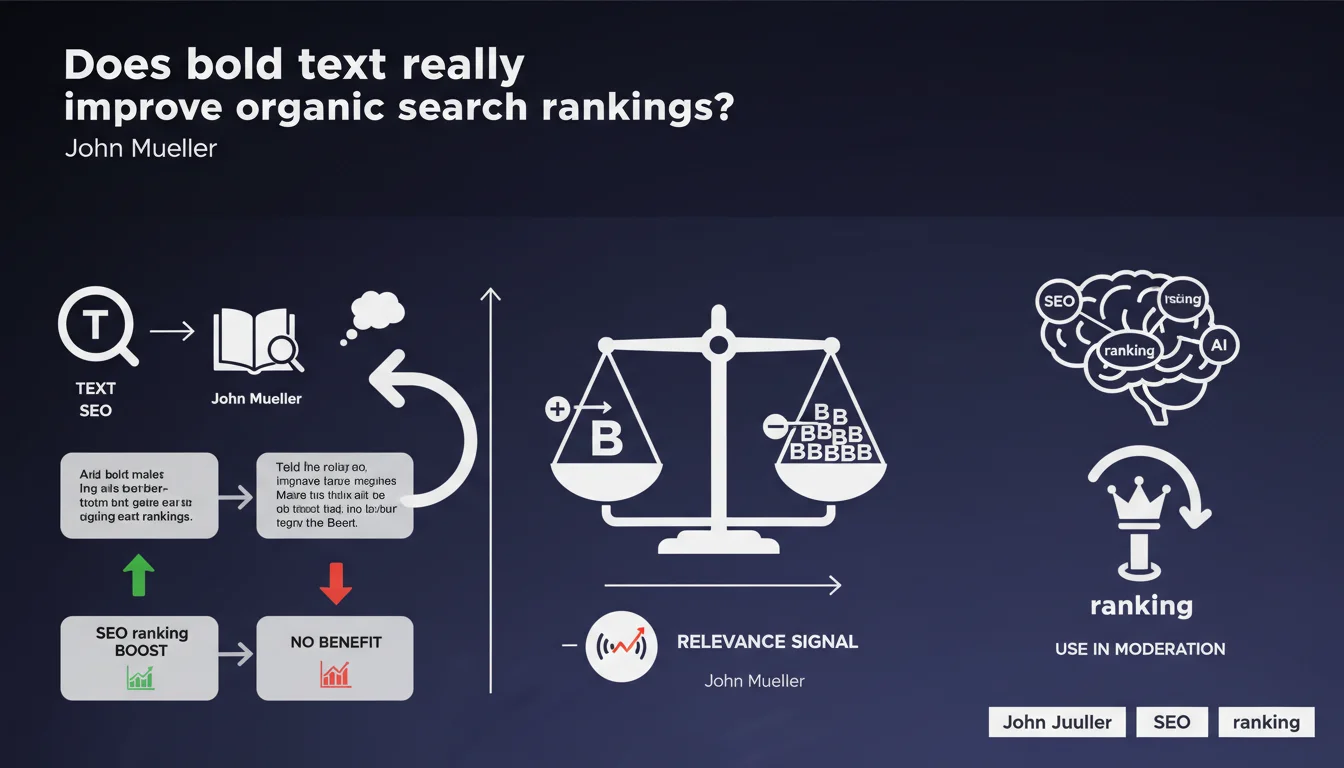
Google officially confirms that bolding certain words in content constitutes a relevance signal for its ranking algorithm. This typographic technique helps crawlers identify the important terms and concepts of a page, just like titles and headings.
However, the effectiveness of this practice relies on a fundamental principle: moderation. Excessive use of bold completely dilutes its semantic impact. When everything is emphasized, nothing really is, and Google stops giving weight to this signal.
It's important to note that while bold is not ranked among the most powerful ranking factors, its impact remains greater than certain technical criteria often overinvested in, such as loading performance or HTTPS protocol for pure ranking.
- Bold is a semantic relevance signal recognized by Google
- Overuse of bold completely cancels its SEO benefit
- This factor has more impact than some minor technical criteria
- This is an official confirmation of a long-observed practice
SEO Expert opinion
This statement fits perfectly within the logic of how modern search engines work. Bold (<strong> or <b> tags) functions as a lightweight semantic marker that guides content analysis. In my practice, I do observe a positive correlation between intelligent use of bold and positioning on long-tail queries.
The essential nuance lies in the definition of "moderation". Based on my tests, bolding between 1% and 3% of total text content seems optimal. Beyond 5%, the effect becomes neutral or even counterproductive. It's also crucial to reserve bold for truly important terms: primary keywords, named entities, central concepts of the topic covered.
Practical impact and recommendations
- DO: Bold your primary keywords and their close semantic variants (1 to 3 times maximum per page)
- DO: Use bold for important concepts, named entities, and technical terms essential to understanding
- DO: Prefer the <strong> tag over <b> for its superior semantic value
- DO: Aim for approximately 1 to 3% of total content in bold, never more than 5%
- DON'T: Bold entire sentences or complete paragraphs
- DON'T: Systematically highlight every occurrence of a keyword (risk of over-optimization)
- DON'T: Use bold solely for aesthetic reasons without semantic logic
- IMMEDIATE ACTION: Audit your priority content to check the bold text ratio and adjust if necessary
- PRIORITIZATION: Focus your bold optimization efforts on strategic pages with high traffic potential
💬 Comments (0)
Be the first to comment.