
Official statement
What you need to understand
What Exactly Was the Question Asked to Google?
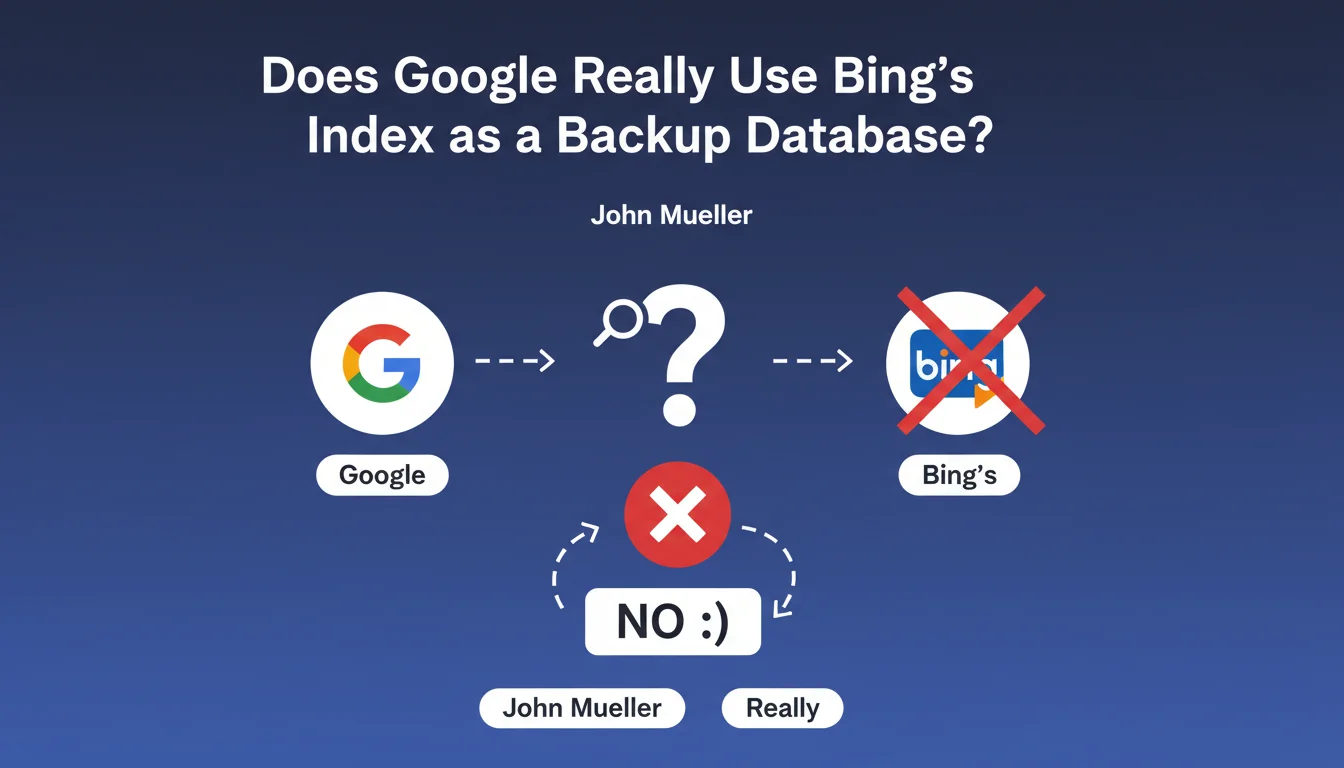
A user inquired whether Google used Bing's index as a fallback solution when its own index doesn't contain satisfactory results for a given query. The underlying hypothesis was that Google might fill its gaps by relying on data from a competing search engine.
John Mueller categorically responded in the negative. Google does not use any external data from Bing or other search engines to populate its results.
Why Does This Question Reveal a Misunderstanding of How Search Engines Work?
This question betrays a fundamental misunderstanding of search engine infrastructure. Each search engine has its own crawling system, its own index, and its own ranking algorithms.
The idea that a giant like Google would rely on a direct competitor to compensate for its shortcomings is technically and strategically unthinkable. Google has massive crawling resources and an index containing hundreds of billions of pages.
What Should We Take Away from This Official Clarification?
- Total independence: Google and Bing operate with completely separate infrastructures
- No data sharing: No search engine uses a competitor's index to generate its results
- Autonomous crawling: Each search engine discovers and indexes the web independently
- Historical anecdote: In 2011, Google had accused Bing of copying its results through rigged tests, which created a controversy
- Pure competition: Search engines are in direct competition and never collaborate on their indexing data
SEO Expert opinion
Is This Statement Consistent with What We Observe in the Field?
Absolutely. As an SEO professional, I observe daily that search results differ significantly between Google and Bing for identical queries. Rankings, featured snippets, and even indexed pages vary considerably.
If Google used Bing's index, we would observe a convergence of results, especially on long-tail queries where Google could theoretically have gaps. Yet, it's precisely the opposite: divergences are even more pronounced on specific queries.
Why Does This Rumor Persist Despite Its Absurdity?
This question reveals a lack of understanding of the technological and legal stakes in the sector. Ranking algorithms and index data are the very core of a search engine's intellectual property.
Sharing or using this data would not only be strategic suicide, but also a potential source of antitrust issues and patent violations. The 2011 case where Google accused Bing of copying its results demonstrates just how jealously guarded this data is.
What Nuances Should Be Added Regarding Multi-Engine Indexing?
Even though search engines are independent, there are third-party services that aggregate or compare data from different search engines. But this has nothing to do with one engine directly using another's index.
For an SEO practitioner, this means you must optimize separately for each search engine if you're targeting a multi-platform presence. Ranking factors are not identical between Google and Bing.
Practical impact and recommendations
Should You Adapt Your SEO Strategy Differently for Google and Bing?
Yes, if your audience significantly uses Bing (particularly in the United States or in certain B2B sectors). The ranking factors differ: Bing, for example, places more importance on exact match domains, social signals, and keywords in the domain name.
However, the fundamentals remain identical: quality content, user experience, domain authority, and technical aspects. Good optimization for Google will generally work well on Bing, even if adjustments can improve performance.
What Should You Concretely Do to Ensure Optimal Indexing?
Focus on solid technical foundations that ensure your site is crawlable and indexable by all search engines. Don't spread yourself thin trying to manipulate the specifics of each algorithm.
- Submit your XML sitemap to both Google Search Console and Bing Webmaster Tools
- Verify that your robots.txt doesn't hinder crawling by different bots (Googlebot, Bingbot)
- Ensure a coherent internal linking architecture facilitating the discovery of all your pages
- Optimize loading speed and Core Web Vitals, valued by all search engines
- Create original, quality content that meets search intents
- Develop your natural backlink profile with quality links
- Properly implement Schema.org structured data understood by all search engines
How Do You Measure and Track Your Multi-Engine Performance?
Use each search engine's official tools to obtain reliable and direct data. Google Search Console and Bing Webmaster Tools provide specific insights into how each search engine perceives your site.
Analyze your server logs to identify crawl patterns for each bot, their visit frequencies, and any access issues. This technical analysis allows you to optimize your crawl budget on each platform.
💬 Comments (0)
Be the first to comment.