
Official statement
What you need to understand
Does Google use data from Google Analytics for ranking?
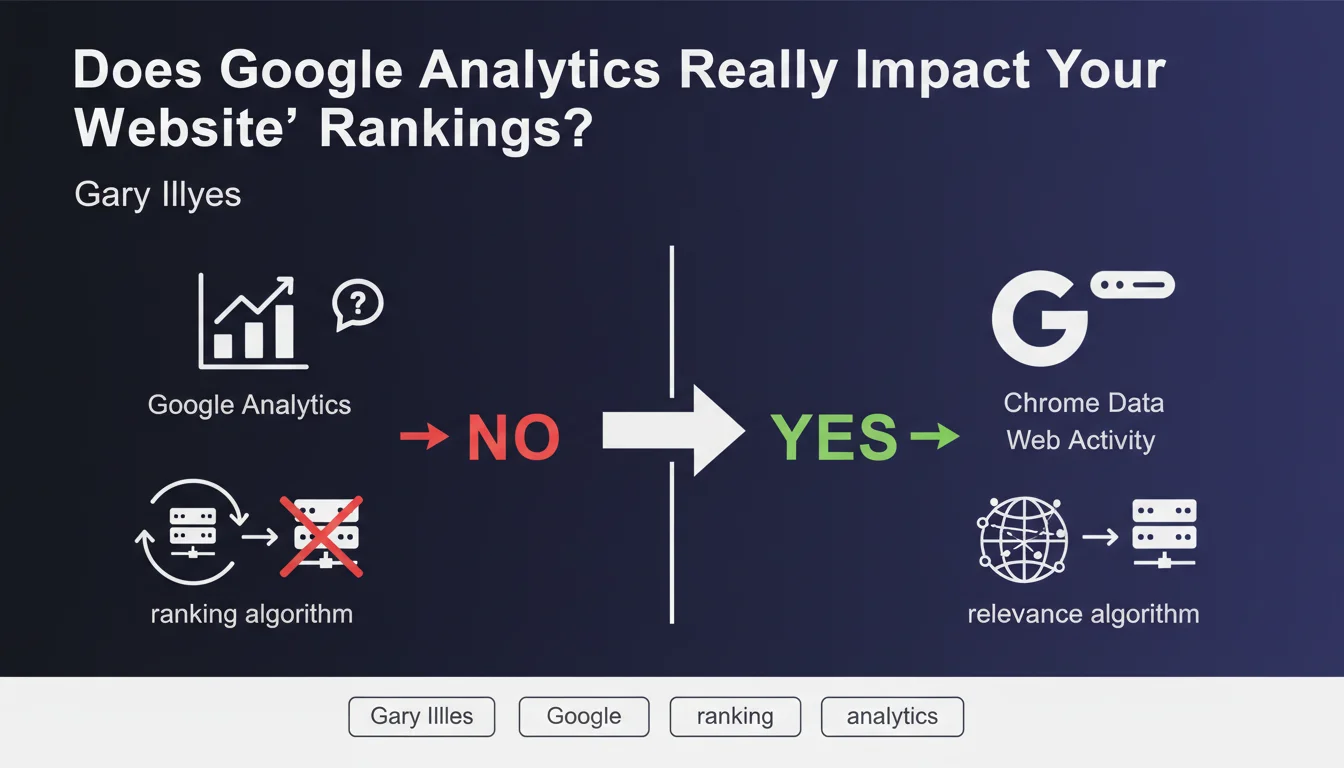
Gary Illyes confirmed that Google's relevance algorithm does not use any data from Google Analytics to evaluate or rank web pages. This clarification puts an end to a widespread belief that metrics like bounce rate, session duration, or page views from Analytics would influence SEO.
This statement follows simple logic: Google does not rely on opt-in data (that webmasters choose to install) for its algorithm. Not all sites use Analytics, which would create a significant bias in relevance evaluation.
What data sources does Google actually use to assess engagement?
Gary Illyes explicitly mentions that Chrome provides all the necessary information in a much more representative manner. With several billion active users, Chrome offers a comprehensive view of user behavior across the entire web, whether or not they have Analytics installed.
Google also has other sources: anonymized browsing data, Search Console signals, interactions with search results (CTR, pogo-sticking, time before returning to SERPs), and Core Web Vitals measured directly in Chrome.
Why does this confusion persist in the SEO community?
Many SEO professionals have observed correlations between good Analytics metrics and good rankings. But correlation is not causation: a well-designed site naturally generates good engagement AND good rankings, without one causing the other via Analytics.
This confusion is also maintained by the fact that Google does indeed use user engagement signals, but collected through channels other than Analytics. The nuance is subtle but crucial to understanding how the algorithm actually works.
- Google Analytics is not a data source for Google's ranking algorithm
- Chrome and other proprietary tools provide more complete and representative engagement data
- User engagement signals exist but do not come from Analytics
- Installing or not installing Analytics has no direct impact on your rankings
SEO Expert opinion
Is this statement consistent with practices and field observations?
Absolutely. This statement from Gary Illyes is perfectly consistent with Google's technical and strategic logic. Using Analytics would create a major flaw: sites without Analytics (or with alternatives like Matomo, Plausible) would be invisible to the algorithm, which is technically unacceptable.
In the field, I've indeed observed that removing or installing Analytics doesn't change rankings. Sites that perform well in SEO generally have good engagement, but this is measured through other signals: time before returning to SERPs, interactions with results, Chrome data, Core Web Vitals.
What nuances should be added to this statement?
The essential nuance is that Google does indeed use engagement signals, but not via Analytics. Behavioral data collected through Chrome, interactions in SERPs, and performance metrics are proven ranking factors, particularly with Page Experience signals.
Another important point: even if Analytics doesn't directly impact SEO, it remains a valuable optimization tool. It helps identify pages with high bounce rates, inefficient user journeys, and guides optimization decisions that will have an indirect impact on rankings.
Do Core Web Vitals change the game regarding Analytics data usage?
Core Web Vitals are measured via the Chrome User Experience Report (CrUX), a public database powered by Chrome, not by Analytics. Even if you can see these metrics in certain Analytics reports, they are only visualizations of data collected elsewhere.
This distinction is crucial: you don't need Analytics for Google to measure your site's performance. CWV are automatically collected for sites with sufficient Chrome traffic, regardless of any installed analytics tool.
Practical impact and recommendations
Should you continue using Google Analytics for SEO?
Yes, but for the right reasons. Analytics doesn't directly boost your rankings, but it remains an essential analysis tool for identifying optimization opportunities. Use it to understand user behavior, not thinking that Google reads this data to rank you.
Focus instead on tools that measure what Google actually measures: Search Console for performance in SERPs, PageSpeed Insights for Core Web Vitals, and Chrome DevTools for technical experience.
What mistakes should you avoid following this clarification?
Don't sacrifice Analytics out of fear of negative impact. Some paranoid SEO professionals have removed Analytics thinking Google penalized sites using it. This is completely unfounded and deprives you of a valuable analysis tool.
Another common mistake: ignoring user engagement on the pretext that Analytics doesn't count. Engagement remains crucial, but optimize it for your real users, not for a hypothetical algorithm reading your Analytics dashboards.
- Continue using Analytics as an analysis and optimization tool, not as a ranking factor
- Focus your SEO efforts on Core Web Vitals measured via CrUX
- Optimize real user engagement: relevant content, smooth UX, meeting search intent
- Monitor Search Console metrics (CTR, positions) that reflect your performance in SERPs
- Test your site with Chrome and PageSpeed Insights to see what Google actually sees
- Don't deprive yourself of alternative tools (Matomo, Plausible) if you prefer: no SEO impact
- Focus on actual user satisfaction rather than intermediate metrics
How can you ensure Google properly measures your site's engagement?
Verify that your site generates enough Chrome traffic to appear in the Chrome User Experience Report. You can consult this data via PageSpeed Insights or the CrUX report available on BigQuery.
Make sure your Core Web Vitals are in the green: this is the technical engagement signal that Google officially uses. Work on LCP (loading), FID/INP (interactivity), and CLS (visual stability).
💬 Comments (0)
Be the first to comment.