
Official statement
What you need to understand
AMP (Accelerated Mobile Pages) is a web page format initially developed by Google to accelerate content loading on mobile devices. For years, many SEO professionals believed that this format provided a direct ranking advantage.
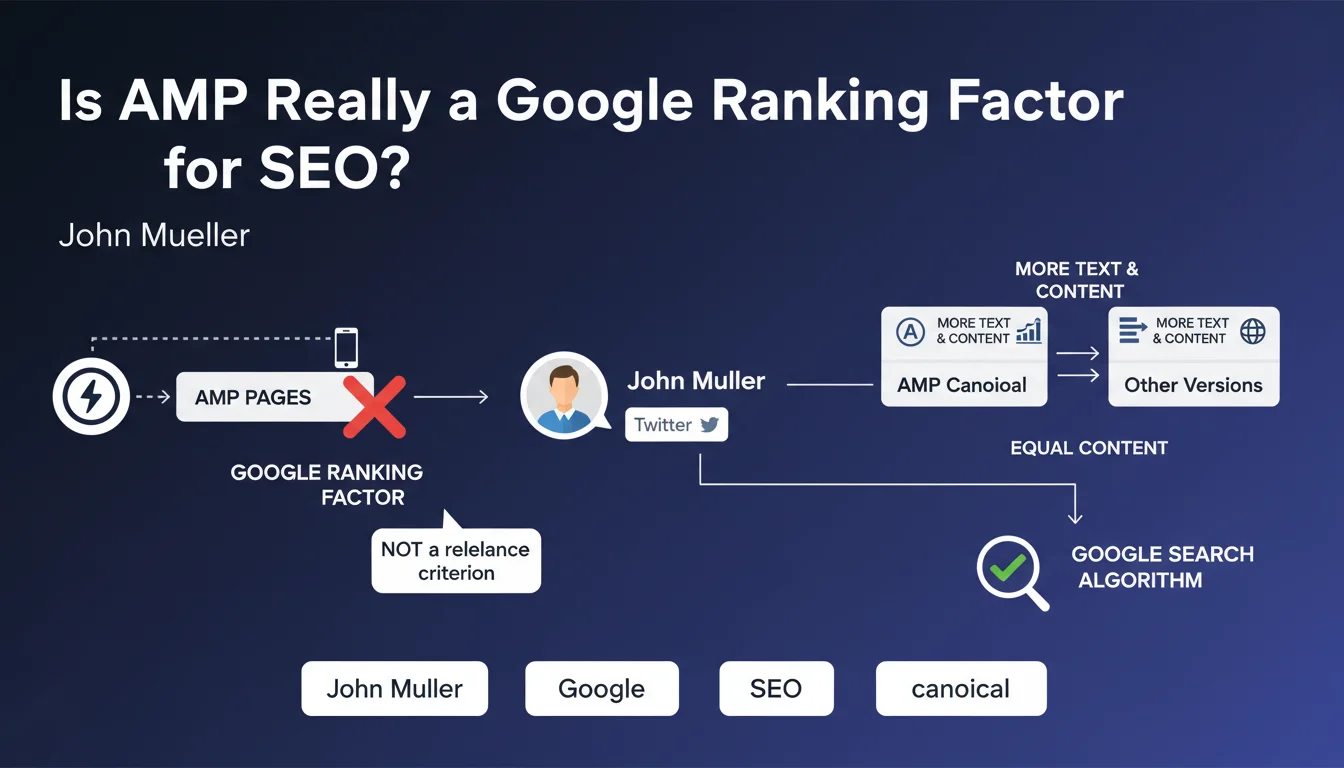
The clarification provided here is unambiguous: AMP is not an algorithmic relevance factor. This means that Google does not inherently favor an AMP page over a standard page in its relevance and ranking calculations.
This statement comes from Martin Splitt, Developer Advocate at Google, recognized for his technical credibility. His intervention on Twitter reinforces a position that Google had already expressed previously, but which continued to raise doubts within the SEO community.
- AMP provides no direct ranking bonus in the search algorithm
- Non-AMP pages can rank just as well, or even better, than their AMP equivalents
- Performance and speed remain important, but can be achieved without AMP
- Core Web Vitals criteria apply equally to both AMP and non-AMP pages
SEO Expert opinion
This statement is perfectly consistent with field observations from recent years. Many websites have abandoned AMP without experiencing any drop in organic traffic, confirming that this format is not a ranking criterion.
The important nuance concerns access to certain display features. Historically, AMP was required to appear in the Top Stories carousel on mobile. However, since June 2021, Google has opened this feature to all pages that meet Core Web Vitals and Google News criteria.
Performance remains critical, but it can be achieved through different technical means. A perfectly optimized non-AMP page will always outperform a poorly designed AMP page. The key is to meet speed and user experience criteria, regardless of the chosen technical format.
Practical impact and recommendations
- Don't launch an AMP project solely for SEO – the technical investment isn't justified by ranking gains
- If you're not using AMP: focus your efforts on optimizing loading speed, reducing render-blocking JavaScript, and improving Core Web Vitals
- If you're already using AMP: objectively evaluate the benefits (simplicity, guaranteed performance) versus constraints (functional limitations, dual maintenance)
- Prioritize overall user experience: loading time, interactivity, visual stability across all devices
- Test your pages with PageSpeed Insights and Search Console to identify priority optimizations
- Consider modern alternatives: native lazy loading, image optimization (WebP, AVIF), efficient caching, CDN
- For media sites: ensure you meet Google News criteria to access Top Stories, with or without AMP
- Audit your current technical stack: CMS, theme, plugins can drastically impact performance without you being aware of it
Technical optimization and web performance are complex areas that require specialized expertise and constant monitoring of algorithm evolutions. These challenges often involve structural technical choices that have lasting impacts on your visibility. For businesses looking to secure their investment and benefit from a personalized strategy aligned with their business objectives, support from a specialized SEO agency helps avoid costly mistakes and accelerate concrete results.
💬 Comments (0)
Be the first to comment.