
Official statement
What you need to understand
What does this Google statement about links really mean?
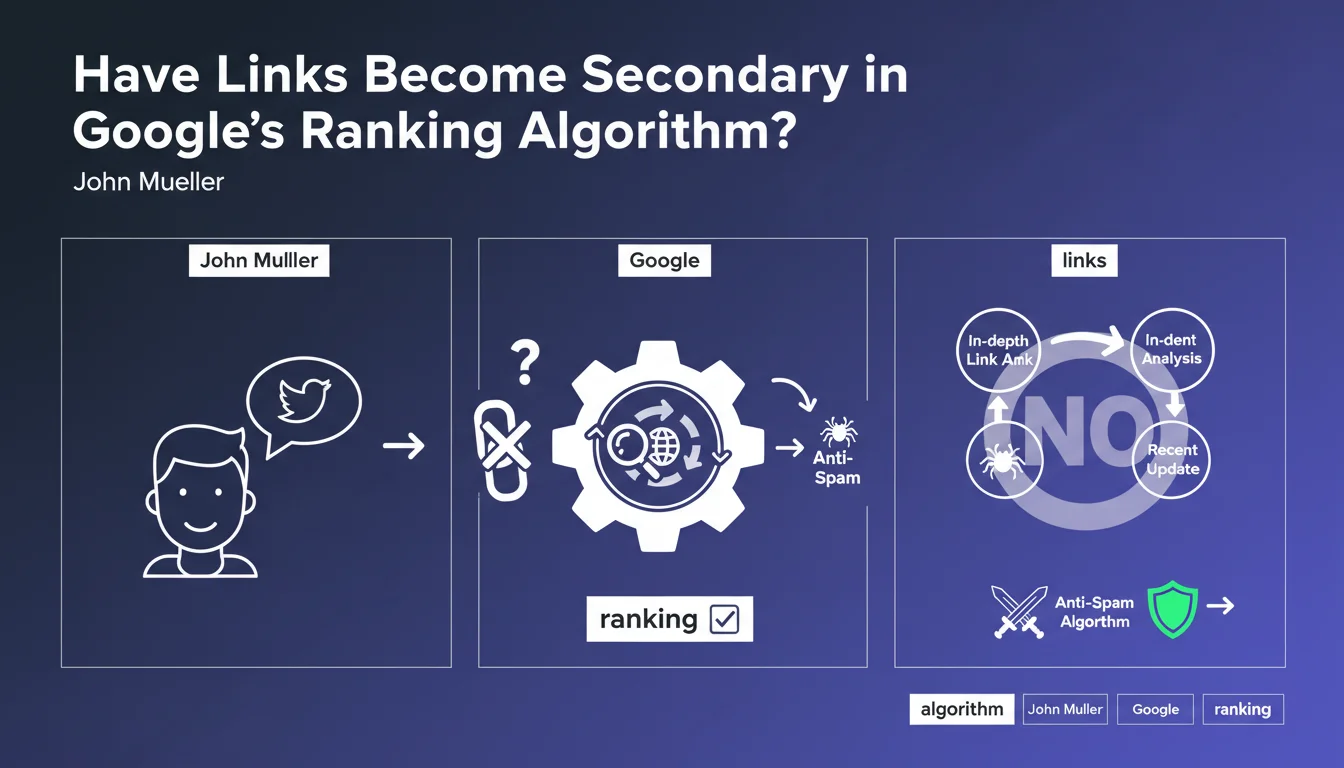
Google states that no recent update to its algorithm has been specifically dedicated to in-depth link analysis to improve rankings. This clarification is important: links remain a ranking factor, but their analysis is not at the heart of the latest algorithm developments.
The only exception concerns anti-spam algorithms which continue to evolve to detect and neutralize artificial links. Google is therefore focusing on detecting bad practices rather than optimizing the detection of good links.
Why does Google make this distinction between links and spam?
The algorithm now treats links from two distinct angles: the first concerns their historical role in ranking (PageRank and authority), the second focuses on combating manipulation.
This separation reveals that Google has likely reached a level of maturity in analyzing legitimate links. Efforts are now directed toward eliminating black-hat techniques rather than improving the understanding of natural links.
Have links lost their importance for SEO?
No, this statement does not mean that links have become obsolete. They remain a signal of trust and authority in Google's algorithm.
What has changed is that Google now has many other signals (content, user experience, E-E-A-T) to evaluate a page's quality. Links are still important, but are no longer the sole determining criterion.
- Links remain an active ranking factor in Google's algorithm
- No recent update aims to improve the analysis of good links
- Efforts are concentrated on detecting artificial and manipulative links
- Google now has multiple signals to evaluate a page's quality
- The distinction is clear between natural links and spam techniques
SEO Expert opinion
Is this statement consistent with practices observed in the field?
As an SEO expert, I indeed observe that sites can now perform without a massive link profile. Sites with few backlinks but excellent content and strong expertise rank better than sites with numerous mediocre links.
This observation confirms that Google has succeeded in diversifying its evaluation criteria. The Helpful Content updates, Core Updates, and the integration of E-E-A-T clearly show that the algorithm relies on a more holistic vision of quality.
Nevertheless, in highly competitive sectors (finance, health, insurance), quality links remain a major differentiator. A site without external authority still struggles to rank on these sensitive topics.
What nuances should be brought to this statement?
We must distinguish between the absence of new updates on links and their actual importance in ranking. Just because Google is no longer improving this aspect doesn't mean it becomes negligible.
Existing algorithms continue to function: PageRank, link relevance analysis, thematic authority evaluation. These systems are simply considered mature enough not to require major revolution.
In what contexts do links remain absolutely critical?
For a new site or a site in a competitive sector, quality backlinks remain indispensable for gaining credibility. Without external signals, Google has few elements to assess your legitimacy against established competitors.
Links also play a crucial role in content discovery and indexing. An isolated site, even with excellent content, will have difficulty being crawled and indexed quickly.
Finally, for YMYL (Your Money Your Life) queries, Google places particular importance on external authority signals. In these sensitive areas, links from recognized sources remain a major trust criterion.
Practical impact and recommendations
What should you concretely do for your link strategy?
Continue to develop a natural and diversified link profile, but focus on quality rather than quantity. Prioritize links from relevant sites in your niche with real authority.
No longer rely exclusively on backlinks as your primary lever. Develop a balanced SEO strategy that integrates content optimization, user experience improvement, and strengthening your perceived expertise.
Invest in content that generates natural links: original studies, infographics, free tools, in-depth analyses. These assets will bring you spontaneous and lasting backlinks.
What mistakes should you absolutely avoid in your link building strategy?
Definitively abandon artificial link techniques: massive link purchases, PBN (Private Blog Networks), systematic exchanges, spam comments. Google continuously strengthens its anti-spam algorithms and these practices represent a major risk.
Don't ignore links on the pretext that they are no longer a priority for Google. A site without quality backlinks remains disadvantaged, particularly in competitive niches.
Also avoid focusing solely on link volume. A single link from a relevant authority site is worth more than dozens of links from low-quality or off-topic sites.
How do you build an effective link strategy in 2024?
Audit your current link profile to identify opportunities and risks. Analyze the backlinks of your best-positioned competitors to spot relevant sources.
Develop authentic relationships with players in your sector: journalists, bloggers, experts. Links from real relationships are more durable and valued by Google.
Integrate link building into a holistic approach combining expert content, technical optimizations, and continuous improvement of user experience.
- Prioritize quality over quantity in your link acquisition
- Create content worthy of being naturally referenced by other sites
- Clean up toxic links inherited from past practices if necessary
- Diversify backlink sources (media, blogs, institutional sites)
- Regularly monitor your link profile with specialized tools
- Definitively abandon black-hat link creation techniques
- Balance your SEO strategy between links, content, and technical aspects
- Target thematically relevant links rather than generic ones
- Invest in lasting relationships with authority sites
💬 Comments (0)
Be the first to comment.