
Official statement
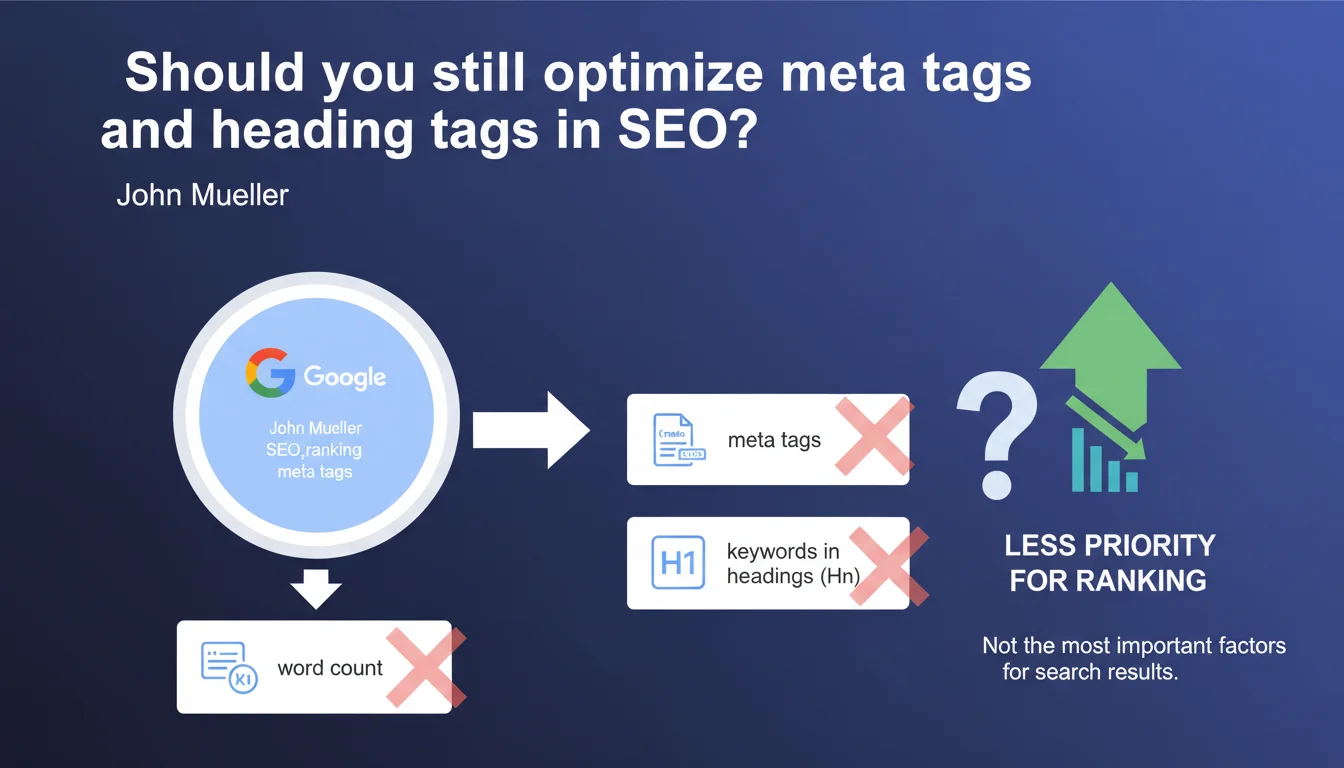
Google claims that meta tags, keywords in headings, and word count are secondary ranking factors. John Mueller downplays their importance — which doesn't mean they're useless, but rather that they won't single-handedly shift your rankings.
What you need to understand
What does Google mean by "secondary factors"?
When Google labels an element as secondary, it means it's not a major ranking lever. Meta keywords tags have been dead for years, but the meta description remains useful for click-through rate. Keywords in heading tags help structure content, not force rankings.
Word count, meanwhile, is never a direct ranking criterion. A 500-word article can outrank a lengthy 3,000-word piece if it better serves relevance and user intent. Google seeks the most effective answer, not the longest one.
Why is Google communicating about these elements now?
Because too many sites still obsess over stuffing H1-H2 tags with keywords or hitting an arbitrary 1,500-word quota per page. Google wants to refocus attention on what truly matters: user experience, content relevance, information freshness, and domain authority.
This statement also aims to temper the obsessions of junior SEOs who spend hours optimizing micro-details instead of working on content strategy and internal linking.
Do these elements remain useful despite that?
Yes, but not for the reasons you might think. Heading tags structure readability and facilitate featured snippet extraction. Meta descriptions influence SERP click-through rate, so indirectly impact traffic. And long-form content may be necessary if the topic demands it — but not as a default rule.
The mistake would be to ignore them entirely. They contribute to the semantic architecture of your page, but they're not heavy-lifting ranking levers.
- Meta keywords tags have been obsolete for years — no direct ranking impact
- Keywords in heading tags help Google understand your content structure, but guarantee nothing in terms of positioning
- Word count is never a ranking criterion by itself — relevance always wins
- Meta description remains essential for click-through rate, thus for indirect organic traffic
- Google pushes you to focus on user experience and content quality rather than outdated technical optimizations
SEO Expert opinion
Is this statement consistent with what we observe in the field?
Yes and no. On competitive queries, well-ranking sites typically have well-structured heading tags and long-form content — but correlation isn't causation. What makes the difference is internal linking, quality backlinks, and the ability to precisely answer search intent.
Conversely, in less competitive niches, I've seen poorly optimized pages dominate simply because they had domain authority and fresh content. Poorly used or missing heading tags didn't prevent ranking. [To verify]: Google remains vague about the exact weight of these signals in the algorithm.
In what cases do these "secondary factors" become critical?
When two pages are evenly matched on strong signals — backlinks, authority, relevance — then details can tip the scales. A well-calibrated H1, an enticing meta description, coherent heading structure can make the difference between position 3 and position 1.
But that's a tie-breaker effect, not a primary lever. If your content is mediocre or your site has zero authority, optimizing heading tags won't change anything. The problem is many junior SEOs invert their priorities.
Is Google telling the whole truth about these elements?
Not certain. Google has incentive to simplify its message to prevent manipulation. Saying heading tags matter little discourages keyword stuffing, but doesn't mean they're ignored. They remain structural signals used to understand information hierarchy.
Let's be honest: if Google truly ignored them, why would they continue indexing them and using them to generate highlighted passages? The reality is probably more nuanced than what Mueller suggests. [To verify]: no public data precisely details their weight in scoring.
Practical impact and recommendations
What should you concretely do with this information?
Stop wasting time counting words or stuffing your H2s with keyword variations. Focus on content quality and precisely answering search intent. If your article is 800 words and perfectly answers the question, that's enough.
Use heading tags to logically structure your points — not to force rankings. And write meta descriptions that compel clicks, because that's where they have real impact.
What mistakes should you avoid after this statement?
Don't fall into the opposite trap: completely ignoring these elements. They remain useful contextual signals. Not having a clear H1 or incoherent heading structure is still a weakness — even if it's not deal-breaking.
Another mistake: believing Google tells you everything. This statement is a simplification. In SEO, you must always cross-reference official statements with field testing and SERP observations.
How do you verify your site is intelligently optimized?
Audit your top-performing pages: do they have coherent heading structure? Look at the featured snippets you capture — they often come from well-marked sections. Compare your CTR across pages based on meta description quality.
If you notice significant gaps, these "secondary factors" are playing a role. Otherwise, direct your energy elsewhere: link building, internal linking, Core Web Vitals optimization.
- Write content that precisely answers search intent, without worrying about arbitrary word quotas
- Use heading tags to logically structure your content, not to force keywords
- Write compelling meta descriptions to improve CTR in SERPs
- Stop wasting time on meta keywords tags — they're dead
- Audit your performing pages to identify structural patterns that work
- Prioritize strong signals: backlinks, domain authority, user experience, content freshness
- Test the real impact of these optimizations on your traffic before scaling them
💬 Comments (0)
Be the first to comment.