
Official statement
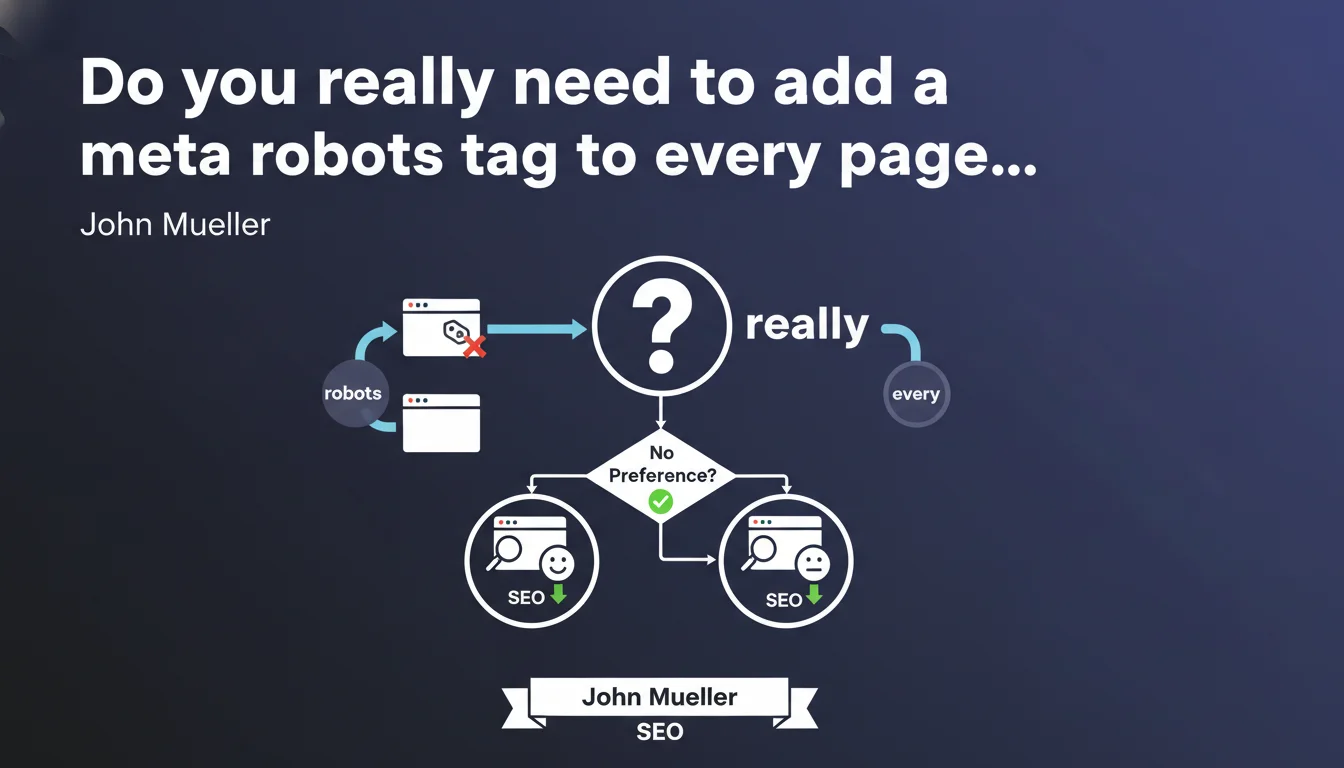
No meta robots tag on a page? Don't worry. Mueller confirms that the absence of this tag is perfectly acceptable if you have no specific instructions to give to Google. Only pages requiring specific control (noindex, nofollow, etc.) justify its use.
What you need to understand
The meta robots tag has long been perceived as a quasi-mandatory element in the source code of web pages. Many SEO audit tools even report its absence as an "error" or "warning".
This statement clarifies things: the absence of a directive amounts to acceptance by default. If you don't specify anything, Google indexes the page normally and follows the links it contains.
What is Google's default value when there is no meta robots tag?
By default, a page without a meta robots tag is treated as index, follow. Google indexes it and follows all links present in the content.
Explicitly adding <meta name="robots" content="index, follow"> changes absolutely nothing in the crawler's behavior. It's redundant.
In what cases does this tag become necessary?
The meta robots tag makes sense when you want to modify the default behavior. Typically: blocking indexation (noindex), preventing link following (nofollow), or controlling SERP display (noarchive, nosnippet).
Without a contrary instruction to give to Google, there's no point in cluttering the code. Less noise = greater clarity for the crawler.
- Absence of tag = index, follow by default
- Adding a tag to repeat the default behavior is pointless
- The tag becomes relevant only to provide specific directives
- No negative impact on SEO if it is absent
SEO Expert opinion
Is this statement consistent with field practices?
Absolutely. The sites that perform best in SEO generally do not have a meta robots tag on their standard indexable pages. Only strategic pages — pagination, filters, member areas — carry explicit directives.
The problem mostly comes from CMS and WordPress themes that automatically add index, follow everywhere "for safety". Result: useless code that bloats the DOM without adding any value.
What nuances should be made?
Be careful: this statement concerns the meta robots tag, not the robots.txt file or HTTP X-Robots-Tag headers. These three mechanisms have distinct functions and are not interchangeable.
Another often neglected point: the absence of a meta robots tag does not protect against accidental indexation. If Google finds your page and it is accessible (no Disallow in robots.txt, no authentication restrictions), it can be indexed. [To verify]: some professionals report cases of unwanted indexation of "forgotten" pages without explicit directive, even though technically Google respects the rules.
In what cases does this rule not apply?
If your site generates thousands of parameterized pages (filters, sorts, sessions), the absence of meta robots tags becomes a real problem. You lose control over what Google indexes or ignores.
Another exception: staging or pre-production environments. Even if the server is supposed to be protected, an explicit noindex tag remains the best insurance against accidental indexation.
Practical impact and recommendations
What should you do concretely on your existing pages?
First step: audit the pages that carry a meta robots tag. If 90% of them display index, follow, you can remove them safely. This will lighten the DOM and simplify maintenance.
Keep the tag only on pages that need a contrary directive: noindex for pagination pages, nofollow on user-generated zones, nosnippet if you want to control snippet display.
What mistakes should you avoid?
Don't confuse "absence of tag" with "page blocked from crawling". A page blocked in robots.txt cannot receive a noindex directive via a meta tag — Google doesn't crawl the content to read the tag.
Another classic pitfall: adding a noindex, follow tag on a page that receives quality backlinks. You lose link juice for no valid reason.
How do you verify that your strategy is coherent?
Use a crawler like Screaming Frog or Oncrawl to list all pages with meta robots tags. Cross-reference with data from Google Search Console to identify indexed pages that shouldn't be, or vice versa.
Also verify consistency between meta robots tags and directives in your robots.txt file. Conflicts between these two mechanisms are frequent and can block the indexation of strategic pages.
- Remove redundant
index, followtags from standard pages - Keep meta robots tags only for specific directives (noindex, nofollow, etc.)
- Verify consistency between meta robots and robots.txt
- Regularly audit indexed pages vs. indexation intentions
- Document your strategy to prevent regressions during site updates
The absence of a meta robots tag is not a technical error. It's even often cleaner than cluttering the code with default directives.
The real challenge lies in defining a coherent indexation strategy at the site level, especially when it generates thousands of dynamic pages. Mapping areas to index, those to block, and maintaining this logic over time requires specialized expertise. If you manage a complex site, guidance from a specialized SEO agency can help you avoid costly mistakes and guarantee flawless technical execution.
❓ Frequently Asked Questions
Dois-je ajouter une balise meta robots sur toutes mes pages ?
Quelle est la différence entre l'absence de balise et une balise index, follow ?
Est-ce que l'absence de balise meta robots peut nuire à mon SEO ?
Puis-je utiliser le robots.txt à la place de la balise meta robots ?
Comment gérer les pages de pagination ou les filtres sans balise meta robots ?
🎥 From the same video 3
Other SEO insights extracted from this same Google Search Central video · published on 20/09/2022
🎥 Watch the full video on YouTube →
💬 Comments (0)
Be the first to comment.