
Official statement
What you need to understand
The question of optimal URL length regularly comes up among SEO practitioners. Many believe that a short URL improves rankings, and some tools even recommend not exceeding 75 characters.
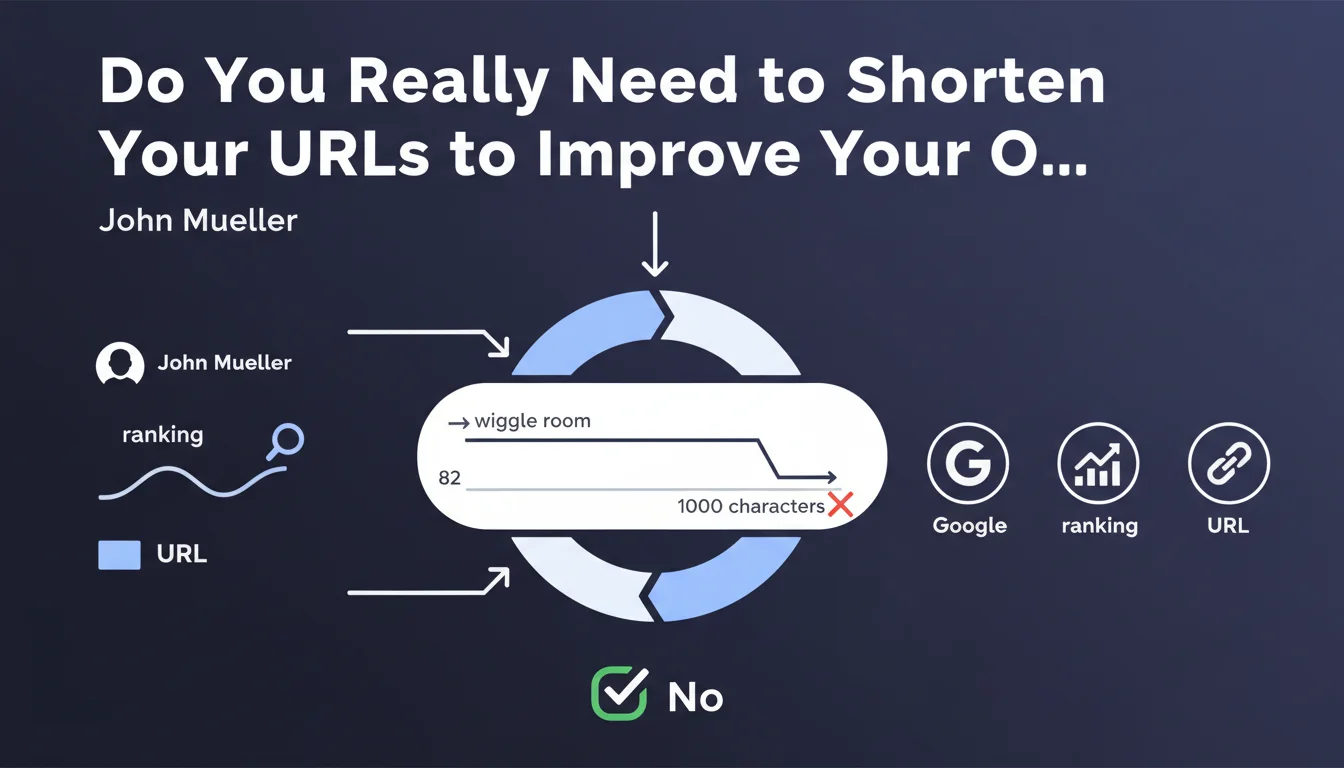
John Mueller from Google provides important technical clarification: Google's systems can process URLs up to approximately 1000 characters. A URL of 75 or 82 characters therefore poses absolutely no indexing or processing problem.
This statement confirms that there is no direct penalty related to the length of a URL, as long as it remains within reasonable proportions. The myth of ultra-short URLs as a ranking factor should therefore be put into perspective.
- Google can process URLs up to approximately 1000 characters
- A URL of 75-100 characters has no negative impact on SEO
- Length is not a direct ranking criterion
- Readability and structure remain more important than raw length
SEO Expert opinion
This position from Google is consistent with field observations for several years. Many well-ranked sites use URLs longer than 100 characters without any measurable negative impact on their performance.
However, this needs to be nuanced: while technical length is not penalizing, an overly long URL can cause user experience problems. A URL that is difficult to read, remember, or share reduces the chances of clicks in SERPs and complicates social sharing.
The balance is therefore found between technical optimization and semantic clarity. Favor descriptive URLs that include your target keywords, even if this means a few extra characters.
Practical impact and recommendations
- Stop setting a strict 75-character limit for your URLs
- Focus on logical structure and the inclusion of relevant keywords
- Avoid URLs with unnecessary parameters, session identifiers, or special characters
- Maintain a clear hierarchy: domain.com/category/subcategory/product
- Prioritize human readability: a URL should clearly indicate the page content
- Use hyphens (-) rather than underscores (_) to separate words
- Remove unnecessary stop words (the, a, of, an) only if they add nothing to the meaning
- Test the readability of your URLs in SERPs: are they understandable when truncated?
- Audit your existing URLs to identify those with superfluous parameters to clean up
URL restructuring on an existing site requires careful planning of 301 redirects and an SEO impact analysis. For large-scale sites, this optimization can quickly become complex and time-consuming.
If you manage a site with several hundred or thousands of pages, bringing in a specialized SEO agency can be wise to conduct a comprehensive audit of your URL structure and implement a migration strategy without risk of traffic loss.
💬 Comments (0)
Be the first to comment.