
Official statement
What you need to understand
What does this 15% new queries figure actually mean?
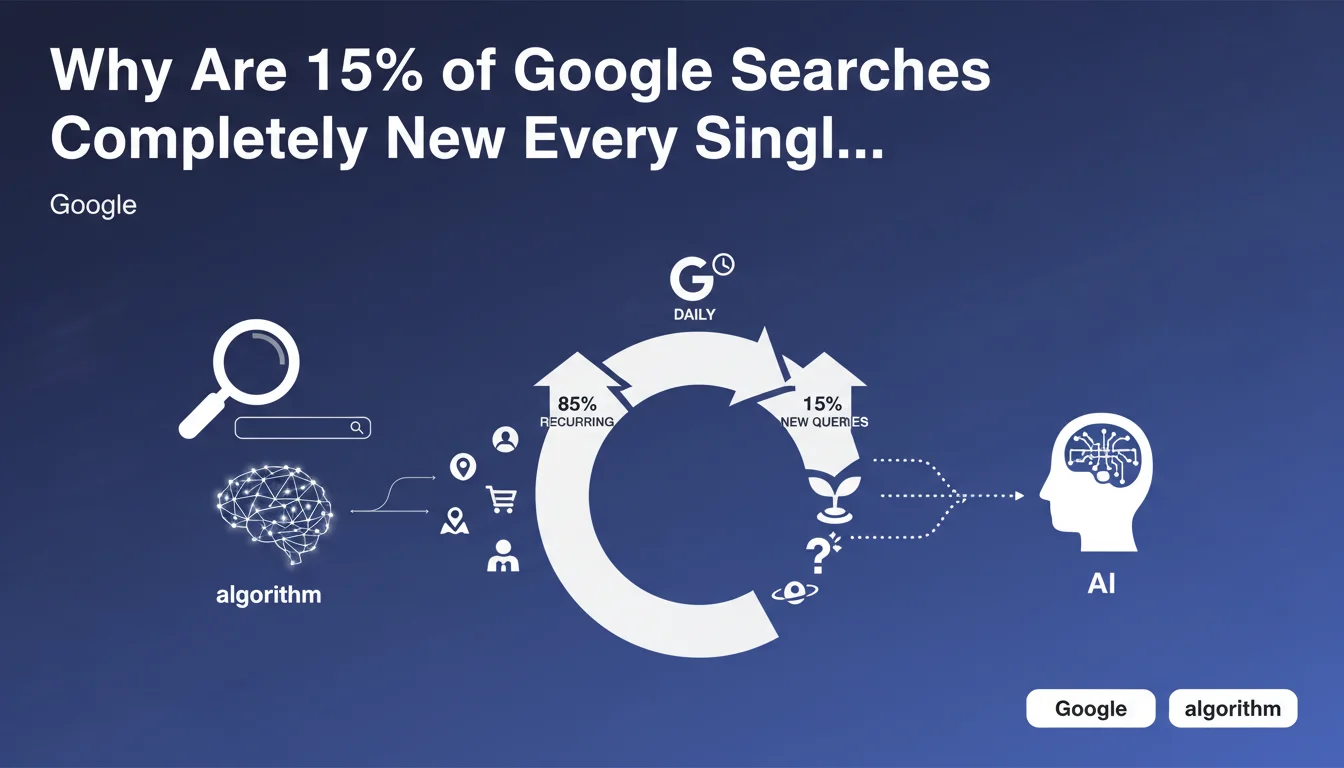
Every day, Google processes more than 5 billion queries, and among these, 15% have never been formulated before. That represents approximately 750 million brand new searches daily.
This statistic, consistent since 2013, demonstrates that search behavior is continuously evolving. Users are formulating increasingly specific and conversational queries, reflecting new needs, events, or ways of expressing their intent.
Why has this phenomenon remained stable over time?
The consistency of this figure may seem surprising as the Internet matures. In reality, several factors explain this stability.
The increase in the total number of users, the diversification of searched topics, the evolution of voice search, and the constant emergence of new themes compensate for the standardization of certain common queries.
What are the implications for organic search?
- The long tail represents an immense and constantly renewed potential
- Content strategies must integrate a predictive and exploratory dimension
- Google must permanently understand the intent behind never-before-seen formulations
- Machine learning and semantic processing are essential for interpreting these new queries
- Sites with rich and varied content have a better chance of capturing these unprecedented searches
SEO Expert opinion
Is this statement consistent with observed SEO practices?
Absolutely. In the field, we observe that high-performing pages generate traffic on hundreds, even thousands of different keywords, many of which are long-tail variations never explicitly targeted.
SEO tools like Google Search Console regularly reveal surprising queries generating traffic. These discoveries confirm that Google associates your content with search intents you hadn't anticipated, thanks to its semantic understanding.
What nuances should be added to this statistic?
It's crucial to understand that "new" doesn't necessarily mean "unique in the world." Google is talking about queries never detected before in its logs, which includes minor variations in spelling, punctuation, or formulation.
Moreover, this 15% represents a considerable volume but often low individual traffic. A completely new query may only be typed once. The challenge isn't to target these queries one by one, but to create content that's sufficiently comprehensive and semantically rich to capture them naturally.
How does Google interpret these unknown queries?
Google relies on several advanced technologies. Natural language processing (NLP), notably with BERT and MUM, enables understanding of context and intent even from unprecedented formulations.
The search engine compares these new queries with existing patterns, analyzes mentioned entities, and identifies pages that best respond to the probable intent. That's why semantically rich and well-structured content naturally captures these variations.
Practical impact and recommendations
What should you actually do to capture these new queries?
The winning strategy consists of creating comprehensive and intent-focused content rather than targeting isolated keywords. Prioritize in-depth articles that cover a topic from all angles.
Use varied vocabulary and synonyms naturally in your content. Structure your pages with sections answering different related questions. Integrate FAQs to cover conversational formulations.
Adopt a topical approach rather than keyword-centric. Create semantic silos where several complementary contents reinforce each other, increasing your topical authority in Google's eyes.
What mistakes should you avoid in this long-tail approach?
Don't create thin content pages for every imaginable keyword variation. This outdated practice is counterproductive and can lead to penalties for duplicate or low-quality content.
Also avoid neglecting generic queries exclusively in favor of long tail. A balanced strategy combines pillar content on competitive queries and supporting content capturing the long tail.
Don't forget regular analysis of your performance. Queries generating traffic reveal opportunities to exploit further.
How can you optimize your content strategy in light of this finding?
- Regularly analyze your Search Console to identify long-tail queries already generating traffic
- Create comprehensive pillar content (2000+ words) that covers a topic in depth
- Develop a semantic network with interconnected satellite articles
- Integrate natural FAQ sections anticipating conversational questions
- Use schema.org markup (FAQPage, HowTo) to facilitate interpretation of your content
- Adopt a People Also Ask approach by answering related questions
- Regularly update your content to remain relevant and comprehensive
- Diversify your formats (text, video, infographics) to cover different search intents
- Monitor emerging trends in your sector to create anticipatory content
In summary: The 15% of new daily queries represent a massive opportunity for sites that adopt a comprehensive and semantically rich content strategy.
Rather than targeting isolated keywords, focus on complete coverage of search intents in your thematic area. This approach requires deep expertise in content architecture, internal linking, and semantic optimization.
Implementing such a strategy can prove complex, requiring precise technical analysis and long-term strategic vision. For businesses truly wanting to exploit this potential without spreading their resources too thin, support from a specialized SEO agency allows for methodical structuring of this approach, avoiding common pitfalls and significantly accelerating results.
💬 Comments (0)
Be the first to comment.