
Official statement
What you need to understand
Why do some webmasters fear using the word "news" in their site name?
This concern stems from a widespread belief in the SEO community that certain keywords might trigger suspicion filters at Google. Webmasters worry that using terms like "news", "info" or "media" could be associated with low-quality sites or misleading content.
This concern exists in a context where Google actively fights against misinformation and sites that claim to be reliable news sources without meeting the criteria. Hence the legitimate question: can this word harm your search rankings?
What exactly does Google say about using the word "news"?
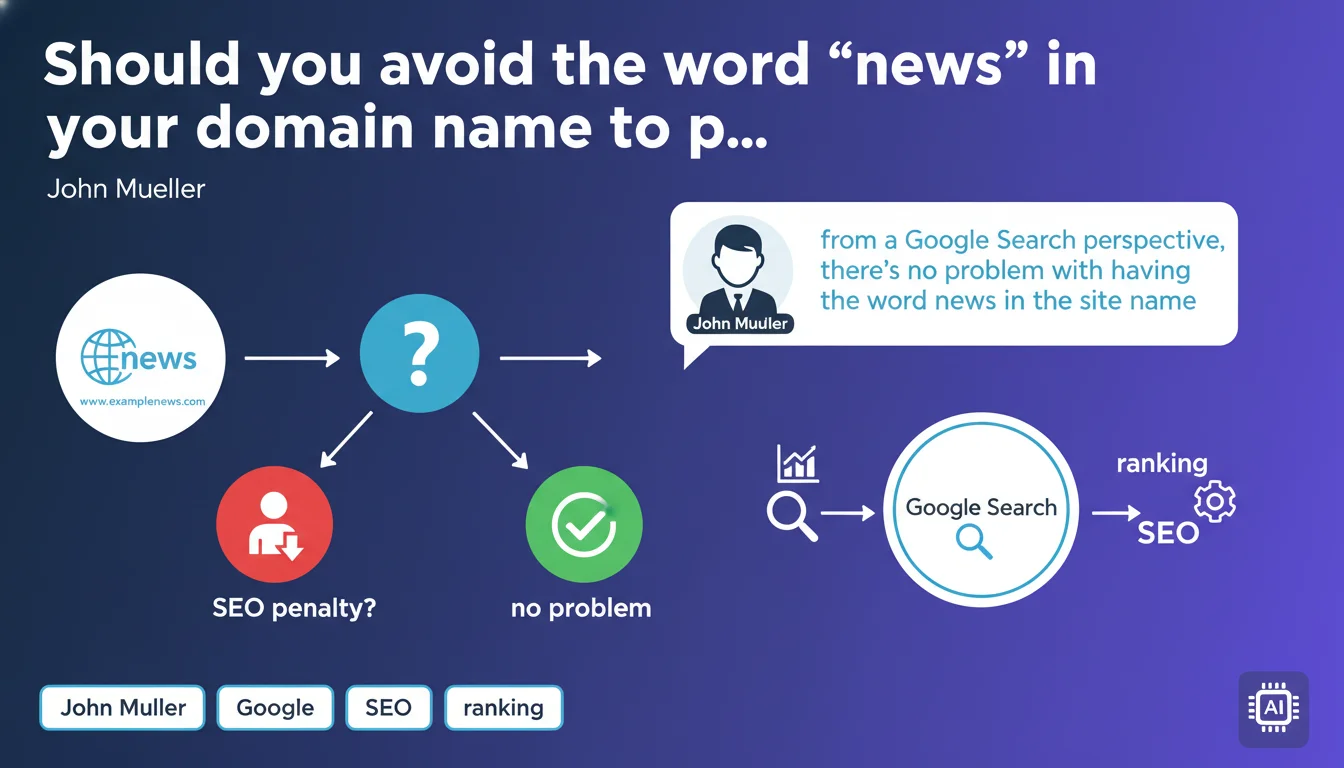
John Mueller was very clear on this point: there is no penalty associated with the presence of the word "news" in the domain name or site name. Google does not filter sites based solely on this lexical criterion.
This statement confirms that Google evaluates sites based on their content and quality, not on the mere presence of certain words in their identity. The search engine has far more sophisticated algorithms for analyzing a site's reliability.
- No automatic filter is triggered by the word "news" in a domain name
- Content quality always takes precedence over domain name choice
- This rule applies to classic organic search (Google Search)
- Other criteria come into play for inclusion in Google News
Does this permission also apply to Google News?
It's crucial to distinguish between two different contexts: general ranking in Google Search and eligibility for Google News. Mueller's statement specifically concerns organic search.
To appear in Google News as a news source, much stricter criteria apply: journalistic standards, editorial transparency, regular updates, etc. The site name is just one element among many others.
SEO Expert opinion
Is this statement consistent with practices observed in the field?
As an SEO expert with 15 years of experience, I confirm that this statement perfectly aligns with field observations conducted on thousands of sites. Numerous sites containing "news" in their name rank excellently without any penalty.
I've audited hundreds of news sites and the domain name alone has never been a deranking factor. Problems encountered always stem from content issues, technical structure, or authority concerns, never from the simple lexical choice of the domain.
What important nuances should be added to this statement?
While the word "news" isn't penalizing in itself, it nevertheless creates implicit expectations among users and potentially with Google. A site named "example-news.com" that publishes no news content could suffer from a disconnect between promise and reality.
Moreover, in the context of Google Discover and news feeds, using this term without actually producing fresh editorial content can limit your visibility opportunities in these specific spaces. Consistency between name and content remains fundamental.
In what cases might this rule not be enough to guarantee good rankings?
Even with a domain name containing "news" that's perfectly acceptable, other critical factors will determine your SEO success. Editorial expertise (E-E-A-T), publication frequency, article structure, and quality signals remain decisive.
A news site must also demonstrate its credibility through tangible elements: detailed "About" pages, author transparency, source citations, public corrections of errors, etc. The name alone will never establish this authority.
Practical impact and recommendations
What should you do concretely if you're considering using "news" in your name?
First, free yourself from this unjustified concern about a penalty related to the word "news". Focus your energy on aspects that genuinely impact your search rankings.
If this term corresponds to your actual activity and helps your users understand your value proposition, use it without hesitation. Clarity and relevance of the name for your visitors are more important than unfounded SEO fears.
Simply ensure that your site fulfills the implicit promise contained in its name: regular editorial content, fresh news, verified information, and a structure suited to a news media outlet.
What common mistakes should you absolutely avoid?
The most frequent error consists of using "news" in the name when the site doesn't actually produce news content. This inconsistency creates confusion for users and can affect your engagement metrics.
Another pitfall: thinking that the word "news" in your domain will automatically give you access to Google News or privileged positions in news carousels. These placements rely on much more demanding editorial and technical criteria.
Also avoid multiplying generic keywords in your domain name (example: "best-news-info-media.com"). This now-obsolete practice can actually harm your brand image and memorability.
How can you optimize your news site beyond simply choosing the name?
Choosing the domain name is only the first step. To succeed in SEO with a news site, you must implement a comprehensive technical and editorial strategy: schema.org Article markup, speed optimization, thematic silo architecture, etc.
Content production must follow rigorous journalistic standards: source verification, appropriate citations, regular article updates, transparent error corrections. These elements reinforce your E-E-A-T in the information domain.
- Choose your domain name based on your business criteria, not out of fear of a non-existent penalty
- If you use "news", actually produce regular, quality news content
- Implement structured markup appropriate for articles (schema.org NewsArticle)
- Create robust editorial pages: About, Team, Editorial Charter, Contact
- Develop your topical authority through expert content and reliable sources
- Optimize your Core Web Vitals to offer a fast reading experience
- Establish a strategy for updating and archiving your content
- Monitor your engagement metrics (reading time, bounce rate, pages per session)
💬 Comments (0)
Be the first to comment.