
Official statement
What you need to understand
What is Google's official position on Wix websites?
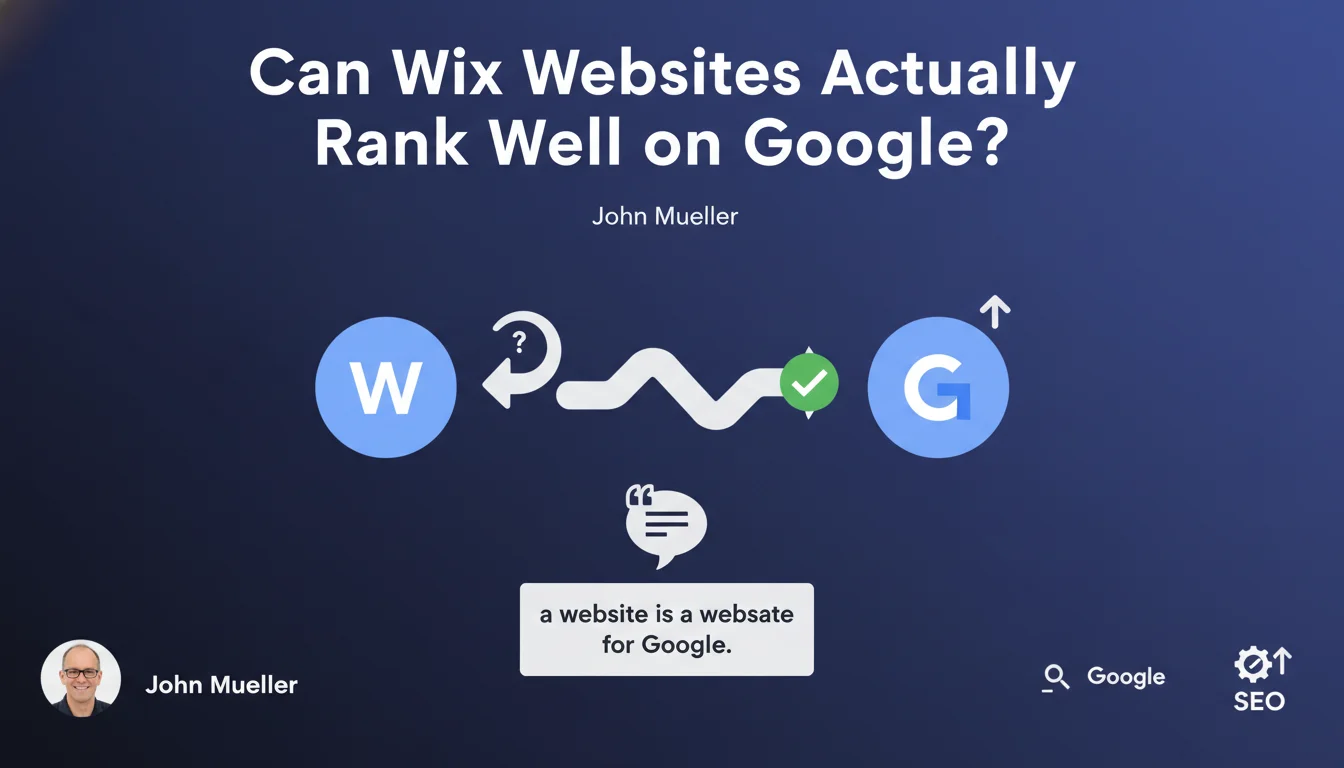
Google has clearly stated that websites created with Wix have no intrinsic SEO disadvantage. This statement contradicts a negative reputation that has persisted for years in the SEO community.
The phrase "a website is a website for Google" means that Google's algorithm does not discriminate based on the platform used. What matters is the technical quality of the final site, its content, and its user experience.
Why did Wix have a bad reputation in SEO?
Historically, Wix used Flash and AJAX technology that made content difficult to crawl. The early versions did not allow proper customization of meta tags, URLs, or technical structure.
These technical limitations created a lasting perception in the SEO community, even after Wix considerably improved its platform. Today, Wix offers advanced SEO tools and generates standard HTML5 websites.
What technical elements are now supported by Wix?
The Wix platform now offers SEO features comparable to other CMS. Users can control title tags, meta descriptions, canonical URLs, and heading structure.
- Complete customization of meta tags (title, description, robots)
- Clean and customizable URLs for each page
- Automatically generated XML sitemap submitted to Google
- Native responsive design for mobile-first indexing
- Structured data integrable via dedicated tools
- Optimized performance with CDN and automatic compression
SEO Expert opinion
Is this statement consistent with real-world performance?
As an SEO expert, I confirm that properly optimized Wix sites can achieve competitive rankings. I have observed several Wix websites ranking on the first page for moderately competitive queries.
However, the reality is more nuanced than the official statement. While Google does not penalize Wix as such, the platform imposes certain structural constraints that can limit advanced optimizations compared to WordPress or a custom website.
What limitations remain despite Wix's improvements?
Even though Wix has significantly improved, certain technical limitations persist for ambitious SEO projects. Code customization remains restricted, which complicates advanced technical optimizations.
Wix sites sometimes generate heavier JavaScript code than necessary, which can impact Core Web Vitals. Fine-tuned management of crawl budget and complex redirections also remains less flexible than with other solutions.
In which cases does Wix remain a relevant choice for SEO?
Wix is perfectly suited for small local businesses, showcase websites, and portfolios that do not require ultra-advanced SEO optimizations. For these projects, ease of use largely compensates for technical limitations.
The platform is also relevant for entrepreneurs who prioritize autonomy and speed of launch. If your SEO strategy primarily relies on quality content and good user experience, Wix can be sufficient.
Practical impact and recommendations
What priority optimizations should be implemented on a Wix site?
On Wix, focus first on SEO fundamentals that have the most impact. The interface offers dedicated tools for each essential technical aspect.
Start by optimizing your title tags and meta descriptions for each important page. Use Wix's SEO panel to customize your URLs and create a logical, hierarchical structure.
- Customize title tags (50-60 characters) with your main keywords
- Write engaging meta descriptions (150-160 characters)
- Create short and descriptive URLs without special characters
- Structure content with hierarchical H1, H2, H3 tags
- Optimize image alt attributes for accessibility and SEO
- Enable SSL and responsive design (normally by default)
- Install Google Search Console and Analytics for tracking
How can you work around Wix's technical limitations?
To compensate for Wix's constraints, focus on a solid content strategy and relevant internal linking. Quality content remains the most important ranking factor.
Use Wix App Market applications to extend native SEO features. Some applications allow you to add structured data, optimize performance, or manage complex redirections.
For sites requiring advanced features, consider a hybrid architecture: Wix site for the main presentation and WordPress subdomain for the SEO-optimized blog.
Should you migrate from an existing Wix site to another platform?
Migration is only justified if you reach Wix's technical limits for your SEO strategy. If your site is performing well, a migration presents more risks than benefits.
Before deciding, evaluate your business objectives and resources. A poorly executed migration can destroy years of SEO work. If you feel that Wix is hindering your growth, plan a progressive transition while preserving URLs.
💬 Comments (0)
Be the first to comment.