
Official statement
What you need to understand
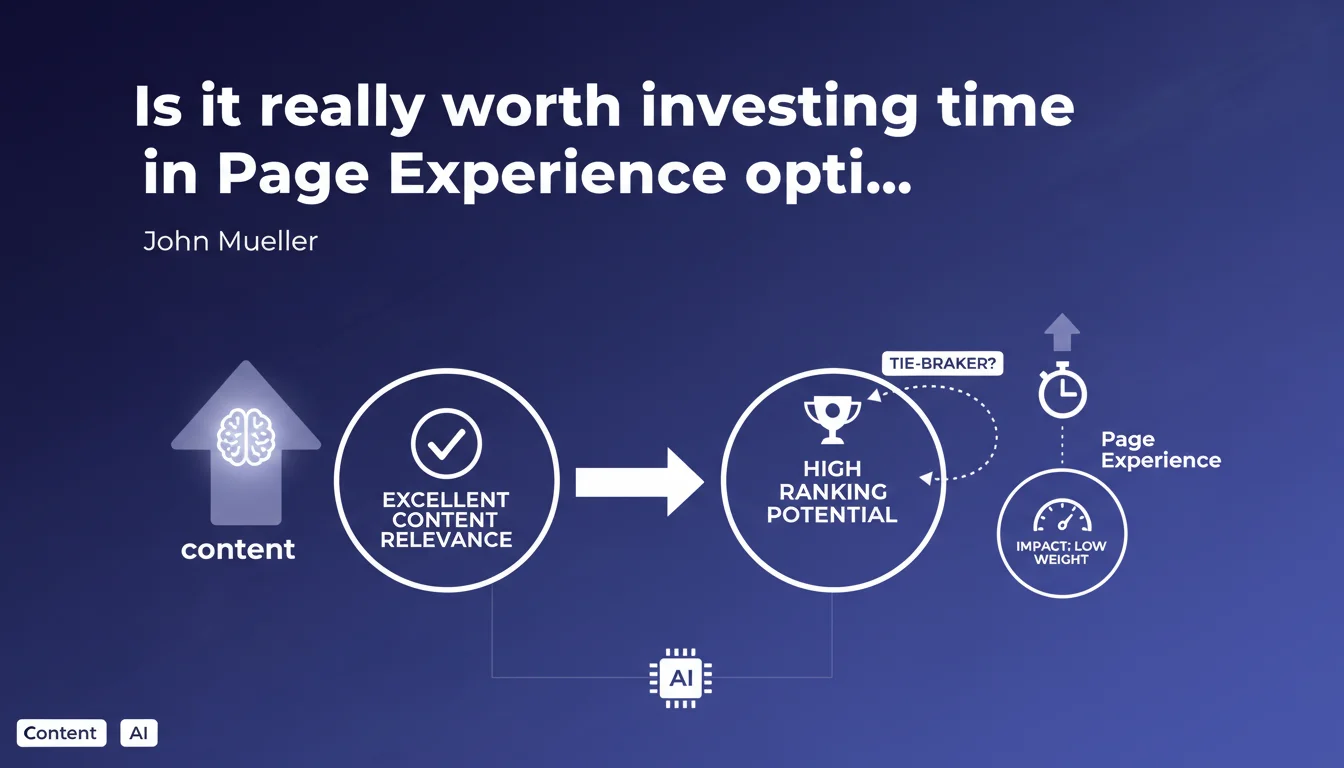
John Mueller recently clarified Google's position regarding the Page Experience criterion. Contrary to previous communications that presented it as a simple "tie breaker" (deciding factor in case of equality), he now states that this signal has a more significant role in rankings.
However, Mueller immediately tempers this statement by specifying that the weight of this criterion remains low in the overall algorithm. He particularly insists on the fact that Page Experience will never compensate for poor quality or irrelevant content.
This statement is part of a series of sometimes contradictory communications from Google on this topic. It likely reflects a progressive evolution of the weight given to user experience in the algorithm.
- Page Experience is no longer considered a simple tie breaker
- Its impact remains relatively limited in overall rankings
- Content relevance and quality remain the priority
- User experience signals complement but do not replace content
- Google is progressively adjusting the weight of these criteria
SEO Expert opinion
This statement is generally consistent with field observations from SEO professionals. Sites with exceptional content but average Page Experience continue to rank well, while technically perfect sites with weak content struggle to rank.
The important nuance here concerns highly competitive markets. When multiple pieces of equivalent quality content compete for top positions, Page Experience can indeed make the difference. In this context, its role goes beyond that of a simple tie breaker.
It's also important to note that Page Experience indirectly influences other behavioral metrics like bounce rate or time on site, which themselves can impact SEO. The real effect is therefore probably more important than the direct signal alone.
Practical impact and recommendations
- Always prioritize content: invest 70-80% of your efforts on the quality, relevance and depth of your content
- Don't neglect the technical side: dedicate 20-30% to Page Experience optimization, particularly Core Web Vitals, mobile-friendliness and HTTPS
- Audit your direct competitors: if your content is of similar quality, Page Experience can become decisive
- Fix critical issues: eliminate major blocking elements (intrusive pop-ups, catastrophic loading times of +5s)
- Adopt a progressive approach: improve Page Experience through iterations rather than aiming for immediate perfection
- Monitor user metrics: bounce rate, time on page and conversions are often more revealing than technical scores alone
- Test the real impact: measure correlations between your technical improvements and your positions on targeted queries
In summary, the winning strategy remains an intelligent balance between content excellence and optimized user experience. Never sacrifice editorial quality for marginal technical gains.
Technical optimizations, particularly those related to Core Web Vitals and Page Experience, often require advanced web development skills and a deep understanding of algorithmic mechanisms. Given the increasing complexity of these criteria and their constant adjustment, support from a specialized SEO agency can prove relevant to develop a balanced strategy and obtain measurable results without dispersing your internal resources.
💬 Comments (0)
Be the first to comment.