
Official statement
What you need to understand
When a website experiences a prolonged server outage, Google encounters errors during its crawl attempts. The crucial question for any SEO practitioner is knowing how long it will take for the site to regain its positions once the technical situation is resolved.
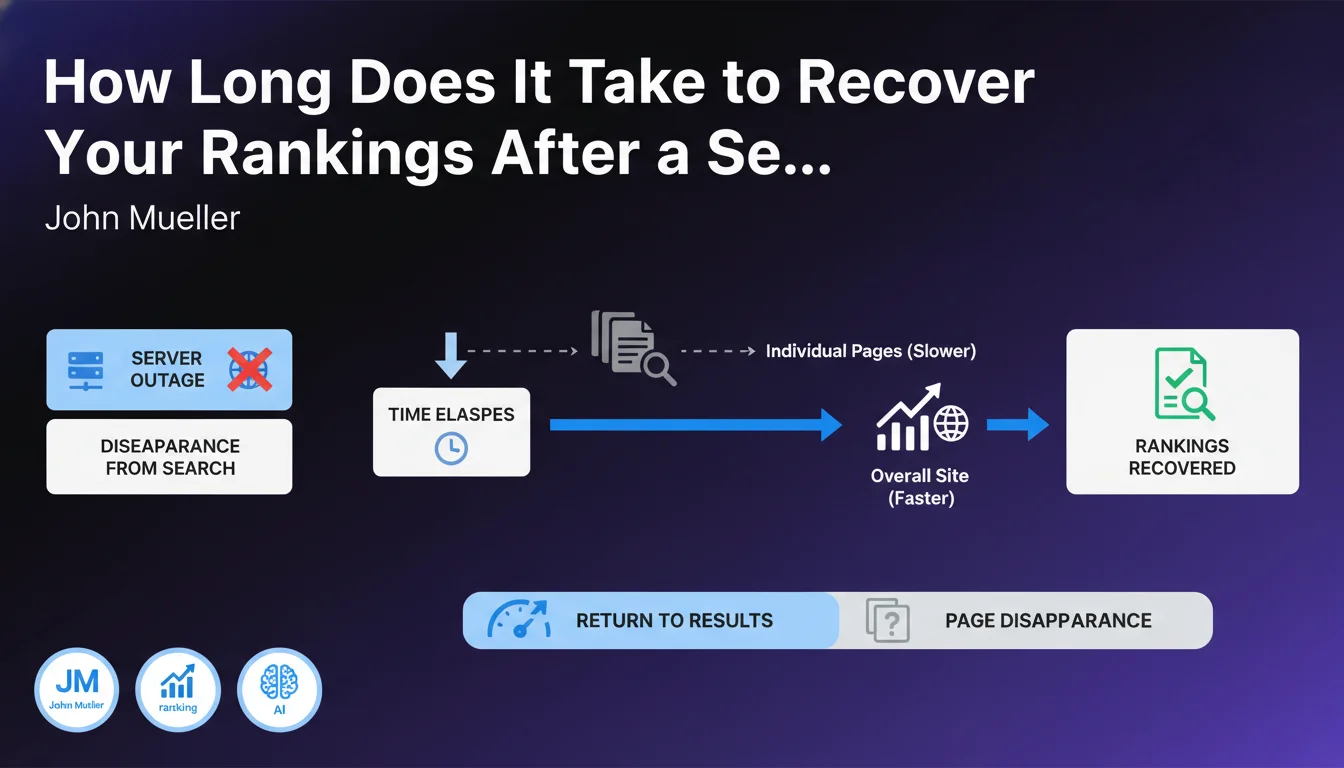
According to this official statement, Google indicates that the return to normal is generally faster than the initial degradation. In other words, if your site takes several days to drop out of results following an outage, it will likely only take a few hours or days to return once operational.
The important nuance lies in the duration of unavailability. An outage of a few hours will have virtually no visible impact, as Google understands it's a temporary incident. However, an unavailability of several days signals a more serious problem.
- Short outages (a few hours) are transparent for SEO
- Long outages (several days) can lead to partial deindexing
- The return to results is faster than the disappearance
- Google shows tolerance toward one-time technical incidents
SEO Expert opinion
This statement is consistent with field observations from numerous sites that have experienced outages. Google has indeed implemented mechanisms to distinguish temporary outages from permanently abandoned sites. The search engine doesn't immediately penalize a site for a few hours of unavailability.
However, an important nuance must be made regarding sensitive sites. For news sites, e-commerce sites during high-activity periods (Black Friday, sales) or transactional sites, even an outage of a few hours can have significant economic consequences, even if the SEO impact remains limited.
Furthermore, recovery speed also depends on your crawl budget and site authority. A major site with intensive daily crawling will recover faster than a small site crawled occasionally.
Practical impact and recommendations
- Implement 24/7 server monitoring with automatic alerts to detect any downtime in real time
- Configure Search Console notifications to be immediately informed of abnormal crawl errors
- Document your incidents: note the exact duration, affected pages, and recovery time for future analysis
- Don't touch your content during recovery: let Google recrawl naturally without forcing massive submissions
- Check your robots.txt file and sitemap as soon as you're back online to facilitate recrawling of important sections
- Avoid misconfigured 503 redirects that could artificially extend the recovery period
- Invest in robust server infrastructure with redundancy and disaster recovery plan
- Analyze server logs post-incident to observe Googlebot's behavior and crawl recovery speed
Implementing a resilient technical architecture and continuous monitoring requires in-depth expertise in web infrastructure and technical SEO. These optimizations touch on both DevOps aspects, server configuration, and SEO best practices. If your internal team doesn't have these cross-functional skills, guidance from a specialized SEO agency can prove valuable for establishing a tailored prevention strategy and preventing technical incidents from durably impacting your visibility.
💬 Comments (0)
Be the first to comment.