
Official statement
What you need to understand
What Are Core Web Vitals and Why Does Google Prioritize Them?
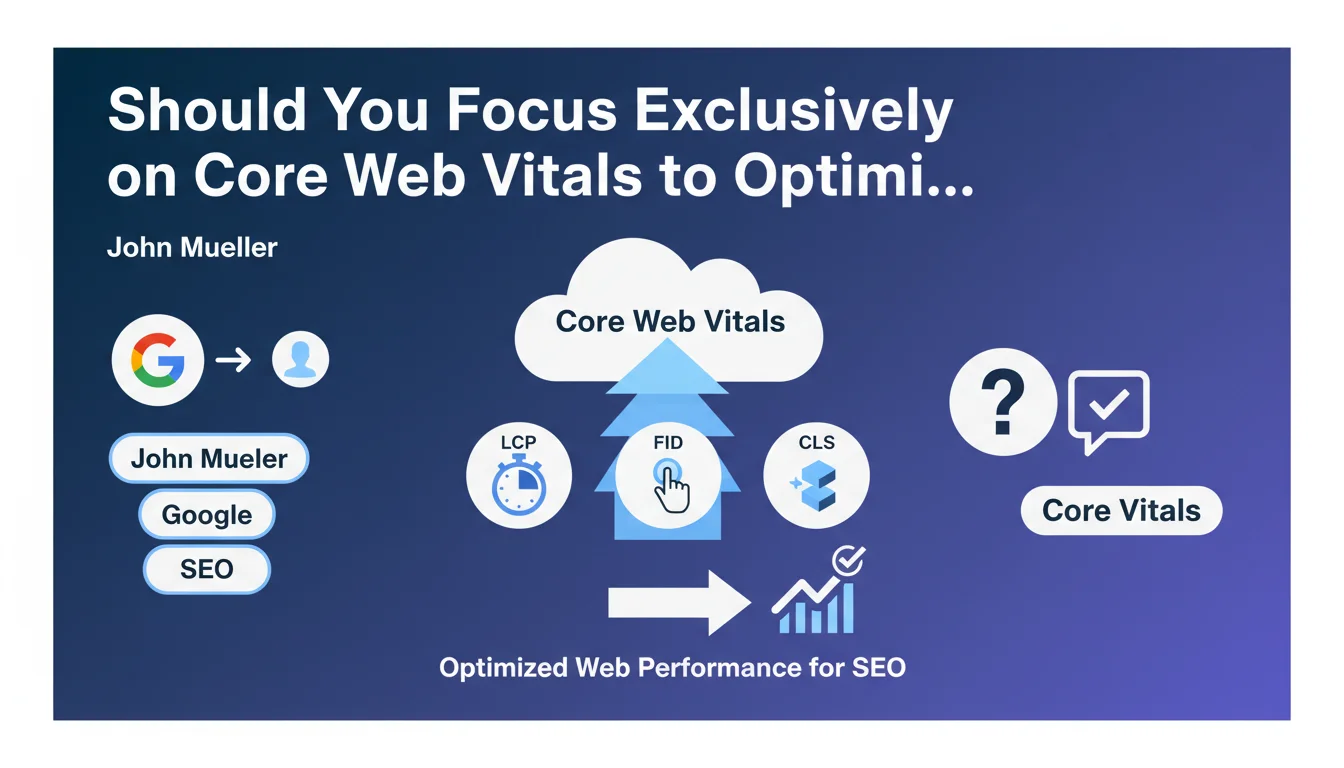
Core Web Vitals represent three key metrics defined by Google to measure user experience on a web page. These are LCP (Largest Contentful Paint) which measures the loading time of the main content, FID (First Input Delay) which evaluates responsiveness to interactions, and CLS (Cumulative Layout Shift) which quantifies visual stability.
Google has chosen to simplify the message by focusing on these three indicators rather than on the multitude of available metrics. This approach aims to give SEO professionals a clear direction in a technical field that is often complex and constantly evolving.
Why This Simplification of Performance Criteria?
The webperf field includes dozens of different metrics, which can quickly become overwhelming for SEO professionals. Between Time to First Byte, Speed Index, Time to Interactive and many others, it was difficult to know where to concentrate efforts.
By focusing on Core Web Vitals, Google establishes a clear and measurable standard. These three metrics cover the essential aspects of user experience: perceived speed, interactivity and visual stability.
Which Tools Should You Use to Measure These Metrics?
Google provides several official tools to measure Core Web Vitals. Search Console provides a dedicated report based on real user data (RUM). PageSpeed Insights combines lab data and field data for a comprehensive analysis.
- Search Console displays the real performance of your pages with a classification into three categories: good, needs improvement, poor
- PageSpeed Insights provides specific technical recommendations to improve each metric
- Third-party tools like GTMetrix offer complementary perspectives and detailed analyses
- Chrome DevTools allows testing in controlled conditions to precisely identify problems
- Chrome User Experience Report (CrUX) data reflects the real experience of Chrome users
SEO Expert opinion
Is This Focus on Three Metrics Sufficient for SEO?
While Core Web Vitals do indeed constitute the official performance-related ranking signal, they don't tell the whole story of user experience. Other metrics like Time to First Byte or Total Blocking Time remain important because they indirectly impact Core Web Vitals.
The reality is that Google has chosen these three metrics as a proxy for overall experience. But a site can have excellent Core Web Vitals and offer a mediocre experience if other aspects are neglected. The holistic approach remains relevant, even if priority should go to the three official indicators.
What Is the Real Weight of Core Web Vitals in the Ranking Algorithm?
The editorial comment raises a crucial question: will the impact be "slight or very slight"? This questioning reflects a reality observed since the rollout of the Page Experience Update. Core Web Vitals are a tiebreaker rather than a dominant criterion.
In practice, content relevance and site authority remain the predominant factors. Core Web Vitals mainly play a role in differentiating pages of equivalent quality. However, their importance increases in highly competitive sectors where every advantage counts.
Do Core Web Vitals Evolve Over Time?
Google replaced FID with INP (Interaction to Next Paint) in March 2024, demonstrating that these metrics are not set in stone. INP offers a more comprehensive measure of responsiveness by taking into account all interactions, not just the first one.
This evolution confirms that SEO professionals must remain in constant watch mode on these indicators. What is considered good performance today could become insufficient tomorrow. Core Web Vitals optimization is an ongoing process, not a one-time project.
Practical impact and recommendations
How Should You Prioritize Core Web Vitals Optimizations?
Start by analyzing your data in Search Console to identify problematic pages. Focus first on high-traffic or high-commercial-value pages that display poor performance.
For LCP, optimize the loading of images and critical resources. For INP (which replaced FID), reduce JavaScript execution and optimize event handlers. For CLS, define explicit dimensions for all media elements and avoid dynamic content insertion.
What Common Mistakes Should You Avoid in Optimization?
The most common mistake is focusing solely on lab scores while ignoring field data. PageSpeed Insights may display a perfect score under test conditions, but real users may experience something different depending on their device and connection.
Another trap: optimizing at the expense of functionality. Removing all scripts to improve the score makes no sense if it breaks essential functionalities. The goal is to improve real user experience, not to maximize an artificial score.
What Should You Concretely Implement on Your Site?
A comprehensive optimization strategy requires interventions at several technical levels. Some actions are simple, others require deep expertise in web development and server architecture.
- Audit your pages with Search Console and identify URLs requiring improvements
- Optimize images: compression, modern formats (WebP, AVIF), lazy loading and explicit dimensions
- Implement a CDN to reduce latency and improve TTFB
- Minimize and defer non-critical JavaScript to improve INP
- Use preconnect and preload for critical resources
- Stabilize layout by reserving space for dynamic elements (ads, embeds)
- Optimize the Critical Rendering Path with inline CSS for above-the-fold content
- Enable Brotli or Gzip compression at server level
- Monitor your Core Web Vitals continuously with monitoring tools
- Test on various devices and connections, not just under optimal conditions
Core Web Vitals have become the official standard for evaluating web performance in SEO. Although their impact on ranking remains moderate, they constitute a strategic investment for user experience and can make the difference on competitive queries.
Technical optimization requires a methodical and progressive approach. This is a complex field where interdependencies between optimizations are numerous and where mistakes can negatively impact user experience.
For high-stakes sites or complex projects, support from a specialized SEO agency can prove beneficial. These experts have the field experience and advanced tools to precisely diagnose problems, prioritize actions according to their ROI, and implement optimizations without compromising existing functionalities.
💬 Comments (0)
Be the first to comment.