
Official statement
What you need to understand
What is Google's ability to geolocate search results?
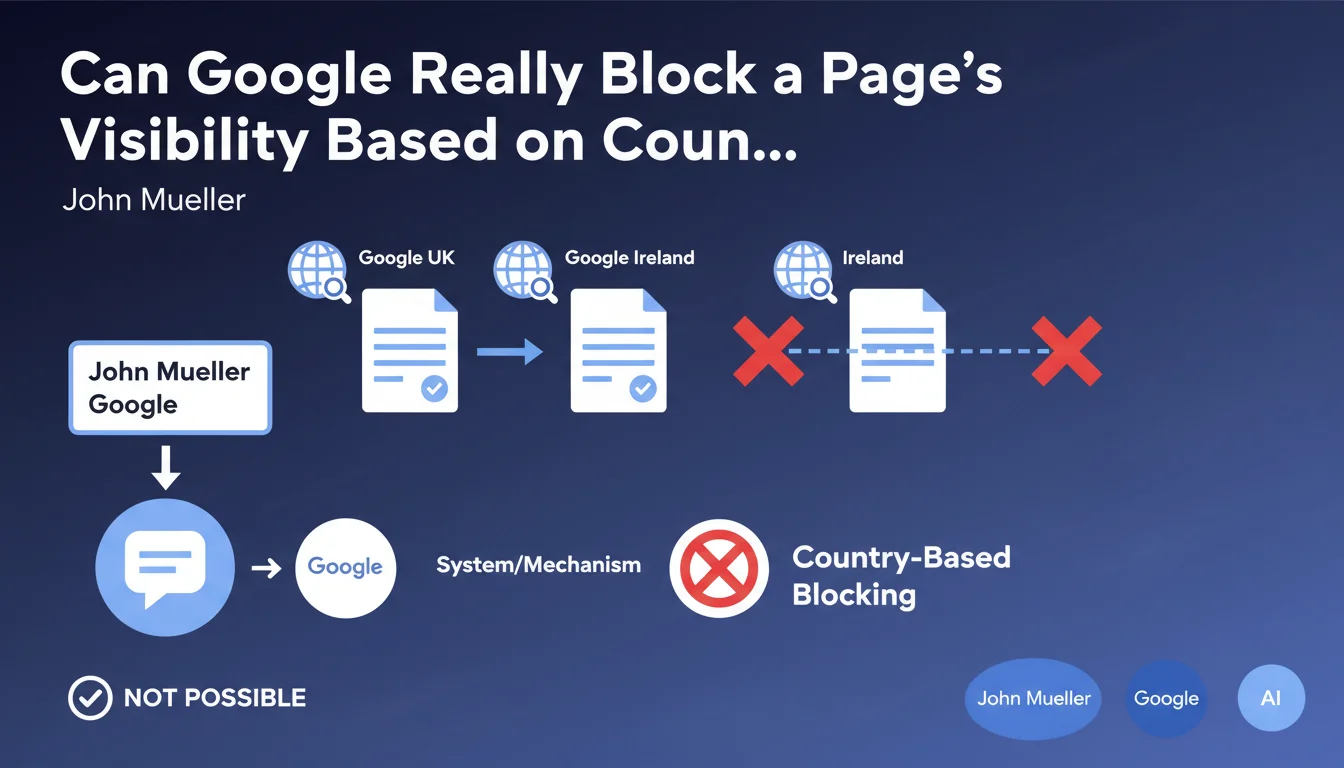
Google has mechanisms to personalize results based on the user's geolocation. Each national version of Google (google.fr, google.co.uk, google.ie) displays results adapted to the local context.
However, this personalization doesn't mean that Google can technically block a page so that it's visible in one country and completely absent in another. The search engine operates on a single global index.
Why is this clarification from John Mueller important?
This statement clarifies a common misunderstanding among SEO practitioners. Many believe they can ask Google to limit a URL's visibility to certain countries only through technical parameters.
In reality, if your page is indexed, it can potentially appear in any national version of Google, depending on its relevance to the user's query.
What geographic targeting tools does Google offer?
Google offers tools like geographic targeting in Search Console and the hreflang attribute to indicate language and regional preferences. But these are signals, not absolute blocks.
- Hreflang: indicates alternative versions of a page by language/region
- Search Console geographic targeting: preference signal for a country
- Domain extension: .fr, .uk, .ie send strong geographic signals
- Important limitation: none of these elements actually block visibility
SEO Expert opinion
Is this statement consistent with practices observed in the field?
Absolutely. After 15 years of experience, I regularly observe French pages appearing in international SERPs and vice versa. This is particularly visible for English queries or topics with little local competition.
Google prioritizes above all the content's relevance to the query. If a French page better answers a British user's query than local pages, it can very well rank on google.co.uk.
What are the implications for multilingual and multi-country sites?
For international sites, this technical reality requires rigorous architecture management. You cannot rely on Google to hermetically isolate your national versions.
Common problems include: French content appearing for English-speaking users, cannibalization issues between country versions, or pages intended for a specific market being globally visible with inappropriate pricing.
In which cases does this technical limitation pose the most problems?
The most impacted sectors are e-commerce with price differentiation by country, services with geographic legal restrictions, and content under territorial licensing.
In these cases, the SEO solution alone is insufficient. You need to combine server redirects based on IP geolocation, adapted content, and sometimes even user authentication.
Practical impact and recommendations
What specifically needs to be implemented on a multi-country site?
The recommended strategy combines several layers of protection and optimization. You need to act on both the technical infrastructure and the signals sent to Google.
For content intended for specific markets, use dedicated subdomains or subdirectories (fr.example.com or example.com/fr/) rather than relying on hypothetical blocking by Google.
- Properly implement hreflang tags on all language/regional versions
- Configure geographic targeting in Search Console for each property
- Use local domain extensions when strategically relevant (.fr, .uk, .de)
- Host on localized servers in primary target countries
- Create truly adapted content for each market (not just translated)
- Set up server redirects based on IP geolocation for sensitive content
- Use server-level blocking (.htaccess, server configuration) for absolute restrictions
- Add country selection pop-ups with user preference memorization
What technical mistakes should absolutely be avoided?
The most common mistake is believing that hreflang blocks the display of a page in certain countries. Hreflang is a preference signal, not a wall. If you don't have a better local alternative, Google may still display the "unwanted" version.
Another trap: using client-side JavaScript to redirect users based on their geolocation. Google often crawls without fully executing JS, thus indexing content you thought was blocked.
Finally, don't neglect signal consistency. If your domain is .fr, hosted in France, with French content, but you're targeting Spain in Search Console, you're sending contradictory signals.
How do I audit and verify my site's current configuration?
Start by checking impressions by country in Google Search Console. If you see significant impressions in non-targeted countries, it's a warning signal.
Test your pages with VPNs or proxies from different countries to observe actual behavior. Verify that redirects work correctly and that the displayed content matches the geolocation.
💬 Comments (0)
Be the first to comment.